• 文献检索
  • 文档翻译
  • 深度研究
  • 学术资讯
  • Suppr Zotero 插件Zotero 插件
  • 邀请有礼
  • 套餐&价格
  • 历史记录
应用&插件
Suppr Zotero 插件Zotero 插件浏览器插件Mac 客户端Windows 客户端微信小程序
定价
高级版会员购买积分包购买API积分包
服务
文献检索文档翻译深度研究API 文档MCP 服务
关于我们
关于 Suppr公司介绍联系我们用户协议隐私条款
关注我们

Suppr 超能文献

核心技术专利:CN118964589B侵权必究
粤ICP备2023148730 号-1Suppr @ 2026

文献检索

告别复杂PubMed语法,用中文像聊天一样搜索,搜遍4000万医学文献。AI智能推荐,让科研检索更轻松。

立即免费搜索

文件翻译

保留排版,准确专业,支持PDF/Word/PPT等文件格式,支持 12+语言互译。

免费翻译文档

深度研究

AI帮你快速写综述,25分钟生成高质量综述,智能提取关键信息,辅助科研写作。

立即免费体验

一种用于减轻马来西亚新冠疫情期间医疗系统负担的自动化患者自我监测系统:开发与实施研究

An Automated Patient Self-Monitoring System to Reduce Health Care System Burden During the COVID-19 Pandemic in Malaysia: Development and Implementation Study.

作者信息

Lim Hooi Min, Teo Chin Hai, Ng Chirk Jenn, Chiew Thiam Kian, Ng Wei Leik, Abdullah Adina, Abdul Hadi Haireen, Liew Chee Sun, Chan Chee Seng

机构信息

Department of Primary Care Medicine, University of Malaya Medical Centre, Kuala Lumpur, Malaysia.

eHealth Unit, Faculty of Medicine, University of Malaya, Kuala Lumpur, Malaysia.

出版信息

JMIR Med Inform. 2021 Feb 26;9(2):e23427. doi: 10.2196/23427.

DOI:10.2196/23427
PMID:33600345
原文链接:https://pmc.ncbi.nlm.nih.gov/articles/PMC7919845/
Abstract

BACKGROUND

During the COVID-19 pandemic, there was an urgent need to develop an automated COVID-19 symptom monitoring system to reduce the burden on the health care system and to provide better self-monitoring at home.

OBJECTIVE

This paper aimed to describe the development process of the COVID-19 Symptom Monitoring System (CoSMoS), which consists of a self-monitoring, algorithm-based Telegram bot and a teleconsultation system. We describe all the essential steps from the clinical perspective and our technical approach in designing, developing, and integrating the system into clinical practice during the COVID-19 pandemic as well as lessons learned from this development process.

METHODS

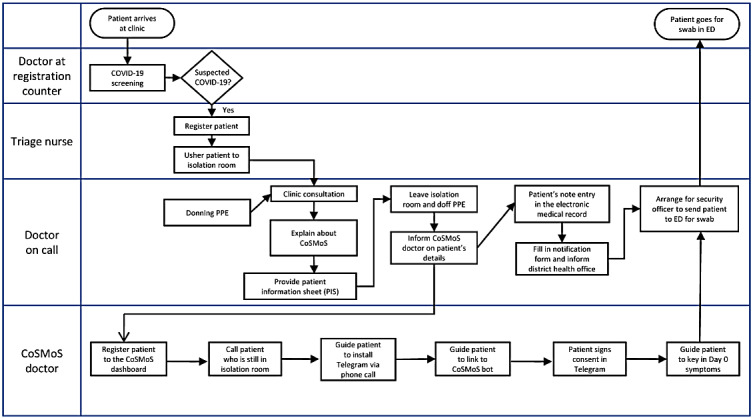
CoSMoS was developed in three phases: (1) requirement formation to identify clinical problems and to draft the clinical algorithm, (2) development testing iteration using the agile software development method, and (3) integration into clinical practice to design an effective clinical workflow using repeated simulations and role-playing.

RESULTS

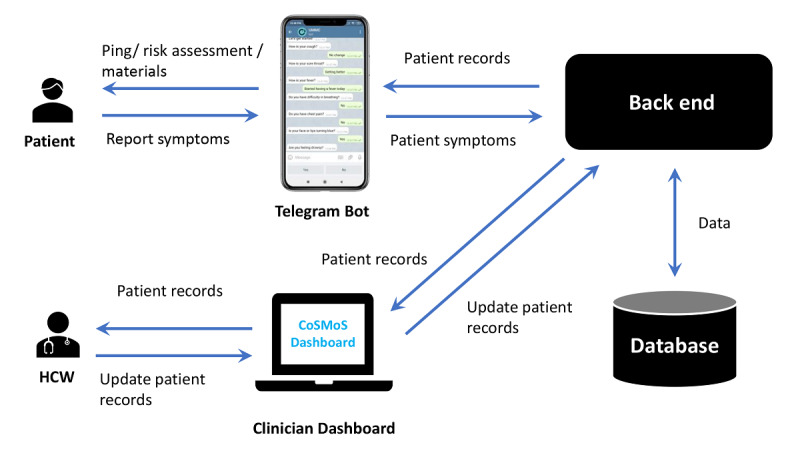
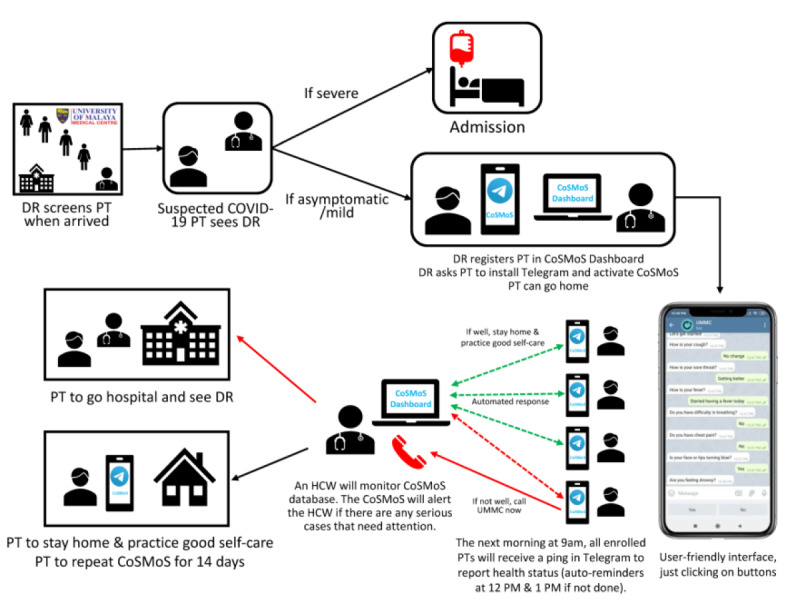
We completed the development of CoSMoS in 19 days. In Phase 1 (ie, requirement formation), we identified three main functions: a daily automated reminder system for patients to self-check their symptoms, a safe patient risk assessment to guide patients in clinical decision making, and an active telemonitoring system with real-time phone consultations. The system architecture of CoSMoS involved five components: Telegram instant messaging, a clinician dashboard, system administration (ie, back end), a database, and development and operations infrastructure. The integration of CoSMoS into clinical practice involved the consideration of COVID-19 infectivity and patient safety.

CONCLUSIONS

This study demonstrated that developing a COVID-19 symptom monitoring system within a short time during a pandemic is feasible using the agile development method. Time factors and communication between the technical and clinical teams were the main challenges in the development process. The development process and lessons learned from this study can guide the future development of digital monitoring systems during the next pandemic, especially in developing countries.

摘要

背景

在新冠疫情期间,迫切需要开发一个自动化的新冠症状监测系统,以减轻医疗系统的负担,并在家中提供更好的自我监测。

目的

本文旨在描述新冠症状监测系统(CoSMoS)的开发过程,该系统由一个基于算法的自我监测Telegram机器人和一个远程会诊系统组成。我们从临床角度描述了在新冠疫情期间设计、开发并将该系统整合到临床实践中的所有基本步骤,以及从这一开发过程中吸取的经验教训。

方法

CoSMoS分三个阶段开发:(1)需求形成,以识别临床问题并起草临床算法;(2)使用敏捷软件开发方法进行开发测试迭代;(3)整合到临床实践中,通过反复模拟和角色扮演设计有效的临床工作流程。

结果

我们在19天内完成了CoSMoS的开发。在第一阶段(即需求形成),我们确定了三个主要功能:患者每日自动症状自查提醒系统、指导患者进行临床决策的安全患者风险评估,以及实时电话会诊的主动远程监测系统。CoSMoS的系统架构包括五个组件:Telegram即时通讯、临床医生仪表板、系统管理(即后端)、数据库以及开发和运营基础设施。将CoSMoS整合到临床实践中需要考虑新冠病毒的传染性和患者安全。

结论

本研究表明,在疫情期间短时间内开发新冠症状监测系统,采用敏捷开发方法是可行的。时间因素以及技术团队与临床团队之间的沟通是开发过程中的主要挑战。本研究的开发过程和经验教训可为下一次疫情期间数字监测系统的未来发展提供指导,尤其是在发展中国家。
https://cdn.ncbi.nlm.nih.gov/pmc/blobs/43a9/7919845/897fb89eb413/medinform_v9i2e23427_fig3.jpg
https://cdn.ncbi.nlm.nih.gov/pmc/blobs/43a9/7919845/338d57bcae17/medinform_v9i2e23427_fig1.jpg
https://cdn.ncbi.nlm.nih.gov/pmc/blobs/43a9/7919845/61793ae2f17a/medinform_v9i2e23427_fig2.jpg
https://cdn.ncbi.nlm.nih.gov/pmc/blobs/43a9/7919845/897fb89eb413/medinform_v9i2e23427_fig3.jpg
https://cdn.ncbi.nlm.nih.gov/pmc/blobs/43a9/7919845/338d57bcae17/medinform_v9i2e23427_fig1.jpg
https://cdn.ncbi.nlm.nih.gov/pmc/blobs/43a9/7919845/61793ae2f17a/medinform_v9i2e23427_fig2.jpg
https://cdn.ncbi.nlm.nih.gov/pmc/blobs/43a9/7919845/897fb89eb413/medinform_v9i2e23427_fig3.jpg

相似文献

1
An Automated Patient Self-Monitoring System to Reduce Health Care System Burden During the COVID-19 Pandemic in Malaysia: Development and Implementation Study.一种用于减轻马来西亚新冠疫情期间医疗系统负担的自动化患者自我监测系统:开发与实施研究
JMIR Med Inform. 2021 Feb 26;9(2):e23427. doi: 10.2196/23427.
2
Utility and usability of an automated COVID-19 symptom monitoring system (CoSMoS) in primary care during COVID-19 pandemic: A qualitative feasibility study.在 COVID-19 大流行期间,初级保健中 COVID-19 症状监测系统(CoSMoS)的实用性和可用性:一项定性可行性研究。
Int J Med Inform. 2021 Nov;155:104567. doi: 10.1016/j.ijmedinf.2021.104567. Epub 2021 Sep 6.
3
Use of eHealth Platforms and Apps to Support Monitoring and Management of Home-Quarantined Patients With COVID-19 in the Province of Trento, Italy: App Development and Implementation.意大利特伦托省使用电子健康平台和应用程序支持对新冠疫情居家隔离患者的监测与管理:应用程序的开发与实施
JMIR Form Res. 2021 May 31;5(5):e25713. doi: 10.2196/25713.
4
Mobile Health Apps on COVID-19 Launched in the Early Days of the Pandemic: Content Analysis and Review.大流行早期推出的 COVID-19 移动健康应用程序:内容分析和综述。
JMIR Mhealth Uhealth. 2020 Sep 16;8(9):e19796. doi: 10.2196/19796.
5
Experiences, Lessons, and Challenges With Adapting REDCap for COVID-19 Laboratory Data Management in a Resource-Limited Country: Descriptive Study.在资源有限国家将REDCap应用于新冠病毒疾病实验室数据管理的经验、教训与挑战:描述性研究
JMIR Form Res. 2024 Apr 16;8:e50897. doi: 10.2196/50897.
6
A Web-Based, Mobile-Responsive Application to Screen Health Care Workers for COVID-19 Symptoms: Rapid Design, Deployment, and Usage.一款基于网络且响应式移动的应用程序,用于筛查医护人员的新冠病毒疾病症状:快速设计、部署及使用情况
JMIR Form Res. 2020 Oct 8;4(10):e19533. doi: 10.2196/19533.
7
Mobile App-Based Remote Patient Monitoring in Acute Medical Conditions: Prospective Feasibility Study Exploring Digital Health Solutions on Clinical Workload During the COVID Crisis.急性疾病中基于移动应用的远程患者监测:探索新冠疫情期间数字健康解决方案对临床工作量影响的前瞻性可行性研究
JMIR Form Res. 2021 Jan 15;5(1):e23190. doi: 10.2196/23190.
8
Expanding Telemonitoring in a Virtual World: A Case Study of the Expansion of a Heart Failure Telemonitoring Program During the COVID-19 Pandemic.在虚拟世界中扩展远程监护:COVID-19 大流行期间心力衰竭远程监护计划扩展的案例研究。
J Med Internet Res. 2021 Jan 22;23(1):e26165. doi: 10.2196/26165.
9
The Use of Telemonitoring in Managing the COVID-19 Pandemic: Pilot Implementation Study.远程监测在管理新冠疫情中的应用:试点实施研究
JMIR Form Res. 2021 Sep 27;5(9):e20131. doi: 10.2196/20131.
10
Agile Requirements Engineering and Software Planning for a Digital Health Platform to Engage the Effects of Isolation Caused by Social Distancing: Case Study.敏捷需求工程与软件规划在数字健康平台以应对社交隔离导致的隔离影响:案例研究。
JMIR Public Health Surveill. 2020 May 6;6(2):e19297. doi: 10.2196/19297.

引用本文的文献

1
A review on the efficacy of artificial intelligence for managing anxiety disorders.人工智能在焦虑症管理中的疗效综述。
Front Artif Intell. 2024 Oct 16;7:1435895. doi: 10.3389/frai.2024.1435895. eCollection 2024.
2
Remote Patient Monitoring at Home in Patients With COVID-19: Narrative Review.远程患者监护在 COVID-19 患者家中的应用:叙述性综述。
JMIR Nurs. 2024 Nov 19;7:e44580. doi: 10.2196/44580.
3
Health Care Professionals' Views on the Use of Passive Sensing, AI, and Machine Learning in Mental Health Care: Systematic Review With Meta-Synthesis.
卫生保健专业人员对被动感知、人工智能和机器学习在精神卫生保健中的应用的看法:系统评价与元综合。
JMIR Ment Health. 2024 Jan 23;11:e49577. doi: 10.2196/49577.
4
Development and implementation of a community-based COVID-19 assessment centre in Selangor: A descriptive study.雪兰莪州基于社区的2019冠状病毒病评估中心的建立与实施:一项描述性研究。
Malays Fam Physician. 2023 Jun 8;18:33. doi: 10.51866/oa.156. eCollection 2023.
5
Artifact removal from sEMG signals recorded during fully unsupervised daily activities.从完全无监督日常活动期间记录的表面肌电信号中去除伪迹。
Digit Health. 2023 Mar 20;9:20552076231164239. doi: 10.1177/20552076231164239. eCollection 2023 Jan-Dec.
6
Self-care for coronavirus disease through electronic health technologies: A scoping review.通过电子健康技术进行冠状病毒病的自我护理:一项范围综述。
Health Sci Rep. 2023 Feb 20;6(2):e1122. doi: 10.1002/hsr2.1122. eCollection 2023 Feb.
7
International Collaboration to Develop a Remote Monitoring Web App for COVID-19 Patients in Armenia: Design and Development With Agile Methodology.亚美尼亚开发用于新冠肺炎患者的远程监测网络应用程序的国际合作:采用敏捷方法进行设计与开发
JMIR Hum Factors. 2022 Nov 25;9(4):e40110. doi: 10.2196/40110.
8
Health care professionals' perspectives on the utilisation of a remote surveillance and care tool for patients with COVID-19 in general practice: a qualitative study.卫生保健专业人员对一般实践中使用远程监测和护理工具对 COVID-19 患者的看法:一项定性研究。
BMC Prim Care. 2022 Sep 27;23(1):254. doi: 10.1186/s12875-022-01863-z.
9
Pragmatic AI-augmentation in mental healthcare: Key technologies, potential benefits, and real-world challenges and solutions for frontline clinicians.精神卫生保健中的实用人工智能增强:关键技术、潜在益处以及一线临床医生面临的现实挑战与解决方案
Front Psychiatry. 2022 Sep 6;13:990370. doi: 10.3389/fpsyt.2022.990370. eCollection 2022.
10
"It's all about time and timing": nursing staffs' experiences with an agile development process, from its initial requirements to the deployment of its outcome of ICT solutions to support discharge planning.“这一切都关乎时间和时机”:护理人员在敏捷开发过程中的体验,从最初的需求到部署 ICT 解决方案的结果,以支持出院计划。
BMC Med Inform Decis Mak. 2022 Jul 17;22(1):186. doi: 10.1186/s12911-022-01932-4.