• 文献检索
  • 文档翻译
  • 深度研究
  • 学术资讯
  • Suppr Zotero 插件Zotero 插件
  • 邀请有礼
  • 套餐&价格
  • 历史记录
应用&插件
Suppr Zotero 插件Zotero 插件浏览器插件Mac 客户端Windows 客户端微信小程序
定价
高级版会员购买积分包购买API积分包
服务
文献检索文档翻译深度研究API 文档MCP 服务
关于我们
关于 Suppr公司介绍联系我们用户协议隐私条款
关注我们

Suppr 超能文献

核心技术专利:CN118964589B侵权必究
粤ICP备2023148730 号-1Suppr @ 2026

文献检索

告别复杂PubMed语法,用中文像聊天一样搜索,搜遍4000万医学文献。AI智能推荐,让科研检索更轻松。

立即免费搜索

文件翻译

保留排版,准确专业,支持PDF/Word/PPT等文件格式,支持 12+语言互译。

免费翻译文档

深度研究

AI帮你快速写综述,25分钟生成高质量综述,智能提取关键信息,辅助科研写作。

立即免费体验

用于 COVID-19 虚假信息分类的分类感知神经主题模型。

Classification aware neural topic model for COVID-19 disinformation categorisation.

机构信息

Department of Computer Science, University of Sheffield, Sheffield, United Kingdom.

Austrian Research Institute for Artificial Intelligence, Vienna, Austria.

出版信息

PLoS One. 2021 Feb 18;16(2):e0247086. doi: 10.1371/journal.pone.0247086. eCollection 2021.

DOI:10.1371/journal.pone.0247086
PMID:33600477
原文链接:https://pmc.ncbi.nlm.nih.gov/articles/PMC7891716/
Abstract

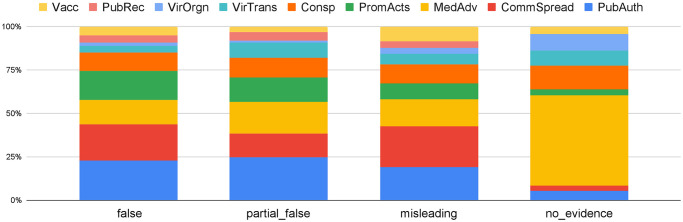
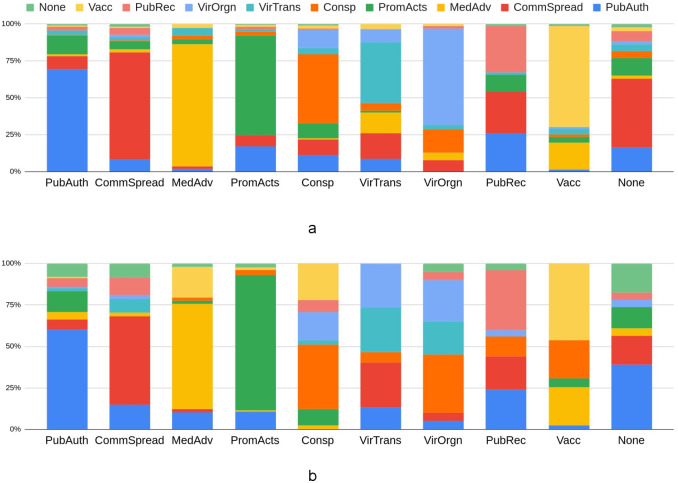
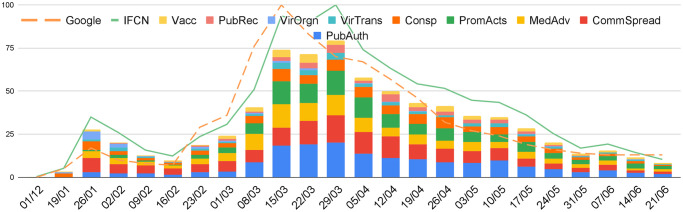
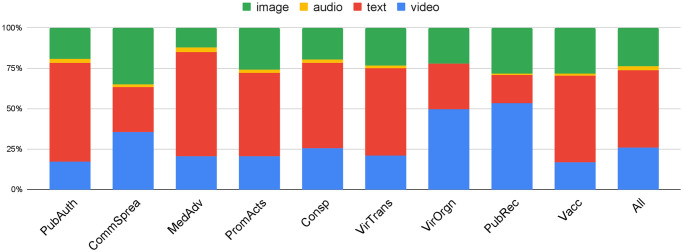
The explosion of disinformation accompanying the COVID-19 pandemic has overloaded fact-checkers and media worldwide, and brought a new major challenge to government responses worldwide. Not only is disinformation creating confusion about medical science amongst citizens, but it is also amplifying distrust in policy makers and governments. To help tackle this, we developed computational methods to categorise COVID-19 disinformation. The COVID-19 disinformation categories could be used for a) focusing fact-checking efforts on the most damaging kinds of COVID-19 disinformation; b) guiding policy makers who are trying to deliver effective public health messages and counter effectively COVID-19 disinformation. This paper presents: 1) a corpus containing what is currently the largest available set of manually annotated COVID-19 disinformation categories; 2) a classification-aware neural topic model (CANTM) designed for COVID-19 disinformation category classification and topic discovery; 3) an extensive analysis of COVID-19 disinformation categories with respect to time, volume, false type, media type and origin source.

摘要

伴随 COVID-19 大流行的假消息爆炸式传播,使全世界的事实核查人员和媒体不堪重负,也给各国政府的应对措施带来了新的重大挑战。假消息不仅在公民中对医学科学造成混淆,还加剧了公众对政策制定者和政府的不信任。为了帮助解决这个问题,我们开发了用于对 COVID-19 假消息进行分类的计算方法。COVID-19 假消息类别可用于:a)将事实核查工作集中在最具破坏性的 COVID-19 假消息上;b)为试图传达有效公共卫生信息和有效应对 COVID-19 假消息的政策制定者提供指导。本文提出了:1)一个包含当前最大手动标注 COVID-19 假消息类别集合的语料库;2)一个针对 COVID-19 假消息类别分类和主题发现而设计的分类感知神经主题模型(CANTM);3)对 COVID-19 假消息类别进行了关于时间、数量、错误类型、媒体类型和来源的广泛分析。
https://cdn.ncbi.nlm.nih.gov/pmc/blobs/93c7/7891716/4b134d7c2908/pone.0247086.g006.jpg
https://cdn.ncbi.nlm.nih.gov/pmc/blobs/93c7/7891716/a98988dae47d/pone.0247086.g001.jpg
https://cdn.ncbi.nlm.nih.gov/pmc/blobs/93c7/7891716/2114f5564465/pone.0247086.g002.jpg
https://cdn.ncbi.nlm.nih.gov/pmc/blobs/93c7/7891716/b521beaa4469/pone.0247086.g003.jpg
https://cdn.ncbi.nlm.nih.gov/pmc/blobs/93c7/7891716/f522f10171c3/pone.0247086.g004.jpg
https://cdn.ncbi.nlm.nih.gov/pmc/blobs/93c7/7891716/6561b2ba2c90/pone.0247086.g005.jpg
https://cdn.ncbi.nlm.nih.gov/pmc/blobs/93c7/7891716/4b134d7c2908/pone.0247086.g006.jpg
https://cdn.ncbi.nlm.nih.gov/pmc/blobs/93c7/7891716/a98988dae47d/pone.0247086.g001.jpg
https://cdn.ncbi.nlm.nih.gov/pmc/blobs/93c7/7891716/2114f5564465/pone.0247086.g002.jpg
https://cdn.ncbi.nlm.nih.gov/pmc/blobs/93c7/7891716/b521beaa4469/pone.0247086.g003.jpg
https://cdn.ncbi.nlm.nih.gov/pmc/blobs/93c7/7891716/f522f10171c3/pone.0247086.g004.jpg
https://cdn.ncbi.nlm.nih.gov/pmc/blobs/93c7/7891716/6561b2ba2c90/pone.0247086.g005.jpg
https://cdn.ncbi.nlm.nih.gov/pmc/blobs/93c7/7891716/4b134d7c2908/pone.0247086.g006.jpg

相似文献

1
Classification aware neural topic model for COVID-19 disinformation categorisation.用于 COVID-19 虚假信息分类的分类感知神经主题模型。
PLoS One. 2021 Feb 18;16(2):e0247086. doi: 10.1371/journal.pone.0247086. eCollection 2021.
2
Disinformation: analysis and identification.虚假信息:分析与识别
Comput Math Organ Theory. 2021;27(3):357-375. doi: 10.1007/s10588-021-09336-x. Epub 2021 Jun 18.
3
Health and science-related disinformation on COVID-19: A content analysis of hoaxes identified by fact-checkers in Spain.健康与科学相关的 COVID-19 虚假信息:西班牙事实核查者发现的骗局内容分析。
PLoS One. 2022 Apr 13;17(4):e0265995. doi: 10.1371/journal.pone.0265995. eCollection 2022.
4
[Communication in times of pandemic: information, disinformation, and provisional lessons from the coronavirus crisis].[疫情期间的沟通:信息、虚假信息以及冠状病毒危机带来的临时教训]
Gac Sanit. 2022;36 Suppl 1:S97-S104. doi: 10.1016/j.gaceta.2022.01.003.
5
The Role of Social Media in Health Misinformation and Disinformation During the COVID-19 Pandemic: Bibliometric Analysis.社交媒体在 COVID-19 大流行期间健康错误信息和虚假信息中的作用:文献计量分析。
JMIR Infodemiology. 2023 Sep 20;3:e48620. doi: 10.2196/48620.
6
Journalistic Fact-Checking of Information in Pandemic: Stakeholders, Hoaxes, and Strategies to Fight Disinformation during the COVID-19 Crisis in Spain.疫情中的新闻事实核查:西班牙 COVID-19 危机期间的利益相关者、骗局和打击虚假信息的策略。
Int J Environ Res Public Health. 2021 Jan 29;18(3):1227. doi: 10.3390/ijerph18031227.
7
A scoping review of COVID-19 online mis/disinformation in Black communities.一项针对 COVID-19 在线错误/虚假信息在黑人群体中的范围综述。
J Glob Health. 2022 Jul 23;12:05026. doi: 10.7189/jogh.12.05026.
8
Trend analysis of COVID-19 mis/disinformation narratives-A 3-year study.COVID-19 错误/虚假信息叙述的趋势分析-一项为期 3 年的研究。
PLoS One. 2023 Nov 17;18(11):e0291423. doi: 10.1371/journal.pone.0291423. eCollection 2023.
9
Revisited: A Product of Planned Disinformation Amplifying the COVID-19 "infodemic".重新审视:计划制造的假信息的产物,放大了 COVID-19“信息疫情”。
Front Public Health. 2021 Jul 14;9:649930. doi: 10.3389/fpubh.2021.649930. eCollection 2021.
10
Building a framework for fake news detection in the health domain.构建健康领域假新闻检测框架。
PLoS One. 2024 Jul 8;19(7):e0305362. doi: 10.1371/journal.pone.0305362. eCollection 2024.

引用本文的文献

1
Classifying and fact-checking health-related information about COVID-19 on Twitter/X using machine learning and deep learning models.使用机器学习和深度学习模型对推特/ X上有关COVID - 19的健康相关信息进行分类和真实性核查。
BMC Med Inform Decis Mak. 2025 Feb 11;25(1):73. doi: 10.1186/s12911-025-02895-y.
2
A hybrid transformer and attention based recurrent neural network for robust and interpretable sentiment analysis of tweets.基于混合变压器和注意力的循环神经网络的 tweet 情感分析的鲁棒性和可解释性。
Sci Rep. 2024 Oct 22;14(1):24882. doi: 10.1038/s41598-024-76079-5.
3
The impact and management of internet-based public opinion dissemination during emergencies: A case study of Baidu News during the first wave of coronavirus disease 2019 (COVID-19).

本文引用的文献

1
COVID-Twitter-BERT: A natural language processing model to analyse COVID-19 content on Twitter.COVID-Twitter-BERT:一种用于分析推特上新冠疫情相关内容的自然语言处理模型。
Front Artif Intell. 2023 Mar 14;6:1023281. doi: 10.3389/frai.2023.1023281. eCollection 2023.
2
A Large-Scale COVID-19 Twitter Chatter Dataset for Open Scientific Research-An International Collaboration.用于开放科学研究的大规模COVID-19推特聊天数据集——一项国际合作。
Epidemiologia (Basel). 2021 Aug 5;2(3):315-324. doi: 10.3390/epidemiologia2030024.
3
Work from home during the COVID-19 pandemic: An observational study based on a large geo-tagged COVID-19 Twitter dataset (UsaGeoCov19).
突发事件中基于互联网的舆情传播的影响与管理:以新型冠状病毒肺炎(COVID-19)疫情第一波期间百度新闻为例。
PLoS One. 2024 Apr 4;19(4):e0299374. doi: 10.1371/journal.pone.0299374. eCollection 2024.
4
User feedback on the NHS test & Trace Service during COVID-19: The use of machine learning to analyse free-text data from 37,914 England adults.新冠疫情期间国民保健署检测与追踪服务的用户反馈:利用机器学习分析来自37914名英格兰成年人的自由文本数据。
Public Health Pract (Oxf). 2023 Jun 29;6:100401. doi: 10.1016/j.puhip.2023.100401. eCollection 2023 Dec.
5
CovTiNet: Covid text identification network using attention-based positional embedding feature fusion.CovTiNet:使用基于注意力的位置嵌入特征融合的新冠文本识别网络。
Neural Comput Appl. 2023;35(18):13503-13527. doi: 10.1007/s00521-023-08442-y. Epub 2023 Mar 14.
6
Preventing profiling for ethical fake news detection.防止在道德假新闻检测中进行特征分析。
Inf Process Manag. 2023 Mar;60(2):None. doi: 10.1016/j.ipm.2022.103206.
7
Agenda-Setting for COVID-19: A Study of Large-Scale Economic News Coverage Using Natural Language Processing.新冠疫情的议程设置:一项运用自然语言处理技术对大规模经济新闻报道的研究
Int J Data Sci Anal. 2023;15(3):291-312. doi: 10.1007/s41060-022-00364-7. Epub 2022 Oct 6.
8
Applications of machine learning for COVID-19 misinformation: a systematic review.机器学习在新冠疫情虚假信息方面的应用:一项系统综述
Soc Netw Anal Min. 2022;12(1):94. doi: 10.1007/s13278-022-00921-9. Epub 2022 Jul 29.
9
Multistage BiCross encoder for multilingual access to COVID-19 health information.多阶段 BiCross 编码器,用于多语言访问 COVID-19 健康信息。
PLoS One. 2021 Sep 7;16(9):e0256874. doi: 10.1371/journal.pone.0256874. eCollection 2021.
10
Applications of artificial intelligence in battling against covid-19: A literature review.人工智能在抗击新冠疫情中的应用:文献综述
Chaos Solitons Fractals. 2021 Jan;142:110338. doi: 10.1016/j.chaos.2020.110338. Epub 2020 Oct 3.
2019冠状病毒病大流行期间的居家办公:基于一个大型带有地理标签的2019冠状病毒病推特数据集(美国地理新冠19)的观察性研究
Inf Process Manag. 2022 Mar;59(2):102820. doi: 10.1016/j.ipm.2021.102820. Epub 2021 Dec 9.
4
COVID-19 Discourse on Twitter in Four Asian Countries: Case Study of Risk Communication.四个亚洲国家推特上关于新冠疫情的讨论:风险沟通案例研究
J Med Internet Res. 2021 Mar 16;23(3):e23272. doi: 10.2196/23272.
5
Twitter Discussions and Emotions About the COVID-19 Pandemic: Machine Learning Approach.关于新冠疫情的推特讨论与情绪:机器学习方法
J Med Internet Res. 2020 Nov 25;22(11):e20550. doi: 10.2196/20550.
6
An "Infodemic": Leveraging High-Volume Twitter Data to Understand Early Public Sentiment for the Coronavirus Disease 2019 Outbreak.一场“信息疫情”:利用大量推特数据来了解公众对2019年冠状病毒病疫情的早期情绪
Open Forum Infect Dis. 2020 Jun 30;7(7):ofaa258. doi: 10.1093/ofid/ofaa258. eCollection 2020 Jul.
7
The COVID-19 social media infodemic.新冠病毒肺炎疫情相关社交媒体信息疫情。
Sci Rep. 2020 Oct 6;10(1):16598. doi: 10.1038/s41598-020-73510-5.
8
Framing COVID-19: How we conceptualize and discuss the pandemic on Twitter.新冠疫情的话语构建:我们如何在 Twitter 上对其进行概念化和讨论。
PLoS One. 2020 Sep 30;15(9):e0240010. doi: 10.1371/journal.pone.0240010. eCollection 2020.
9
Retweets of officials' alarming vs reassuring messages during the COVID-19 pandemic: Implications for crisis management.新冠疫情期间官员发布的警示性与安抚性信息的转发情况:对危机管理的启示
Int J Inf Manage. 2020 Dec;55:102187. doi: 10.1016/j.ijinfomgt.2020.102187. Epub 2020 Jun 23.
10
Public Opinions towards COVID-19 in California and New York on Twitter.加利福尼亚州和纽约州民众在推特上对新冠疫情的看法。
medRxiv. 2020 Jul 14:2020.07.12.20151936. doi: 10.1101/2020.07.12.20151936.