Jerónimo Jaqueti Aroca, Laboratorio Clínico, Hospital Universitario de Fuenlabrada, Camino del Molino, 2. 28942 Madrid, Spain.
Rev Esp Quimioter. 2021 Apr;34(2):141-144. doi: 10.37201/req/010.2020. Epub 2021 Feb 19.
Clostridioides difficile (CD) is the most common cause of nosocomial diarrhea. Detection of CD toxin in patients' faecal samples is the traditional rapid method for the diagnosis of CD infection. Various testing algorithms have been proposed: an initial screening test using a rapid test, and a confirmatory test (cytotoxicity neutralization assay, toxigenic culture, nucleic acid amplification test) for discordant results. The aim of this study was to evaluate the effectiveness of a two-step algorithm using an immunochromatographic test followed of a polymerase chain reaction (PCR).
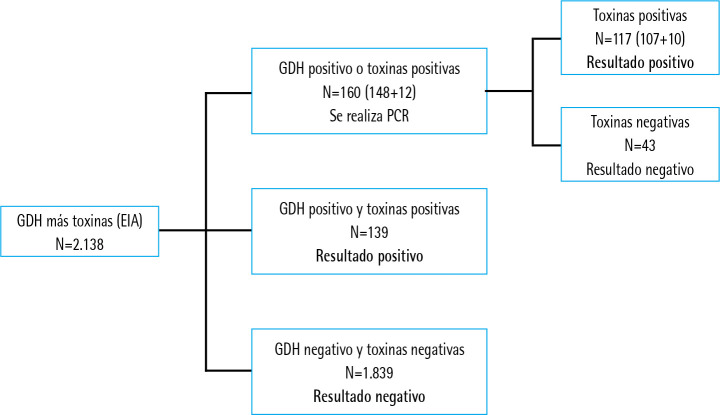
The specimens have been tested according to the following schedule: 1) Step one: All samples were tested for detection of glutamate dehydrogenase antigen (GDH) and toxin A/B using the C. diff QUIK CHEK Complete test. All GDH and toxins positive results were considered CD positives; 2) Step two: When the results were discrepant (only GDH+ or toxins+), the samples were confirmed using the PCR test BD MAX Cdiff. All PCR positive results were considered CD positives.
A total of 2,138 specimens were initially tested. 139 were positive for GDH and toxins. 160 discrepant results (148 GDH+ and 12 toxins+) were tested by PCR, 117 were positive (107/148 GDH+ and 10/12 toxins+).
The implementation of a PCR method showed an increase de 117 positive results (73.1% of discrepant). Considering the sensitivity of C.diff QUIK CHEK (instructions of manufacturer), the GDH discrepant results may be false negatives, y the samples PCR and toxins positives may be real positives results.
艰难梭菌(CD)是医院获得性腹泻最常见的原因。检测患者粪便样本中的 CD 毒素是诊断 CD 感染的传统快速方法。已经提出了各种检测算法:使用快速检测进行初始筛选检测,以及用于不一致结果的确认检测(细胞毒性中和测定、产毒培养、核酸扩增检测)。本研究的目的是评估两步算法(免疫层析试验 followed 聚合酶链反应(PCR))的有效性。
按照以下方案检测标本:1)步骤一:所有样本均使用 C. diff QUIK CHEK Complete 试验检测谷氨酸脱氢酶抗原(GDH)和毒素 A/B。所有 GDH 和毒素阳性结果均视为 CD 阳性;2)步骤二:结果不一致时(仅 GDH+或毒素+),使用 PCR 试验 BD MAX Cdiff 确认样本。所有 PCR 阳性结果均视为 CD 阳性。
共检测了 2138 个标本。有 139 个标本 GDH 和毒素均阳性。160 个不一致结果(148 个 GDH+和 12 个毒素+)用 PCR 检测,117 个阳性(107/148 GDH+和 10/12 毒素+)。
实施 PCR 方法显示阳性结果增加了 117 个(不一致结果的 73.1%)。考虑到 C.diff QUIK CHEK 的灵敏度(制造商的说明),GDH 不一致的结果可能是假阴性,而 PCR 和毒素阳性的样本可能是真正的阳性结果。