Key Laboratory of Ministry of Industry and Information, Technology of Biomedical Engineering and Translational Medicine, Chinese PLA General Hospital, Beijing, 100853, People's Republic of China.
Translational Medical Research Center, Chinese PLA General Hospital, Beijing, 100853, People's Republic of China.
Sci Rep. 2021 Feb 18;11(1):4145. doi: 10.1038/s41598-021-83424-5.
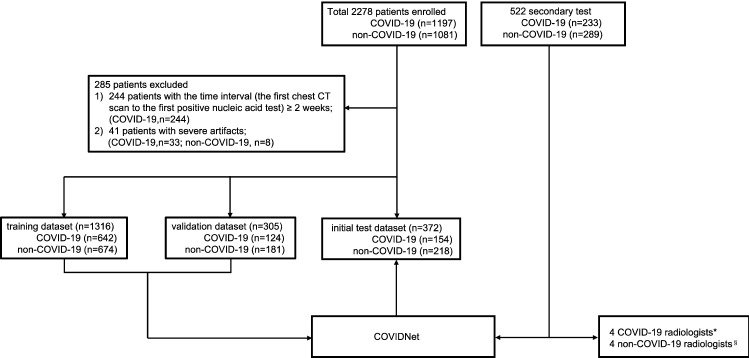
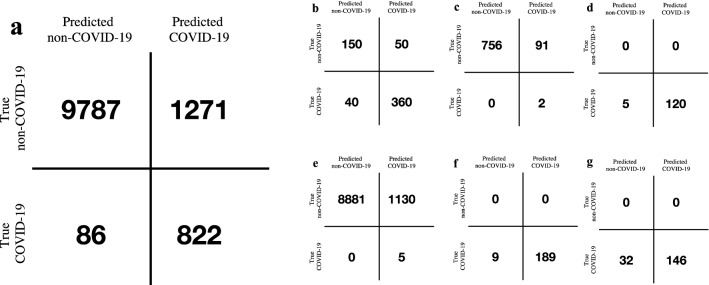
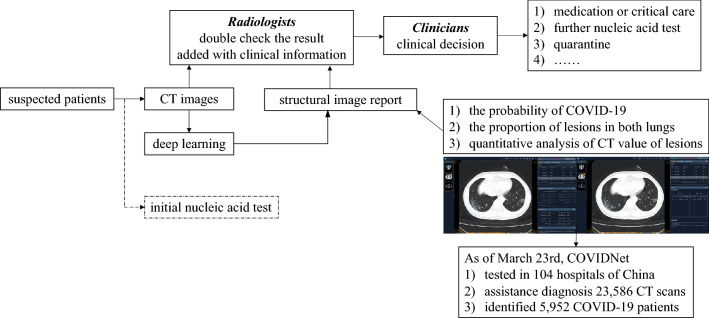
The pandemic of Coronavirus Disease 2019 (COVID-19) is causing enormous loss of life globally. Prompt case identification is critical. The reference method is the real-time reverse transcription PCR (RT-PCR) assay, whose limitations may curb its prompt large-scale application. COVID-19 manifests with chest computed tomography (CT) abnormalities, some even before the onset of symptoms. We tested the hypothesis that the application of deep learning (DL) to 3D CT images could help identify COVID-19 infections. Using data from 920 COVID-19 and 1,073 non-COVID-19 pneumonia patients, we developed a modified DenseNet-264 model, COVIDNet, to classify CT images to either class. When tested on an independent set of 233 COVID-19 and 289 non-COVID-19 pneumonia patients, COVIDNet achieved an accuracy rate of 94.3% and an area under the curve of 0.98. As of March 23, 2020, the COVIDNet system had been used 11,966 times with a sensitivity of 91.12% and a specificity of 88.50% in six hospitals with PCR confirmation. Application of DL to CT images may improve both efficiency and capacity of case detection and long-term surveillance.
新型冠状病毒病 2019(COVID-19)大流行在全球范围内造成了巨大的生命损失。及时发现病例至关重要。参考方法是实时逆转录聚合酶链反应(RT-PCR)检测,但该方法的局限性可能会限制其及时大规模应用。COVID-19 的表现为胸部计算机断层扫描(CT)异常,有些甚至在症状出现之前。我们检验了一个假设,即应用深度学习(DL)对 3D CT 图像进行分析有助于识别 COVID-19 感染。我们使用了 920 例 COVID-19 和 1073 例非 COVID-19 肺炎患者的数据,开发了一个经过改进的 DenseNet-264 模型 COVIDNet,用于将 CT 图像分类到任一类。在对 233 例 COVID-19 和 289 例非 COVID-19 肺炎患者的独立数据集进行测试时,COVIDNet 的准确率为 94.3%,曲线下面积为 0.98。截至 2020 年 3 月 23 日,COVIDNet 系统已在六家具有 PCR 确认的医院中使用了 11966 次,其敏感性为 91.12%,特异性为 88.50%。将 DL 应用于 CT 图像可能会提高病例检测的效率和能力,并进行长期监测。