Kernozek Thomas W, Rutherford Drew, Heinert Becky, Onsager Jessica, Lee Maria, Schiedermayer Jeremie, Dietrich Stephanie, Dade Renee, Almonroeder Thomas Gus
Department of Health Professions, Physical Therapy Program, University of Wisconsin - La Crosse, 1300 Badger Street, La Crosse, WI, USA; La Crosse Institute for Movement Science (LIMS), University of Wisconsin - La Crosse, 1300 Badger Street, La Crosse, WI, USA.
La Crosse Institute for Movement Science (LIMS), University of Wisconsin - La Crosse, 1300 Badger Street, La Crosse, WI, USA; Gundersen Health System, Sports Medicine, La Crosse, WI, USA.
Int J Sports Phys Ther. 2021 Feb 2;16(1):87-95. doi: 10.26603/001c.18808.
Post-performance verbal and visual feedback based on data collected via lab-based instruments have been shown to improve landing patterns related to non-contact ACL injury. Biomechanical methods are often complex, difficult to transport and utilize in field settings, and costly, which limits their use for injury prevention. Developing systems that can readily provide feedback outside of the lab setting may support large scale use of feedback training for ACL injury prevention.
PURPOSE/HYPOTHESIS: The purpose of this study was to investigate the effectiveness of a single training session using a custom portable feedback training system that provides performance cues to promote changes in impact kinetics and lower extremity position during landing in female athletes.
Repeated measures.
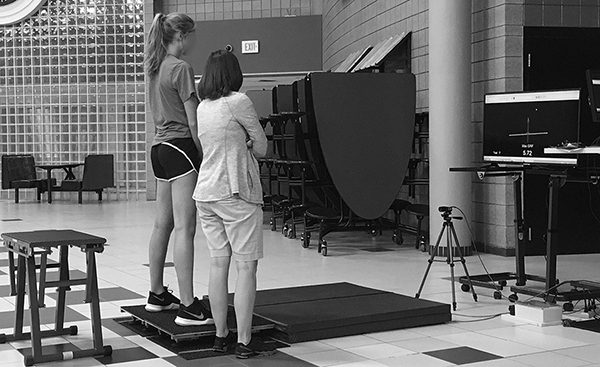
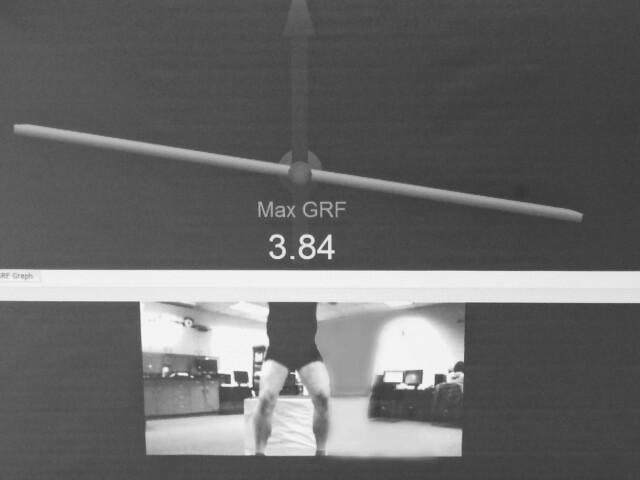
One hundred fifty female athletes (ages 13-18 years old) landed from a 50 cm platform with and without feedback related to vertical ground reaction force (vGRF), vGRF symmetry and lower extremity position. Feedback was provided via a portable, low-cost system that included two custom-built force plates interfaced with a digital camera. Each athlete performed six pre-test trials followed by two blocks of six trials where they received visual feedback from the training system and individualized verbal cues from an investigator. Following training blocks, athletes completed six post-test trials without feedback and then six dual-task trials where a ball was randomly thrown to the performer during the landing (transfer task). vGRF and knee to ankle (K:A) separation ratio were measured and the average responses were reported for each trial block.
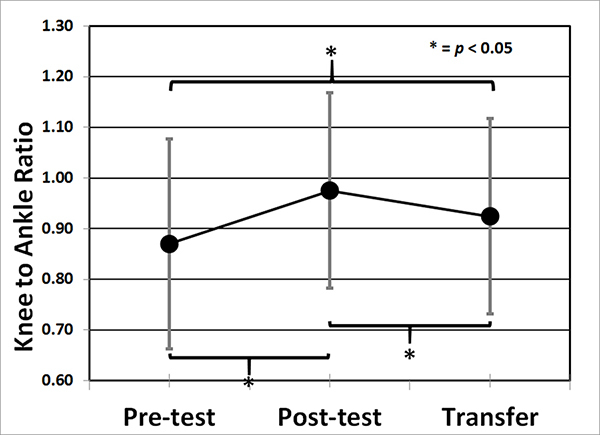
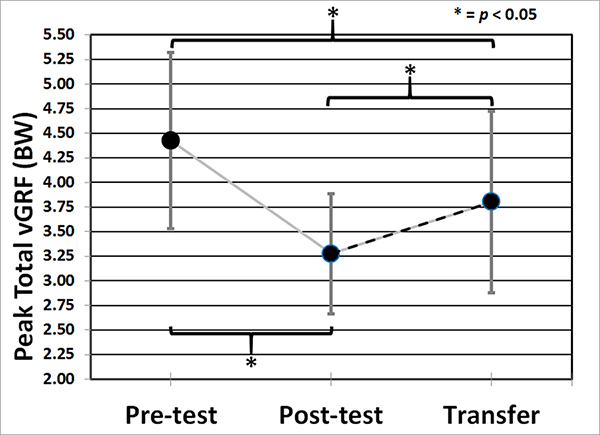
Differences in vGRF between baseline, post-test and transfer task trial blocks were observed (F(2,298)=181.68, p < .0001). Mean (SD) peak vGRF (body weight) were 4.43 (0.90), 3.28 (0.61), and 3.80 (0.92), respectively. Differences in K:A ratio between baseline, post-test and transfer task trial blocks were shown (F(2,298)=68.47, p < .0001). Mean (SD) K:A ratio were 0.87 (0.21), 0.98 (0.19), and 0.92 (0.19), respectively.
A portable feedback system may be effective in reducing peak vGRFs and promoting a more desirable K:A ratio during landing and transfer task landing in adolescent female athletes.
3b.
基于实验室仪器收集的数据进行的运动后言语和视觉反馈已被证明可改善与非接触性前交叉韧带损伤相关的落地模式。生物力学方法通常复杂、难以运输且难以在现场环境中使用,并且成本高昂,这限制了它们在预防损伤方面的应用。开发能够在实验室环境之外轻松提供反馈的系统可能支持大规模使用反馈训练来预防前交叉韧带损伤。
目的/假设:本研究的目的是调查使用定制便携式反馈训练系统进行单次训练的效果,该系统提供性能提示以促进女性运动员落地时冲击动力学和下肢位置的变化。
重复测量。
150名女性运动员(年龄13 - 18岁)从50厘米高的平台上跳下,分别在有和没有与垂直地面反作用力(vGRF)、vGRF对称性和下肢位置相关反馈的情况下进行。反馈通过一个便携式、低成本系统提供,该系统包括两个与数码相机连接的定制测力板。每位运动员进行6次预测试试验,然后是两个包含6次试验的组块,在试验组块中她们从训练系统接收视觉反馈并从一名研究人员那里获得个性化言语提示。在训练组块之后,运动员完成6次无反馈的后测试试验,然后是6次双重任务试验,即在落地过程中随机向运动员扔球(转移任务)。测量vGRF和膝踝(K:A)分离比,并报告每个试验组块的平均反应。
观察到基线、后测试和转移任务试验组块之间vGRF的差异(F(2,298)=181.68,p <.0001)。平均(标准差)峰值vGRF(体重倍数)分别为4.43(0.90)、3.28(0.61)和3.80(0.92)。显示了基线、后测试和转移任务试验组块之间K:A比的差异(F(2,298)=68.47,p <.0001)。平均(标准差)K:A比分别为0.87(0.21)、0.98(0.19)和0.92(0.19)。
便携式反馈系统可能有效地降低青少年女性运动员在落地和转移任务落地过程中的峰值vGRF,并促进更理想的K:A比。
3b。