Strand Robin, Kullberg Joel, Ahlström Håkan, Lind Lars
Division of Radiology, Department of Surgical Sciences, Uppsala University, Uppsala, Sweden.
Department of Information Technology, Uppsala University, Uppsala, Sweden.
Cytokine X. 2020 Dec 21;3(1):100050. doi: 10.1016/j.cytox.2020.100050. eCollection 2021 Mar.
Obesity has previously been linked to inflammation. Here we investigated how plasma levels of six interleukins were related to body fat distribution.
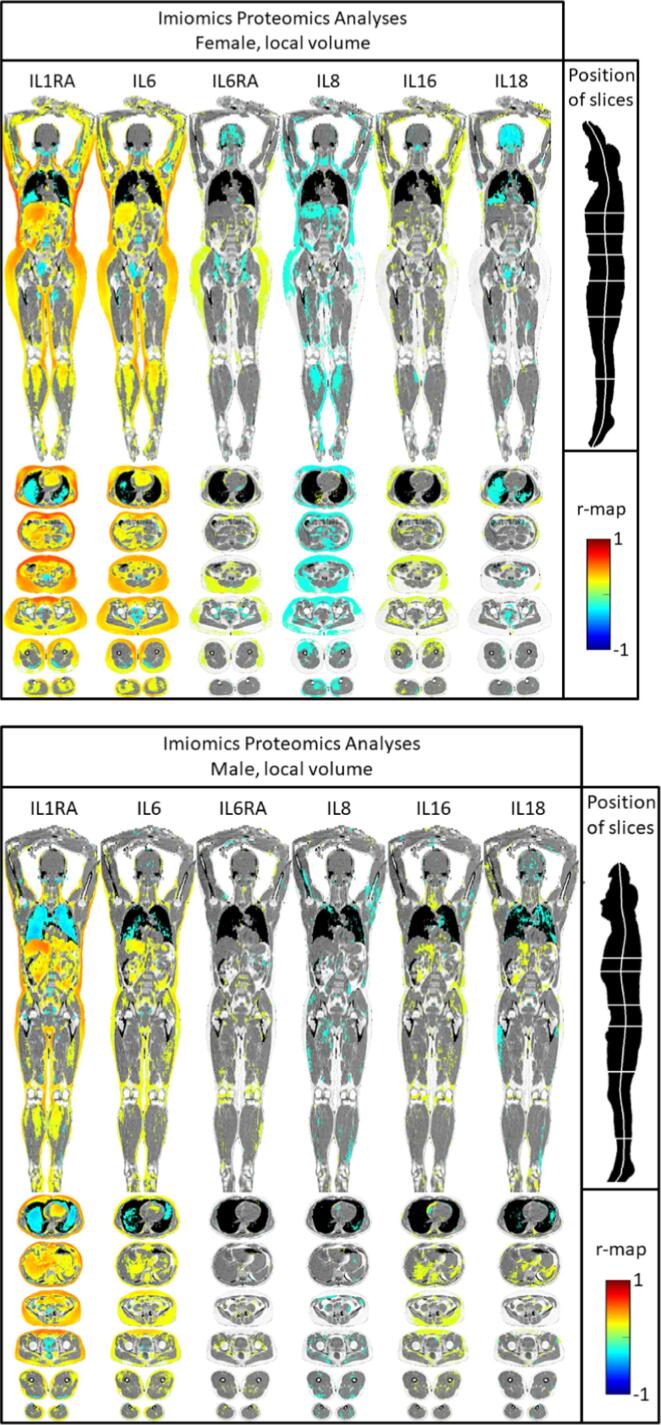
In 321 subjects, all aged 50 years, in the population-based POEM study (mean BMI 26-27 kg/m), six interleukins were measured together with a DXA scan for determination of fat and lean mass. Also a whole-body magnetic resonance imaging (MRI) scan, in which fat content measurements were acquired in > 1 million voxels was performed. Interleukin levels were related to each of these voxels by the voxel-based technique "Imiomics" to create a 3D-view of how these measurements were related to size of each part of the body.
Levels of IL-1RA and IL-6 were related to traditional DXA and MRI measurements of adipose tissue at all locations. Neither IL-6R, nor IL-8 or IL-18, showed any consistent significant relationships vs the traditional measurements of body composition, while IL-16 showed relationships being of borderline significance. The Imiomics evaluation further strengthen the view that IL-1RA and IL-6 were related to subcutaneous adipose tissue (SAT), as well to ectopic fat distribution. In women, IL-16 levels were weakly related to expansion of SAT in the upper part of the body, while on the contrary, IL-8 levels were related to a reduction of SAT volume.
Of the six evaluated interleukins, plasma IL-1RA and IL-6 levels were related to the amount of adipose tissue in all parts of the body, while a diverse picture was seen for other interleukins, suggesting that different interleukins are related to fat distribution in different ways.
肥胖先前已被证明与炎症有关。在此,我们研究了六种白细胞介素的血浆水平与身体脂肪分布之间的关系。
在基于人群的POEM研究中,选取了321名年龄均为50岁的受试者(平均BMI为26 - 27kg/m²),测量了六种白细胞介素,并进行双能X线吸收法(DXA)扫描以确定脂肪和瘦体重。同时还进行了全身磁共振成像(MRI)扫描,在超过100万个体素中获取脂肪含量测量值。通过基于体素的“Imiomics”技术,将白细胞介素水平与这些体素中的每一个相关联,以创建一个三维视图,展示这些测量值与身体各部位大小之间的关系。
IL - 1受体拮抗剂(IL - 1RA)和白细胞介素 - 6(IL - 6)的水平与所有部位脂肪组织的传统DXA和MRI测量值相关。白细胞介素 - 6受体(IL - 6R)、白细胞介素 - 8(IL - 8)或白细胞介素 - 18(IL - 18)与身体成分的传统测量值均未显示出任何一致的显著关系,而白细胞介素 - 16(IL - 16)显示出的关系具有临界显著性。Imiomics评估进一步强化了这样的观点,即IL - 1RA和IL - 6与皮下脂肪组织(SAT)以及异位脂肪分布有关。在女性中,IL - 16水平与上半身SAT的扩张呈弱相关,而相反,IL - 8水平与SAT体积的减少有关。
在评估的六种白细胞介素中,血浆IL - 1RA和IL - 6水平与身体所有部位的脂肪组织量有关,而其他白细胞介素呈现出不同的情况,这表明不同的白细胞介素以不同的方式与脂肪分布相关。