Institute of Molecular and Translational Medicine, Xian Jiaotong University Health Science Center, Xi'an, China.
School of Basic Medical Sciences, Xi'an Jiaotong University Health Science Center, Xi'an, China.
Front Endocrinol (Lausanne). 2022 Jul 14;13:873699. doi: 10.3389/fendo.2022.873699. eCollection 2022.
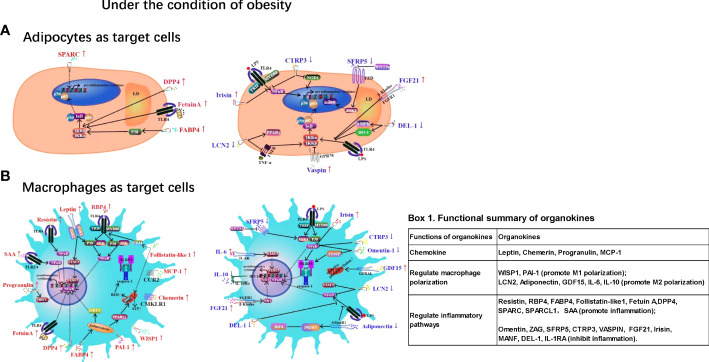
Chronic low-grade inflammation in adipose tissue (AT) is a hallmark of obesity and contributes to various metabolic disorders, such as type 2 diabetes and cardiovascular diseases. Inflammation in ATs is characterized by macrophage infiltration and the activation of inflammatory pathways mediated by NF-κB, JNK, and NLRP3 inflammasomes. Adipokines, hepatokines and myokines - proteins secreted from AT, the liver and skeletal muscle play regulatory roles in AT inflammation endocrine, paracrine, and autocrine pathways. For example, obesity is associated with elevated levels of pro-inflammatory adipokines (e.g., leptin, resistin, chemerin, progranulin, RBP4, WISP1, FABP4, PAI-1, Follistatin-like1, MCP-1, SPARC, SPARCL1, and SAA) and reduced levels of anti-inflammatory adipokines such as adiponectin, omentin, ZAG, SFRP5, CTRP3, vaspin, and IL-10. Moreover, some hepatokines (Fetuin A, DPP4, FGF21, GDF15, and MANF) and myokines (irisin, IL-6, and DEL-1) also play pro- or anti-inflammatory roles in AT inflammation. This review aims to provide an updated understanding of these organokines and their role in AT inflammation and related metabolic abnormalities. It serves to highlight the molecular mechanisms underlying the effects of these organokines and their clinical significance. Insights into the roles and mechanisms of these organokines could provide novel and potential therapeutic targets for obesity-induced inflammation.
慢性低度炎症在脂肪组织(AT)中是肥胖的标志,并导致各种代谢紊乱,如 2 型糖尿病和心血管疾病。脂肪组织的炎症表现为巨噬细胞浸润和 NF-κB、JNK 和 NLRP3 炎性小体介导的炎症途径的激活。脂肪细胞因子、肝细胞因子和肌细胞因子 - 从 AT、肝脏和骨骼肌分泌的蛋白质在 AT 炎症的内分泌、旁分泌和自分泌途径中发挥调节作用。例如,肥胖与促炎脂肪细胞因子(例如瘦素、抵抗素、趋化素、颗粒蛋白前体、RBP4、WISP1、FABP4、PAI-1、Follistatin-like1、MCP-1、SPARC、SPARCL1 和 SAA)水平升高和抗炎脂肪细胞因子(如脂联素、网膜素、ZAG、SFRP5、CTRP3、vaspin 和 IL-10)水平降低有关。此外,一些肝细胞因子(胎球蛋白 A、DPP4、FGF21、GDF15 和 MANF)和肌细胞因子(鸢尾素、IL-6 和 DEL-1)在 AT 炎症中也发挥促炎或抗炎作用。本综述旨在提供对这些器官因子及其在 AT 炎症和相关代谢异常中的作用的最新认识。它强调了这些器官因子的作用机制及其临床意义。深入了解这些器官因子的作用和机制可以为肥胖引起的炎症提供新的潜在治疗靶点。