Department of Psychiatry, Radboud University Medical Center, The Netherlands.
Donders Center for Medical Neuroscience, Donders Institute for Brain, Cognition and Behavior, The Netherlands.
Addict Biol. 2021 Nov;26(6):e13015. doi: 10.1111/adb.13015. Epub 2021 Feb 18.
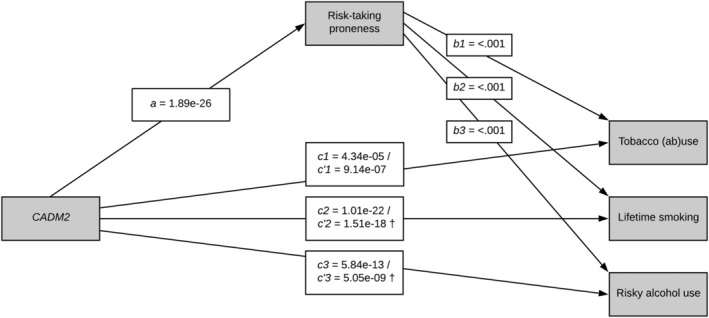
Risky behaviors, such as substance use and unprotected sex, are associated with various physical and mental health problems. Recent genome-wide association studies indicated that variation in the cell adhesion molecule 2 (CADM2) gene plays a role in risky behaviors and self-control. In this phenome-wide scan for risky behavior, it was tested if underlying common vulnerability could be (partly) explained by pleiotropic effects of this gene and how large the effects were. Single nucleotide polymorphism (SNP)-level and gene-level association tests within four samples (25 and Up, Spit for Science, Netherlands Twin Register, and UK Biobank and meta-analyses over all samples (combined sample of 362,018 participants) were conducted to test associations between CADM2, substance- and sex-related risk behaviors, and various measures related to self-control. We found significant associations between the CADM2 gene, various risky behaviors, and different measures of self-control. The largest effect sizes were found for cannabis use, sensation seeking, and disinhibition. Effect sizes ranged from 0.01% to 0.26% for single top SNPs and from 0.07% to 3.02% for independent top SNPs together, with sufficient power observed only in the larger samples and meta-analyses. In the largest cohort, we found indications that risk-taking proneness mediated the association between CADM2 and latent factors for lifetime smoking and regular alcohol use. This study extends earlier findings that CADM2 plays a role in risky behaviors and self-control. It also provides insight into gene-level effect sizes and demonstrates the feasibility of testing mediation. These findings present a good starting point for investigating biological etiological pathways underlying risky behaviors.
风险行为,如物质使用和无保护性行为,与各种身心健康问题有关。最近的全基因组关联研究表明,细胞黏附分子 2(CADM2)基因的变异在风险行为和自我控制中起作用。在这项风险行为的全基因组扫描中,研究测试了这种基因的多效性是否可以(部分)解释潜在的共同脆弱性,以及这种基因的影响有多大。在四个样本(25 岁及以上、荷兰双胞胎登记处和英国生物银行的 Spit for Science 和元分析)中进行了单核苷酸多态性(SNP)水平和基因水平的关联测试,以测试 CADM2 与物质和性相关的风险行为以及与自我控制相关的各种测量值之间的关联。我们发现 CADM2 基因与各种风险行为以及不同的自我控制措施之间存在显著关联。最大的效应大小发现于大麻使用、感觉寻求和去抑制。单顶尖 SNP 的效应大小范围从 0.01%到 0.26%,独立顶尖 SNP 的效应大小范围从 0.07%到 3.02%,仅在较大的样本和元分析中观察到足够的效力。在最大的队列中,我们发现冒险倾向可能介导了 CADM2 与终生吸烟和定期饮酒的潜在因素之间的关联。这项研究扩展了早期的发现,即 CADM2 在风险行为和自我控制中起作用。它还提供了对基因水平效应大小的洞察,并证明了测试中介的可行性。这些发现为研究风险行为背后的生物学病因途径提供了一个良好的起点。