From the Department of Radiology, Massachusetts General Hospital, 55 Fruit St, White 270, Boston, MA 02114 (A.P., S.L., F.J.S., A.R.K.); Department of Radiology and Biomedical Imaging, University of California San Francisco, San Francisco, Calif (C.A., B.M.Y.); Institute for Diagnostic and Interventional Radiology, Faculty of Medicine and University Hospital Cologne, University of Cologne, Cologne, Germany (S.L.); Department of Radiology, Mayo Clinic, Rochester, Minn (P.R.); and Department of Radiology, University of Washington, Seattle, Wash (D.V.S.).
Radiographics. 2021 Mar-Apr;41(2):509-523. doi: 10.1148/rg.2021200049. Epub 2021 Feb 19.
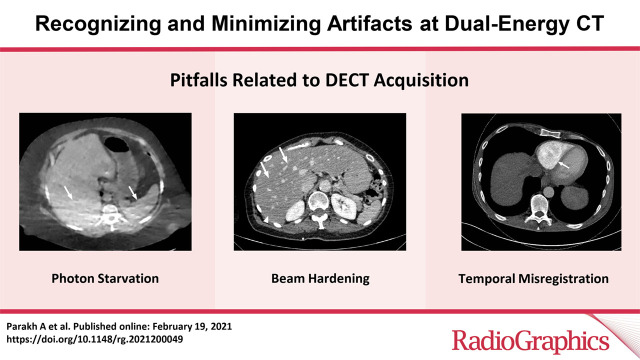
Dual-energy CT (DECT) is an exciting innovation in CT technology with profound capabilities to improve diagnosis and add value to patient care. Significant advances in this technology over the past decade have improved our ability to successfully adopt DECT into the clinical routine. To enable effective use of DECT, one must be aware of the pitfalls and artifacts related to this technology. Understanding the underlying technical basis of artifacts and the strategies to mitigate them requires optimization of scan protocols and parameters. The ability of radiologists and technologists to anticipate their occurrence and provide recommendations for proper selection of patients, intravenous and oral contrast media, and scan acquisition parameters is key to obtaining good-quality DECT images. In addition, choosing appropriate reconstruction algorithms such as image kernel, postprocessing parameters, and appropriate display settings is critical for preventing quantitative and qualitative interpretive errors. Therefore, knowledge of the appearances of these artifacts is essential to prevent errors and allows maximization of the potential of DECT. In this review article, the authors aim to provide a comprehensive and practical overview of possible artifacts that may be encountered at DECT across all currently available commercial clinical platforms. They also provide a pictorial overview of the diagnostic pitfalls and outline strategies for mitigating or preventing the occurrence of artifacts, when possible. The broadening scope of DECT applications necessitates up-to-date familiarity with these technologies to realize their full diagnostic potential.
双能 CT(DECT)是 CT 技术的一项令人振奋的创新,具有极大的潜力可改善诊断并为患者护理增值。该技术在过去十年中的重大进展提高了我们成功将 DECT 纳入临床常规的能力。为了能够有效地使用 DECT,必须了解与该技术相关的陷阱和伪影。理解伪影的潜在技术基础以及减轻它们的策略需要优化扫描协议和参数。放射科医生和技术人员能够预测它们的发生,并为适当选择患者、静脉内和口服对比剂以及扫描采集参数提供建议,这是获得高质量 DECT 图像的关键。此外,选择适当的重建算法,如图像内核、后处理参数和适当的显示设置,对于防止定量和定性解释性错误至关重要。因此,了解这些伪影的外观对于防止错误和最大限度地发挥 DECT 的潜力至关重要。在这篇综述文章中,作者旨在全面而实用地概述在所有当前可用的商业临床平台上在 DECT 上可能遇到的各种伪影。他们还提供了诊断陷阱的图像概述,并概述了在可能的情况下减轻或预防伪影发生的策略。DECT 应用范围的扩大需要及时熟悉这些技术,以充分发挥其诊断潜力。