Uchechukwu L. Osuagwu, PhD, is a Research Fellow, Diabetes, Obesity and Metabolism Translational Research Unit, School of Medicine; and Kingsley Emwinyore Agho, PhD, is an Associate Professor of Biostatistics, School of Health Sciences; both at Western Sydney University, Campbelltown, Australia. Chundung A. Miner is an Associate Professor, Department of Community Medicine, College of Health Sciences; Piwuna Christopher Goson, MBBS, is a Senior Lecturer, Department of Psychiatry, College of Health Sciences; and Tanko Ishaya, PhD, is a Professor, Department of Computer Science; all at the University of Jos, Plateau State, Nigeria. Dipesh Bhattarai, PhD, is an Associate Lecturer, School of Medicine, Faculty of Health, Deakin University, Victoria, Australia. Khathutshelo Percy Mashige, PhD, is a Professor, Discipline of Optometry, African Vision Research Institute, Westville Campus, University of KwaZulu-Natal, Durban, South Africa. Richard Oloruntoba, PhD, is an Associate Professor, Supply Chain Management, School of Management and Marketing, Faculty of Business and Law, Curtin University, Bentley, Western Australia. Emmanuel Kwasi Abu, PhD, is Dean, Department of Optometry and Vision Science, School of Allied Health Sciences, University of Cape Coast, Ghana. Bernadine Ekpenyong, PhD, is Senior Lecturer, Department of Public Health, Faculty of Allied Medical Sciences, College of Medical Sciences, University of Calabar, Cross River State, Nigeria. Timothy G. Chikasirimobi, MSc, is a Master's Student, Masinde Muliro University of Science and Technology, Kakamega, Kenya. Godwin O. Ovenseri-Ogbomo, PhD, is an Assistant Professor, Department of Optometry, College of Applied Medical Sciences, Qassim University, Saudi Arabia, and Department of Optometry, Faculty of Life Sciences, University of Benin, Benin City, Nigeria. Raymond Langsi, MBBS, is Head, Health Division, University of Bamenda, Bambili, Cameroon. Deborah Donald Charwe, MSc, is Senior Research Nutritionist, Tanzania Food and Nutrition Center, Dar es Salaam, Tanzania. Obinna Nwaeze, MBBS, is a Practicing Physician, County Durham and Darlington, National Health Service Foundation, United Kingdom. Uchechukwu L. Osuagwu, Bernadine Ekpenyong, Godwin O. Ovenseri-Ogbomo, and Kingsley Emwinyore Agho are also Conjoint Members, Discipline of Optometry, African Vision Research Institute, Westville Campus, University of KwaZulu-Natal, Durban, South Africa.
Health Secur. 2021 Jan-Feb;19(1):44-56. doi: 10.1089/HS.2020.0202.
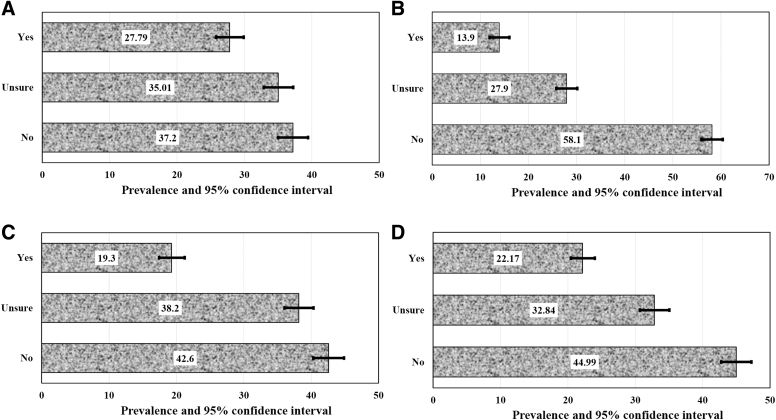
Misinformation about coronavirus disease 2019 (COVID-19) is a significant threat to global public health because it can inadvertently exacerbate public health challenges by promoting spread of the disease. This study used a convenience sampling technique to examine factors associated with misinformation about COVID-19 in sub-Saharan Africa using an online cross-sectional survey. A link to the online self-administered questionnaire was distributed to 1,969 participants through social media platforms and the authors' email networks. Four false statements-informed by results from a pilot study-were included in the survey. The participants' responses were classified as "Agree," "Neutral," and "Disagree." A multinomial logistic regression was used to examine associated factors. Among those who responded to the survey, 19.3% believed that COVID-19 was designed to reduce world population, 22.2% thought the ability to hold your breath for 10 seconds meant that you do not have COVID-19, 27.8% believed drinking hot water flushes down the virus, and 13.9% thought that COVID-19 had little effect on Blacks compared with Whites. An average of 33.7% were unsure whether the 4 false statements were true. Multivariate analysis revealed that those who thought COVID-19 was unlikely to continue in their countries reported higher odds of believing in these 4 false statements. Other significant factors associated with belief in misinformation were age (older adults), employment status (unemployed), gender (female), education (bachelor's degree), and knowledge about the main clinical symptoms of COVID-19. Strategies to reduce the spread of false information about COVID-19 and other future pandemics should target these subpopulations, especially those with limited education. This will also enhance compliance with public health measures to reduce spread of further outbreaks.
关于 2019 年冠状病毒病(COVID-19)的错误信息是对全球公共卫生的重大威胁,因为它可能会通过促进疾病的传播而无意中加剧公共卫生挑战。本研究使用便利抽样技术,通过在线横断面调查研究了撒哈拉以南非洲地区与 COVID-19 错误信息相关的因素。通过社交媒体平台和作者的电子邮件网络向 1969 名参与者分发了在线自我管理问卷的链接。调查中包含了四项虚假陈述,这些陈述是根据一项试点研究的结果得出的。参与者的回答被归类为“同意”、“中立”和“不同意”。使用多项逻辑回归分析了相关因素。在回应调查的人中,有 19.3%的人认为 COVID-19 是为了减少世界人口而设计的,22.2%的人认为能憋气 10 秒钟意味着你没有 COVID-19,27.8%的人认为喝热水可以冲走病毒,13.9%的人认为 COVID-19对黑人的影响比对白人的影响小。平均有 33.7%的人不确定这四项陈述是否属实。多变量分析显示,那些认为 COVID-19不太可能在其国家继续存在的人更有可能相信这四项错误陈述。与相信错误信息相关的其他重要因素包括年龄(老年人)、就业状况(失业)、性别(女性)、教育程度(学士学位)和对 COVID-19 主要临床症状的了解。减少 COVID-19 及未来大流行错误信息传播的策略应针对这些亚人群,尤其是那些受教育程度有限的人群。这也将提高遵守公共卫生措施的程度,以减少进一步爆发的风险。