School of Psychology, University of Adelaide, Adelaide, SA, 5000, Australia.
Health & Biosecurity, Commonwealth Scientific & Industrial Research Organisation (CSIRO), Adelaide, SA, 5000, Australia.
BMC Psychol. 2021 Feb 19;9(1):32. doi: 10.1186/s40359-021-00533-6.
Strict adherence to masculine norms has been associated with deleterious consequences for the physical and mental health of men. However, population-based research is lacking, and it remains unclear whether ageing influences adherence to masculine norms and the extent to which mental health problems like depression are implicated.
This study reports on data from 14,516 males aged 15-55 years who participated in Wave 1 of the Australian Longitudinal Study of Male Health (Ten to Men). Group differences in self-reported conformity to masculine norms (CMNI-22), current depressive symptoms (PHQ-9), and self-reported 12-month depression history were examined for males aged 15-17 years, 18-25 years, 26-35 years, 36-50 years, and 51-55 years. Generalised linear models were used to examine the relationships between these variables across age groups.
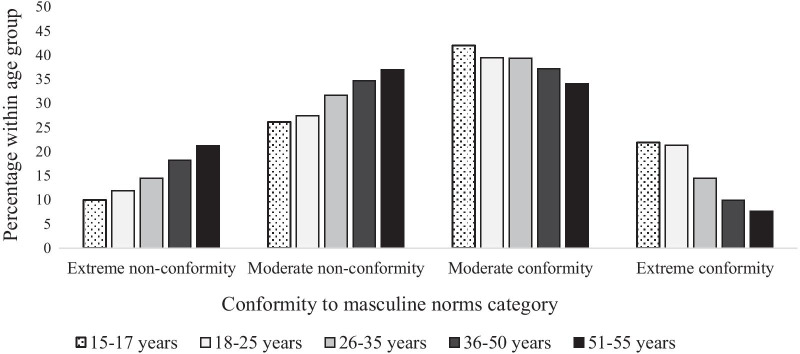
Conformity to masculine norms decreased significantly with age. However, models predicting depression generally showed that higher conformity to masculine norms was associated with an increased risk of current depressive symptoms, especially in the oldest age group. Conversely, higher conformity was associated with a decreased likelihood of a self-reported 12-month depression history, although nuances were present between age groups, such that this trend was not evident in the oldest age group.
Findings provide important insights into the complex relationship between conformity to masculine norms and depressive symptoms across the lifespan and further highlight the importance of mental health campaigns that address the complexities of gendered help-seeking behaviour for men.
严格遵守男性规范与男性身心健康的有害后果有关。然而,缺乏基于人群的研究,目前尚不清楚衰老是否会影响对男性规范的遵守程度,以及心理健康问题(如抑郁症)在多大程度上与之相关。
本研究报告了 14516 名 15-55 岁男性参加澳大利亚男性健康纵向研究(从 10 岁到 50 岁)第 1 波的数据。对于 15-17 岁、18-25 岁、26-35 岁、36-50 岁和 51-55 岁的男性,检查了自我报告的男性规范遵从度(CMNI-22)、当前抑郁症状(PHQ-9)和自我报告的 12 个月抑郁史的组间差异。使用广义线性模型检验了这些变量在年龄组之间的关系。
对男性规范的遵从度随着年龄的增长而显著下降。然而,预测抑郁的模型通常表明,较高的男性规范遵从度与当前抑郁症状的风险增加有关,尤其是在年龄最大的组。相反,较高的遵从度与自我报告的 12 个月抑郁史的可能性降低有关,尽管在年龄组之间存在细微差别,例如这种趋势在年龄最大的组中并不明显。
研究结果提供了重要的见解,阐明了男性规范遵从度和抑郁症状之间在整个生命周期中的复杂关系,并进一步强调了心理健康运动的重要性,这些运动解决了男性寻求帮助的性别复杂行为。