Tsumura Kampo Research Laboratories, Tsumura & Co., Ibaraki, Japan.
Sotobo Children's Clinic, Medical Corporation Shigyo-No-Kai, Isumi, Chiba, Japan.
Sci Rep. 2021 Feb 19;11(1):4232. doi: 10.1038/s41598-021-82707-1.
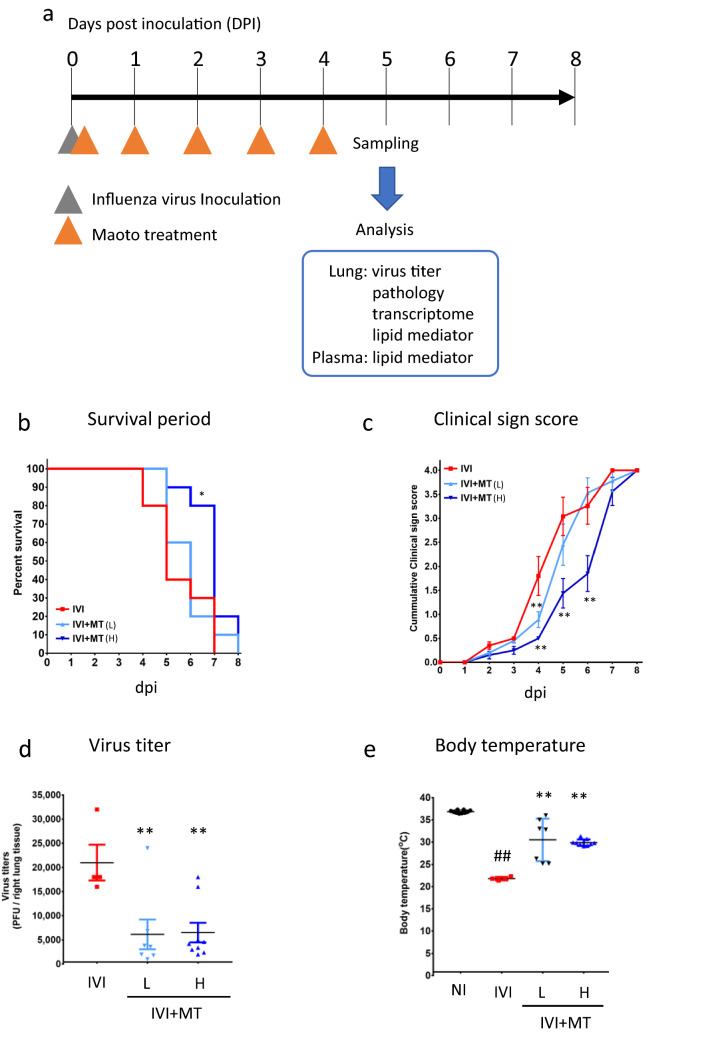
Maoto, a traditional kampo medicine, has been clinically prescribed for influenza infection and is reported to relieve symptoms and tissue damage. In this study, we evaluated the effects of maoto as an herbal multi-compound medicine on host responses in a mouse model of influenza infection. On the fifth day of oral administration to mice intranasally infected with influenza virus [A/PR/8/34 (H1N1)], maoto significantly improved survival rate, decreased viral titer, and ameliorated the infection-induced phenotype as compared with control mice. Analysis of the lung and plasma transcriptome and lipid mediator metabolite profile showed that maoto altered the profile of lipid mediators derived from ω-6 and ω-3 fatty acids to restore a normal state, and significantly up-regulated the expression of macrophage- and T-cell-related genes. Collectively, these results suggest that maoto regulates the host's inflammatory response by altering the lipid mediator profile and thereby ameliorating the symptoms of influenza.
麻黄作为一种传统的汉方药,已被临床用于流感感染的治疗,并被报道能缓解症状和组织损伤。在这项研究中,我们评估了麻黄作为一种草药复方药物对流感病毒感染小鼠模型中宿主反应的影响。在感染流感病毒 [A/PR/8/34 (H1N1)] 的小鼠给予麻黄口服 5 天后,与对照组小鼠相比,麻黄显著提高了生存率,降低了病毒滴度,并改善了感染引起的表型。对肺和血浆转录组以及脂质介质代谢产物谱的分析表明,麻黄改变了源自 ω-6 和 ω-3 脂肪酸的脂质介质谱,使其恢复正常状态,并显著上调了巨噬细胞和 T 细胞相关基因的表达。总之,这些结果表明,麻黄通过改变脂质介质谱来调节宿主的炎症反应,从而改善流感症状。