Chen Huanhuan, Li Xuelian, Ma Hui, Zheng Wei, Shen Xiaoli
Department of Epidemiology and Health Statistics, Medical School of Qingdao University, Qingdao, China.
School of Health Sciences, Purdue University, West Lafayette, IN, United States.
Front Neurosci. 2021 Jan 28;15:621173. doi: 10.3389/fnins.2021.621173. eCollection 2021.
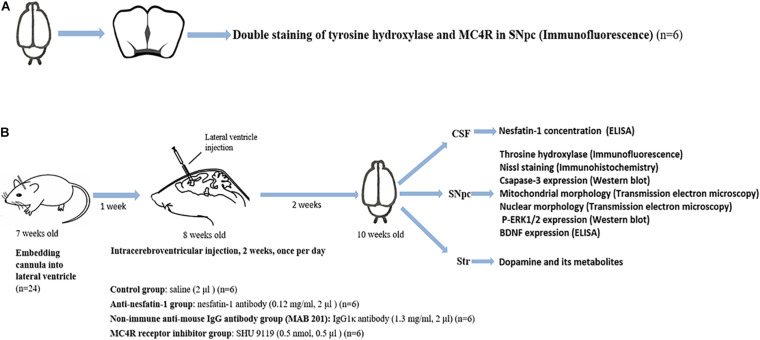
Nesfatin-1 is one of several brain-gut peptides that have a close relationship with the central dopaminergic system. Our previous studies have shown that nesfatin-1 is capable of protecting nigral dopaminergic neurons against 1-methyl-4-phenyl-1,2,3,6-tetrahydropyridine (MPTP)-induced neurotoxicity. A recent study also revealed a reduced blood level of nesfatin-1 in patients with Parkinson's disease (PD). The current study was designed to investigate whether reduced nesfatin-1 in cerebrospinal fluid (CSF) induces nigrostriatal system degeneration. An intra-cerebroventricular (ICV) injection technique was used to administer anti-nesfatin-1 antibody directly into the lateral ventricle of the brain. Enzyme-linked immunosorbent assay (ELISA) results showed that ICV injection of anti-nesfatin-1 antibody into the lateral ventricle of the brain once daily for 2 weeks caused a significant reduction in nesfatin-1 levels in the CSF (93.1%). Treatment with anti-nesfatin-1 antibody resulted in a substantial loss (23%) of TH-positive (TH+) dopaminergic neurons in the substantia nigra pars compacta (SNpc), as shown by immunofluorescence staining, a depletion in dopamine and its metabolites in the striatum detected by high-performance liquid chromatography (HPLC), and obvious nuclear shrinkage and mitochondrial lesions in dopaminergic neurons in the SNpc detected by transmission electron microscopy (TEM). Furthermore, the results from our Western blot and ELISA experiments demonstrated that anti-nesfatin-1 antibody injection induced an upregulation of caspase-3 activation, increased the expression of -ERK, and elevated brain-derived neurotrophic factor (BDNF) levels in the SNpc. Taken together, these observations suggest that reduced nesfatin-1 in the brain may induce nigrostriatal dopaminergic system degeneration; this effect may be mediated mitochondrial dysfunction-related apoptosis. Our data support a role of nesfatin-1 in maintaining the normal physiological function of the nigrostriatal dopaminergic system.
Nesfatin-1是几种与中枢多巴胺能系统密切相关的脑-肠肽之一。我们之前的研究表明,Nesfatin-1能够保护黑质多巴胺能神经元免受1-甲基-4-苯基-1,2,3,6-四氢吡啶(MPTP)诱导的神经毒性。最近一项研究还显示,帕金森病(PD)患者血液中Nesfatin-1水平降低。本研究旨在调查脑脊液(CSF)中Nesfatin-1减少是否会导致黑质纹状体系统退化。采用脑室内(ICV)注射技术将抗Nesfatin-1抗体直接注入脑侧脑室。酶联免疫吸附测定(ELISA)结果显示,每天一次向脑侧脑室注射抗Nesfatin-1抗体,持续2周,可导致CSF中Nesfatin-1水平显著降低(93.1%)。免疫荧光染色显示,用抗Nesfatin-1抗体治疗导致黑质致密部(SNpc)中TH阳性(TH+)多巴胺能神经元大量丢失(23%);高效液相色谱(HPLC)检测显示纹状体中多巴胺及其代谢产物减少;透射电子显微镜(TEM)检测显示SNpc中多巴胺能神经元出现明显核皱缩和线粒体损伤。此外,我们的蛋白质免疫印迹和ELISA实验结果表明,注射抗Nesfatin-1抗体可诱导caspase-3激活上调,增加-ERK表达,并提高SNpc中脑源性神经营养因子(BDNF)水平。综上所述,这些观察结果表明,脑中Nesfatin-1减少可能会导致黑质纹状体多巴胺能系统退化;这种作用可能是由线粒体功能障碍相关的细胞凋亡介导的。我们的数据支持Nesfatin-1在维持黑质纹状体多巴胺能系统正常生理功能中的作用。