Schneider Julio V, Paule Juraj, Jungcurt Tanja, Cardoso Domingos, Amorim André Márcio, Berberich Thomas, Zizka Georg
Department of Botany and Molecular Evolution, Senckenberg Research Institute and Natural History Museum Frankfurt, Frankfurt am Main, Germany.
Entomology III, Department of Terrestrial Zoology, Senckenberg Research Institute and Natural History Museum Frankfurt, Frankfurt am Main, Germany.
Front Plant Sci. 2021 Feb 4;12:638650. doi: 10.3389/fpls.2021.638650. eCollection 2021.
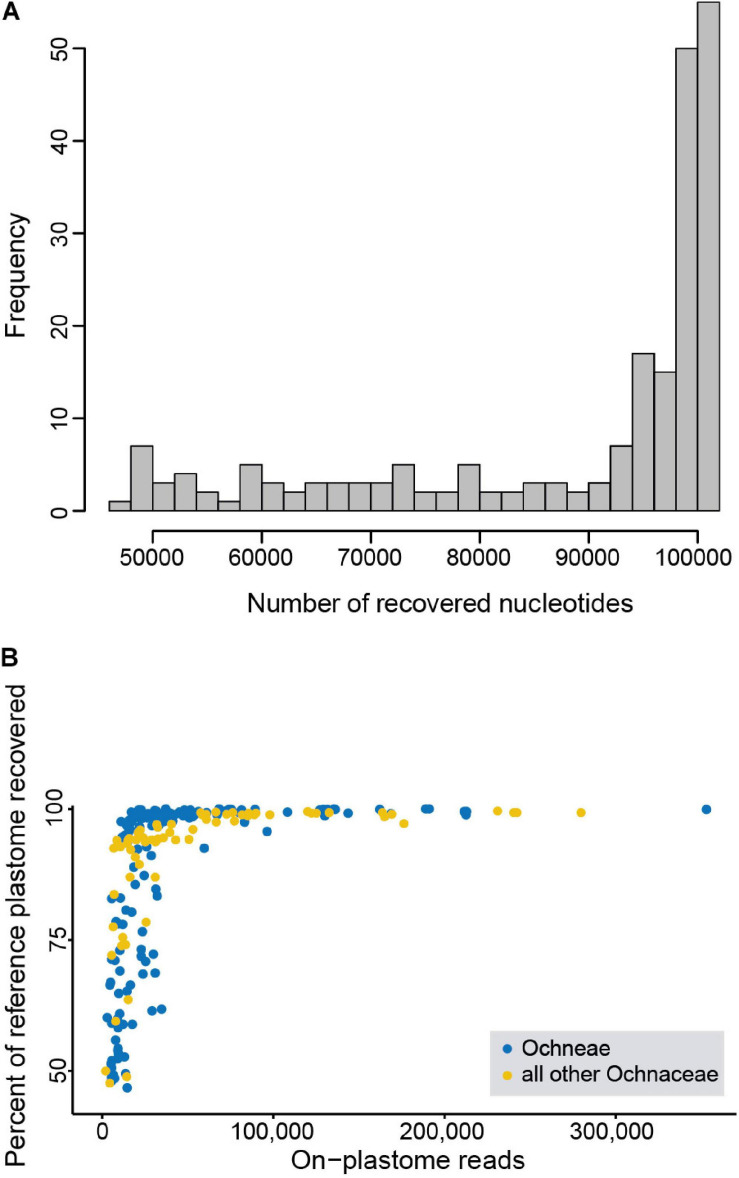
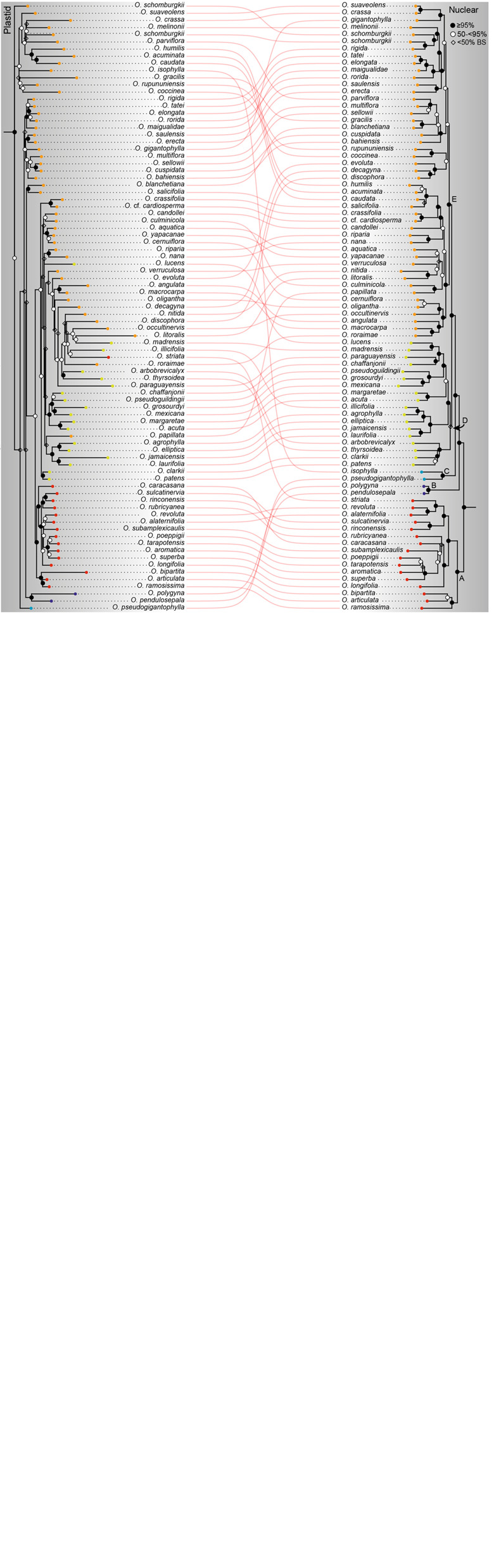
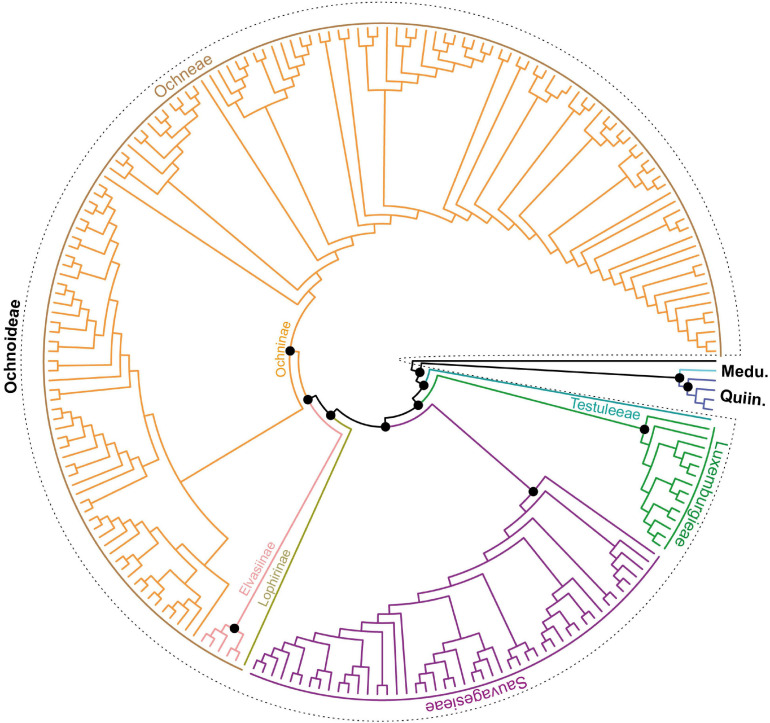
Plastid DNA sequence data have been traditionally widely used in plant phylogenetics because of the high copy number of plastids, their uniparental inheritance, and the blend of coding and non-coding regions with divergent substitution rates that allow the reconstruction of phylogenetic relationships at different taxonomic ranks. In the present study, we evaluate the utility of the plastome for the reconstruction of phylogenetic relationships in the pantropical plant family Ochnaceae (Malpighiales). We used the off-target sequence read fraction of a targeted sequencing study (targeting nuclear loci only) to recover more than 100 kb of the plastid genome from the majority of the more than 200 species of Ochnaceae and all but two genera using and reference-based assembly strategies. Most of the recalcitrant nodes in the family's backbone were resolved by our plastome-based phylogenetic inference, corroborating the most recent classification system of Ochnaceae and findings from a phylogenomic study based on nuclear loci. Nonetheless, the phylogenetic relationships within the major clades of tribe Ochnineae, which comprise about two thirds of the family's species diversity, received mostly low support. Generally, the phylogenetic resolution was lowest at the infrageneric level. Overall there was little phylogenetic conflict compared to a recent analysis of nuclear loci. Effects of taxon sampling were invoked as the most likely reason for some of the few well-supported discords. Our study demonstrates the utility of the off-target fraction of a target enrichment study for assembling near-complete plastid genomes for a large proportion of samples.
由于质体的高拷贝数、单亲遗传以及编码区和非编码区的混合,其替换率不同,能够重建不同分类等级的系统发育关系,因此质体DNA序列数据在植物系统发育学中一直被广泛使用。在本研究中,我们评估了质体基因组在泛热带植物金莲木科(金虎尾目)系统发育关系重建中的作用。我们利用一项靶向测序研究(仅靶向核基因座)的脱靶序列读取片段,采用基于参考序列的组装策略,从金莲木科200多种植物中的大多数以及除两个属之外的所有属中获得了超过100 kb的质体基因组。我们基于质体基因组的系统发育推断解决了该科主干中大多数难以解决的节点,证实了金莲木科最新的分类系统以及基于核基因座的系统基因组学研究结果。尽管如此,包含该科约三分之二物种多样性的金莲木族主要分支内的系统发育关系大多支持率较低。一般来说,在属内水平上系统发育分辨率最低。总体而言,与最近对核基因座的分析相比,系统发育冲突较少。分类群抽样的影响被认为是少数几个得到充分支持的不一致情况的最可能原因。我们的研究证明了目标富集研究的脱靶部分在为大部分样本组装近乎完整的质体基因组方面的作用。