Qin Qiao, Fan Fang-Fang, Liu Meng-Yuan, Liu Bo, Jia Jia, Zhang Long, Li Yu-Xi, Jiang Yi-Meng, Sun Peng-Fei, He Dan-Mei, Li Jian-Ping, Chen Ming, Zheng Bo, Zhang Yan
Department of Cardiology, Institute of Cardiovascular Disease, Peking University First Hospital, Beijing, China.
J Geriatr Cardiol. 2021 Jan 28;18(1):39-46. doi: 10.11909/j.issn.1671-5411.2021.01.003.
Arterial stiffness, as assessed by aortic ultrasound and pulse wave velocity, is associated with incident hypertension. However, there is still no consensus on whether the augmentation index (AI) affects new onset of hypertension. This study investigated the relationship of radial AI (rAI) and incident hypertension in a Chinese community-based population without hypertension at baseline.
A total of 1,615 Chinese non-hypertensive participants from an atherosclerosis cohort in Beijing, China were included in our analysis. Baseline rAI normalized to heart rate of 75 beats/min (rAIp75) was obtained using HEM-9000AI. New-onset hypertension was defined as blood pressure ≥ 140/90 mmHg or self-reported hypertension or taking anti-hypertensive medications at the follow up survey. Multivariate regression models were used to evaluate the impact of rAIp75 on the risk of new-onset hypertension.
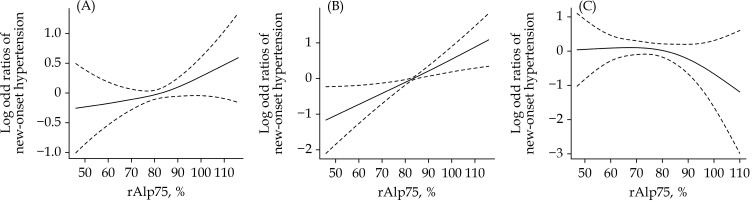
After a mean 2.35-year follow-up, 213 (13.19%) participants developed incident hypertension. No significant relation between rAIp75 and incident hypertension was observed in the whole population after adjustment for possible confounders (adjusted odds ratio (OR) and 95% confidence interval (CI): 1.09 [0.95-1.27]; = 0.2260). However, rAIp75 was significantly associated with incident hypertension in women, but not in men (adjusted OR and 95% CI: 1.29 [1.06-1.56], = 0.0113 for women; 0.91 [0.72-1.15], = 0.4244 for men; for interaction = 0.0133).
Sex modified the effect of the rAI on incident hypertension in a Chinese, community-based, non-hypertensive population. Screening of the rAI could be considered in women with a high risk of hypertension for the purpose of primary intervention.
通过主动脉超声和脉搏波速度评估的动脉僵硬度与高血压发病相关。然而,关于增强指数(AI)是否影响高血压的新发仍未达成共识。本研究在一个基线时无高血压的中国社区人群中,调查了桡动脉AI(rAI)与高血压发病的关系。
我们的分析纳入了来自中国北京一个动脉粥样硬化队列的1615名中国非高血压参与者。使用HEM - 9000AI获得心率为75次/分钟时标准化的基线rAI(rAIp75)。新发高血压定义为在随访调查时血压≥140/90 mmHg或自我报告有高血压或正在服用抗高血压药物。采用多变量回归模型评估rAIp75对新发高血压风险的影响。
经过平均2.35年的随访,213名(13.19%)参与者发生了新发高血压。在调整可能的混杂因素后,在整个人群中未观察到rAIp75与新发高血压之间存在显著关系(调整后的比值比(OR)和95%置信区间(CI):1.09 [0.95 - 1.27];P = 0.2260)。然而,rAIp75与女性新发高血压显著相关,但与男性无关(调整后的OR和95% CI:女性为1.29 [1.06 - 1.56],P = 0.0113;男性为0.91 [0.72 - 1.15],P = 0.4244;交互作用P = 0.0133)。
在一个中国社区非高血压人群中,性别改变了rAI对新发高血压的影响。对于高血压高危女性,为了进行一级干预,可以考虑筛查rAI。