Department of Orthopedics, The Second Xiangya Hospital, Central South University, Changsha, Hunan 410011, China.
Ningxia Geriatric Disease Clinical Research Center, People's Hospital of Ningxia Hui Autonomous Region, Yinchuan, Ningxia Hui Autonomous Region 750001, China.
Biomed Res Int. 2021 Feb 2;2021:6663003. doi: 10.1155/2021/6663003. eCollection 2021.
Osteoarthritis (OA) is the most common degenerative joint disease, causing joint pain, stiffness, and even disability. Guidelines recommend intra-articular injections as an alternative treatment to relieve OA symptoms for patients who demonstrate poor tolerability or compliance to oral administration of drugs. Mesenchymal stem cells (MSCs) are a potential treatment for of OA. We conducted this network meta-analysis to comprehensively compare the efficacy and safety between hyaluronic acid (HA), corticosteroids (GCs), platelet-rich plasma (PRP), and MSCs.
Systematic review and Bayesian network meta-analysis. . Relevant studies, published from January 2000 to January 2020, in the PubMed, Cochrane library, EMBASE, and CKNI databases.
Bayesian network and conventional meta-analyses were conducted. Pain relief, functional improvement, improvement in joint stiffness, and risk of adverse effects (AEs) were assessed.
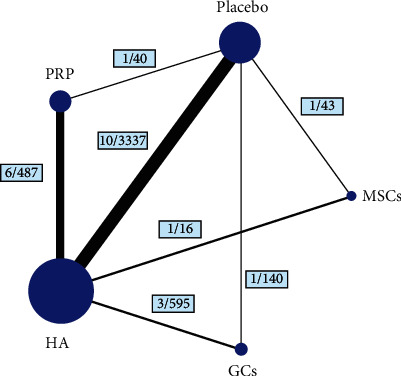
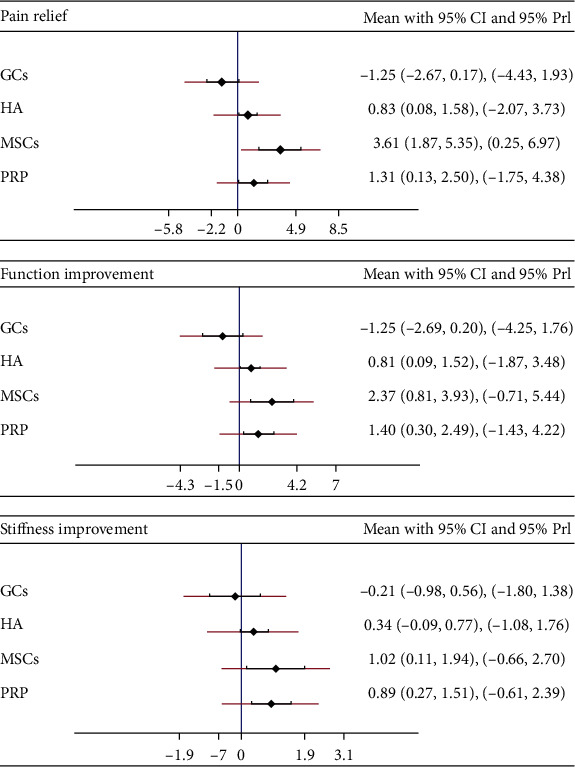
Twenty-five articles with 4642 patients were included. Overall, MSC therapy was the most effective treatment for pain relief (standardized mean difference compared with placebo = 3.61, 95% CI [1.87 to 5.35]). Both MSC and PRP therapies improved every symptom of OA effectively and have an advantage over HA and GCs which are recommended by guidelines. MSCs, PRP, HA, and GCs are tolerated well for patients in long-term treatment of OA compared with placebo.
The results show that MSCs relieve pain, stiffness, and dysfunction due to OA better than PRP, HA, and GCs and are not statistically correlated with greater safety concerns. More high-quality trials are needed to reconfirm the findings of this study, however, standardization of preparation of MSCs and PRP should be investigated in the future.
骨关节炎(OA)是最常见的退行性关节疾病,可导致关节疼痛、僵硬,甚至残疾。指南建议,对于口服药物不耐受或不依从的患者,关节内注射是一种替代治疗方法,可缓解 OA 症状。间充质干细胞(MSCs)是 OA 的一种潜在治疗方法。我们进行了这项网络荟萃分析,以全面比较透明质酸(HA)、皮质类固醇(GCs)、富血小板血浆(PRP)和 MSCs 之间的疗效和安全性。
系统评价和贝叶斯网络荟萃分析。检索了 2000 年 1 月至 2020 年 1 月期间PubMed、Cochrane 图书馆、EMBASE 和 CKNI 数据库中相关研究。
进行了贝叶斯网络和常规荟萃分析。评估了疼痛缓解、功能改善、关节僵硬改善和不良反应(AEs)风险。
纳入了 25 项研究,共 4642 名患者。总体而言,MSC 治疗是最有效的疼痛缓解治疗方法(与安慰剂相比的标准化均数差=3.61,95%CI[1.87 至 5.35])。MSC 和 PRP 治疗均能有效改善 OA 的所有症状,且优于指南推荐的 HA 和 GCs。与安慰剂相比,MSC、PRP、HA 和 GCs 在长期治疗 OA 时对患者的耐受性良好。
结果表明,MSC 缓解疼痛、僵硬和功能障碍的效果优于 PRP、HA 和 GCs,且与更大的安全性问题无统计学相关性。然而,需要更多高质量的试验来证实本研究的结果,但是,未来应调查 MSC 和 PRP 制剂的标准化。