Qin Yixiao, Zheng Xiwang, Gao Wei, Wang Binquan, Wu Yongyan
Shanxi Key Laboratory of Otorhinolaryngology Head and Neck Cancer, First Hospital of Shanxi Medical University, Taiyuan 030001, Shanxi, China.
Department of Otolaryngology Head & Neck Surgery, First Hospital of Shanxi Medical University, Taiyuan 030001, Shanxi, China.
Mol Ther Oncolytics. 2021 Jan 21;20:342-351. doi: 10.1016/j.omto.2021.01.011. eCollection 2021 Mar 26.
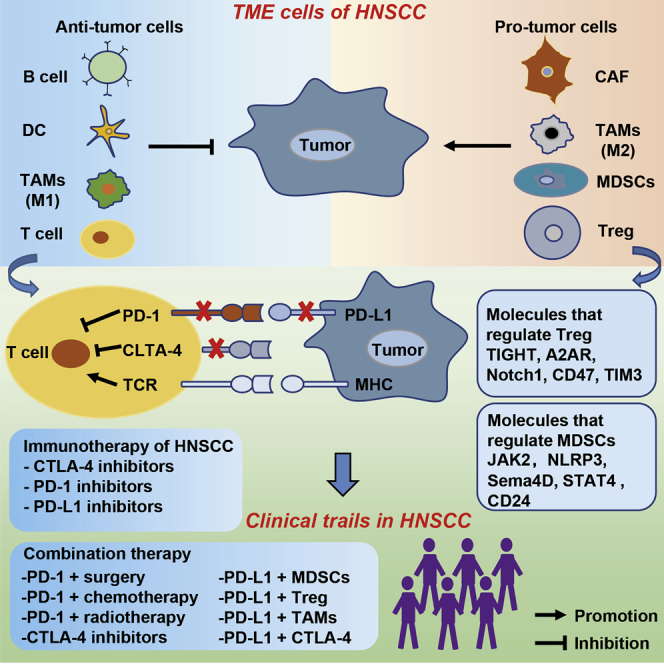
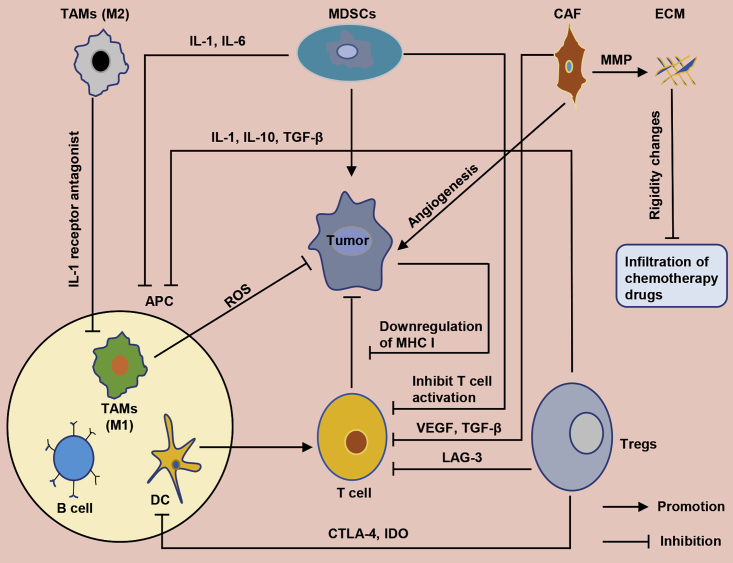
Head and neck squamous cell carcinomas (HNSCCs) are a type of common malignant tumor, mainly manifesting as oropharyngeal, oral cavity, laryngopharyngeal, hypopharyngeal, and laryngeal cancers. These highly aggressive malignant tumors reportedly affect more than 830,000 patients worldwide every year. Currently, the main treatments for HNSCC include surgery, radiotherapy, chemotherapy, and immunotherapy, as well as combination therapy. However, the overall 5-year survival rate of HNSCC has remained 50%, and it has not significantly improved in the past 10 years. Previous studies have shown that the tumor microenvironment (TME) plays a crucial role in the recurrence, metastasis, and drug resistance of patients with HNSCC. In this review, we summarize the role of anti-tumor and pro-tumor immune cells, as well as extracellular components in the TME of HNSCC. We also discuss classical HNSCC immunotherapy and highlight examples of clinical trials using CTLA-4 inhibitors and programmed cell death 1 (PD-1)/programmed cell death ligand 1 (PD-L1)-related combination therapies. We also outline some molecules in the TME known to regulate immunosuppressive cells. Furthermore, the role and underlying mechanism of radiation therapy on the TME, immune cells, and immune response are discussed.
头颈部鳞状细胞癌(HNSCC)是一种常见的恶性肿瘤,主要表现为口咽癌、口腔癌、喉咽癌、下咽癌和喉癌。据报道,这些侵袭性很强的恶性肿瘤每年在全球影响超过83万名患者。目前,HNSCC的主要治疗方法包括手术、放疗、化疗和免疫疗法,以及联合治疗。然而,HNSCC的总体5年生存率一直维持在50%,在过去10年中并未显著提高。以往的研究表明,肿瘤微环境(TME)在HNSCC患者的复发、转移和耐药性中起着关键作用。在这篇综述中,我们总结了抗肿瘤和促肿瘤免疫细胞以及细胞外成分在HNSCC的TME中的作用。我们还讨论了经典的HNSCC免疫疗法,并重点介绍了使用细胞毒性T淋巴细胞相关抗原4(CTLA-4)抑制剂和程序性细胞死亡蛋白1(PD-1)/程序性细胞死亡配体1(PD-L1)相关联合疗法的临床试验实例。我们还概述了TME中一些已知可调节免疫抑制细胞的分子。此外,还讨论了放射治疗对TME、免疫细胞和免疫反应的作用及潜在机制。