Okafor Chukwuemeka N, Li Michael, Paltzer Jason
Department of Public Health, Robbins College of Health and Human Sciences, Baylor University, One Bear Place #97343, Waco, TX, 76798, USA.
Department of Family Medicine, David Geffen School of Medicine, University of California, 10833 Le Conte Avenue, Los Angeles, CA, 90095, USA.
Brain Behav Immun Health. 2020 Aug;7. doi: 10.1016/j.bbih.2020.100109. Epub 2020 Jul 23.
Cannabis is among the most frequently used substance in United States (U.S.). Studies evaluating the association between cannabis use and inflammation in humans have been few and have not explored potential sex-dependent effects.
To examine the relationship between self-reported cannabis use and high-sensitivity C-reactive protein (hsCRP), Interleukin 6 (IL-6) and fibrinogen.
We used Wave 1 of the Population Assessment of Tobacco and Health (PATH) - a nationally representative sample of adults in the U.S. Weighted linear regression models were used to determine associations of self-reported cannabis use with natural log-transformed hs-CRP, IL-6 and fibrinogen adjusting for sociodemographic and psychosocial factors.
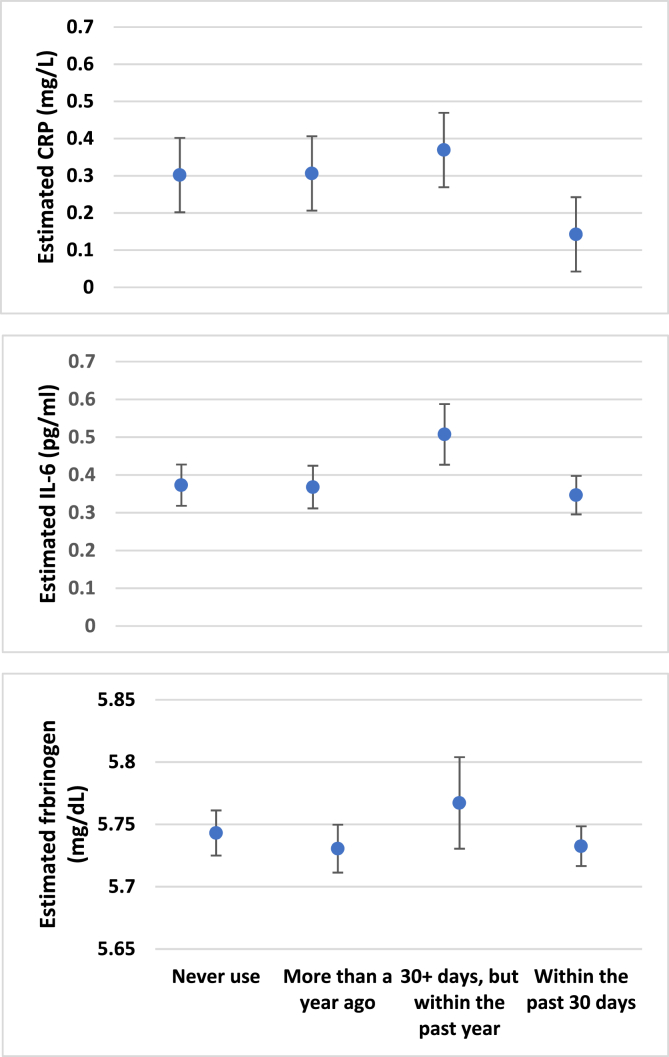
Self-reported cannabis use, particularly cannabis use within the past 30 days, was associated with lower levels of each biomarker of systemic inflammation, although findings were imprecise. Specifically, in multivariable models, the associations between respondents who self-reported cannabis use in the past 30 days compared to never use was imprecise for hs-CRP (β= -0.15, 95% confidence interval (CI): -0.32, 0.00), IL-6 (β= - 0.02, 95% CI: -0.10, 0.05) and fibrinogen (β= - 0.01, 95% CI: -0.04, 0.02). We did not find that these associations differed significantly by sex.
Data from this nationally representative study suggest potential anti-inflammatory effects of recent cannabis use. Additional studies that biologically measure the THC and CBD concentrations of the cannabis used and employ prospective and or experimental study designs investigate cannabis and inflammation associations are needed.
大麻是美国使用最频繁的物质之一。评估大麻使用与人类炎症之间关联的研究较少,且尚未探讨潜在的性别依赖性影响。
研究自我报告的大麻使用与高敏C反应蛋白(hsCRP)、白细胞介素6(IL-6)和纤维蛋白原之间的关系。
我们使用了烟草与健康人口评估(PATH)的第1波数据——美国成年人的全国代表性样本。加权线性回归模型用于确定自我报告的大麻使用与经自然对数转换的hs-CRP、IL-6和纤维蛋白原之间的关联,并对社会人口统计学和心理社会因素进行调整。
自我报告的大麻使用,尤其是过去30天内的大麻使用与全身炎症的每种生物标志物水平较低有关,尽管结果并不精确。具体而言,在多变量模型中,过去30天内自我报告使用大麻的受访者与从未使用者相比,hs-CRP(β=-0.15,95%置信区间(CI):-0.32,0.00)、IL-6(β=-0.02,95%CI:-0.10,0.05)和纤维蛋白原(β=-0.01,95%CI:-0.04,0.02)之间的关联并不精确。我们没有发现这些关联在性别上有显著差异。
这项全国代表性研究的数据表明近期使用大麻可能具有抗炎作用。需要进一步的研究,从生物学角度测量所使用大麻的四氢大麻酚(THC)和大麻二酚(CBD)浓度,并采用前瞻性和/或实验性研究设计来调查大麻与炎症的关联。