Department of Biological, Geological and Environmental Sciences, University of Bologna, Bologna, Italy.
Department of Integrative Biology, University of Texas at Austin, Austin, TX, USA.
Mol Biol Evol. 2021 May 19;38(6):2597-2614. doi: 10.1093/molbev/msab054.
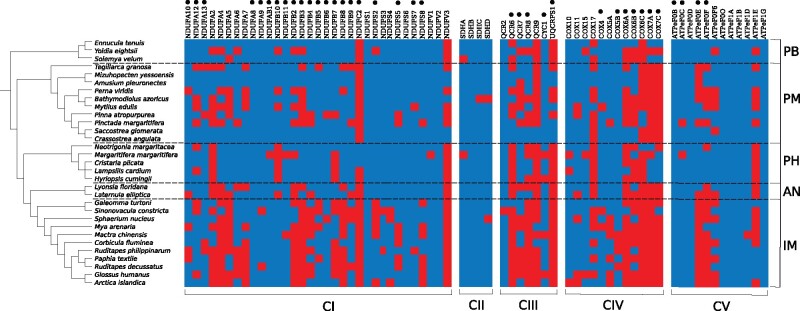
In Metazoa, four out of five complexes involved in oxidative phosphorylation (OXPHOS) are formed by subunits encoded by both the mitochondrial (mtDNA) and nuclear (nuDNA) genomes, leading to the expectation of mitonuclear coevolution. Previous studies have supported coadaptation of mitochondria-encoded (mtOXPHOS) and nuclear-encoded OXPHOS (nuOXPHOS) subunits, often specifically interpreted with regard to the "nuclear compensation hypothesis," a specific form of mitonuclear coevolution where nuclear genes compensate for deleterious mitochondrial mutations due to less efficient mitochondrial selection. In this study, we analyzed patterns of sequence evolution of 79 OXPHOS subunits in 31 bivalve species, a taxon showing extraordinary mtDNA variability and including species with "doubly uniparental" mtDNA inheritance. Our data showed strong and clear signals of mitonuclear coevolution. NuOXPHOS subunits had concordant topologies with mtOXPHOS subunits, contrary to previous phylogenies based on nuclear genes lacking mt interactions. Evolutionary rates between mt and nuOXPHOS subunits were also highly correlated compared with non-OXPHO-interacting nuclear genes. Nuclear subunits of chimeric OXPHOS complexes (I, III, IV, and V) also had higher dN/dS ratios than Complex II, which is formed exclusively by nuDNA-encoded subunits. However, we did not find evidence of nuclear compensation: mitochondria-encoded subunits showed similar dN/dS ratios compared with nuclear-encoded subunits, contrary to most previously studied bilaterian animals. Moreover, no site-specific signals of compensatory positive selection were detected in nuOXPHOS genes. Our analyses extend the evidence for mitonuclear coevolution to a new taxonomic group, but we propose a reconsideration of the nuclear compensation hypothesis.
在原生动物中,参与氧化磷酸化(OXPHOS)的五个复合物中有四个是由线粒体(mtDNA)和核(nuDNA)基因组编码的亚基组成的,这导致了预期的线粒体-核协同进化。先前的研究支持线粒体编码(mtOXPHOS)和核编码 OXPHOS(nuOXPHOS)亚基的共适应,通常具体解释为“核补偿假说”,这是一种特殊形式的线粒体-核协同进化,其中核基因由于线粒体选择效率较低而补偿有害的线粒体突变。在这项研究中,我们分析了 31 种双壳类物种中 79 个 OXPHOS 亚基的序列进化模式,该分类群显示出非凡的 mtDNA 变异性,包括具有“双重单亲遗传”mtDNA 遗传的物种。我们的数据显示了强烈而明显的线粒体-核协同进化信号。与基于缺乏 mt 相互作用的核基因的先前系统发育相比,nuOXPHOS 亚基与 mtOXPHOS 亚基具有一致的拓扑结构。与非 OXPHOS 相互作用的核基因相比,mt 和 nuOXPHOS 亚基之间的进化率也高度相关。嵌合 OXPHOS 复合物(I、III、IV 和 V)的核亚基的 dN/dS 比值也高于仅由 nuDNA 编码的亚基组成的复合物 II。然而,我们没有发现核补偿的证据:与大多数先前研究的两侧对称动物相比,线粒体编码的亚基与核编码的亚基具有相似的 dN/dS 比值。此外,在 nuOXPHOS 基因中没有检测到补偿性正选择的特定部位信号。我们的分析将线粒体-核协同进化的证据扩展到一个新的分类群,但我们建议重新考虑核补偿假说。