Sauer Molly, Vasudevan Prarthana, Meghani Ankita, Luthra Karuna, Garcia Cristina, Knoll Maria Deloria, Privor-Dumm Lois
International Vaccine Access Center, Department of International Health, Johns Hopkins Bloomberg School of Public Health, 415 N Washington St, 5(th) Floor, Baltimore, MD 21231 USA.
International Vaccine Access Center, Department of International Health, Johns Hopkins Bloomberg School of Public Health, 415 N Washington St, 5(th) Floor, Baltimore, MD 21231 USA.
Vaccine. 2021 Mar 12;39(11):1556-1564. doi: 10.1016/j.vaccine.2021.01.066. Epub 2021 Feb 19.
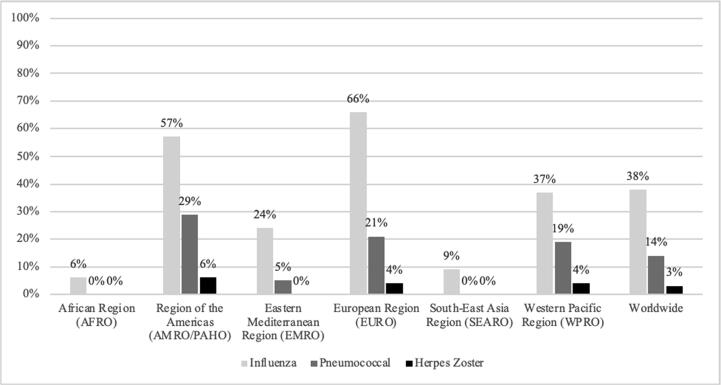
By 2050, the number of adults over 65 years of age will be double the under-5 population, and heavily concentrated in low- and middle-income countries. Population growth and increasing life expectancies call for effective healthy aging strategies inclusive of immunization to reduce the burden of vaccine-preventable diseases, improve quality of life, and mitigate antimicrobial resistance. Based on a review of available literature on the pneumococcal disease, influenza, and herpes zoster epidemiology and economic burden, and the health systems and policy barriers for adult immunization, we identified evidence gaps and considerations for prioritizing adult immunization. The body of evidence for adult immunization and the health and economic burden of adult disease is heavily concentrated in high-income countries. The few countries reporting adult immunization policies generally focus on high-risk groups. Despite robust child immunization programs in most countries, adult immunization programs and policies lag far behind and there is a general lack of appropriate delivery platforms. Global adult disease burden and economic costs are substantial but evidence from low- and middle-income countries is limited. There is a need for a strengthened evidence base and political commitment to drive a comprehensive, global technical consensus on adult immunization.
到2050年,65岁及以上成年人的数量将是5岁以下人口数量的两倍,且主要集中在低收入和中等收入国家。人口增长和预期寿命的增加要求制定有效的健康老龄化战略,包括免疫接种,以减轻疫苗可预防疾病的负担、提高生活质量并减轻抗菌药物耐药性。基于对有关肺炎球菌疾病、流感和带状疱疹流行病学及经济负担的现有文献,以及成人免疫接种的卫生系统和政策障碍的综述,我们确定了证据差距以及优先考虑成人免疫接种的因素。成人免疫接种的证据主体以及成人疾病的健康和经济负担主要集中在高收入国家。少数报告成人免疫接种政策的国家通常侧重于高危人群。尽管大多数国家都有强有力的儿童免疫接种计划,但成人免疫接种计划和政策却远远落后,而且普遍缺乏合适的实施平台。全球成人疾病负担和经济成本巨大,但来自低收入和中等收入国家的证据有限。需要加强证据基础并做出政治承诺,以推动就成人免疫接种达成全面的全球技术共识。