Jamotte Aurélien, Clay Emilie, Macabeo Bérengère, Caicedo Andrès, Lopez Juan Guillermo, Bricks Lucia, Romero Prada Martín, Marrugo Rubén, Alfonso Pamela, Moreno Arévalo Brechla, Franco Danilo, Garcia Diaz Lourdes, Isaza de Molto Yadira
a Creativ-Ceutical , Paris , France.
b Sanofi Pasteur , Lyon , France.
Hum Vaccin Immunother. 2017 Apr 3;13(4):877-888. doi: 10.1080/21645515.2016.1256928. Epub 2017 Jan 24.
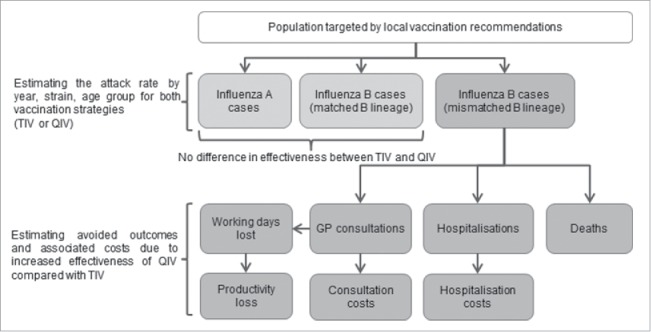
Annual trivalent influenza vaccines (TIV) containing 2 A strains and one B lineage have been recommended for the prevention of influenza in most of Latin American countries. However, the circulation of 2 B lineages (Victoria and Yamagata) and difficulties in predicting the predominating lineage have led to the development of quadrivalent influenza vaccines (QIV), including both B lineages. Thus, the objective was to estimate the public health impact and influenza-related costs if QIV would have been used instead of TIV in 3 Latin American countries. We used a static model over the seasons 2010-2014 in Brazil, 2007-2014 in Colombia and 2006-2014 in Panama, focusing on population groups targeted by local vaccination recommendations: young children, adults with risk factors and the elderly. In Brazil, between 2010 and 2014, using QIV instead of TIV would have avoided US$ 6,200 per 100,000 person-years in societal costs, based on 168 influenza cases, 89 consultations, 3.2 hospitalizations and 0.38 deaths per 100,000 person-years. In Colombia and Panama, these would have ranged from US$ 1,000 to 12,700 (based on 34 cases, 13-25 consultations, 0.6-8.9 hospitalizations and 0.04-1.74 deaths) and from US$ 3,000 to 33,700 (based on 113 cases, 55-82 consultations, 0.5-27.8 hospitalizations and 0.08-6.87 deaths) per 100,000 person-years, respectively. Overall, the broader protection offered by QIV would have reduced the influenza humanistic and economic burden in the 3 countries. Despite the lack of local data leading to several extrapolations, this study is the first to give quantitative estimates of the potential benefits of QIV in Latin America.
在大多数拉丁美洲国家,一直推荐使用含有两种甲型毒株和一种乙型谱系的三价流感疫苗(TIV)来预防流感。然而,两种乙型谱系(维多利亚和山形)的传播以及预测主导谱系的困难促使了四价流感疫苗(QIV)的研发,QIV包含了两种乙型谱系。因此,本研究的目的是评估在三个拉丁美洲国家,如果使用QIV而非TIV,其对公共卫生的影响以及与流感相关的成本。我们在巴西2010 - 2014年、哥伦比亚2007 - 2014年以及巴拿马2006 - 2014年的流感季节使用了静态模型,重点关注当地疫苗接种建议所针对的人群:幼儿、有风险因素的成年人以及老年人。在巴西,2010年至2014年期间,若使用QIV而非TIV,每10万人年的社会成本可避免6200美元,基于每10万人年有168例流感病例、89次门诊、3.2次住院和0.38例死亡。在哥伦比亚和巴拿马,每10万人年的成本分别在1000美元至12700美元(基于34例病例、13 - 25次门诊、0.6 - 8.9次住院和0.04 - 1.74例死亡)以及3000美元至33700美元(基于113例病例、55 - 82次门诊、0.5 - 27.8次住院和0.08 - 6.87例死亡)之间。总体而言,QIV提供的更广泛保护可减轻这三个国家流感的人文和经济负担。尽管缺乏当地数据导致进行了一些推断,但本研究首次对QIV在拉丁美洲的潜在益处给出了定量估计。