Department of Microbiology, College of Natural Sciences, Pusan National University, Busan 46241, Republic of Korea.
Microbiological Resource Research Institute, Pusan National University, Busan 46241, Republic of Korea.
J Microbiol Biotechnol. 2021 Mar 28;31(3):483-491. doi: 10.4014/jmb.2012.12036.
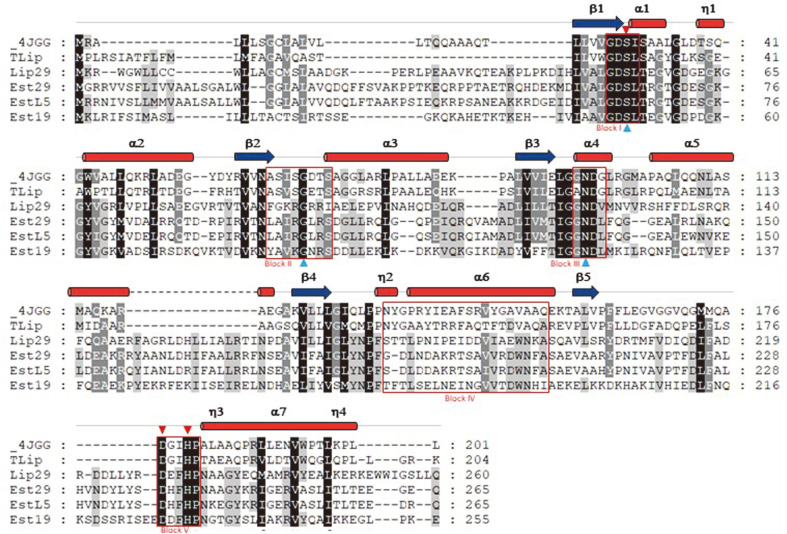
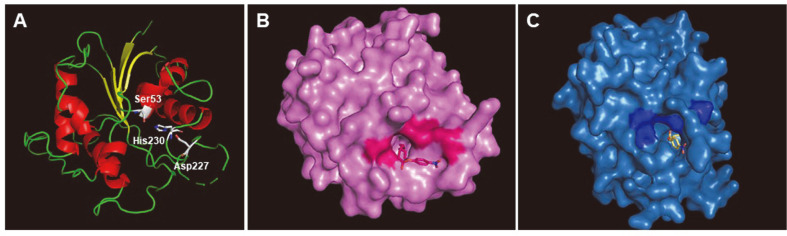
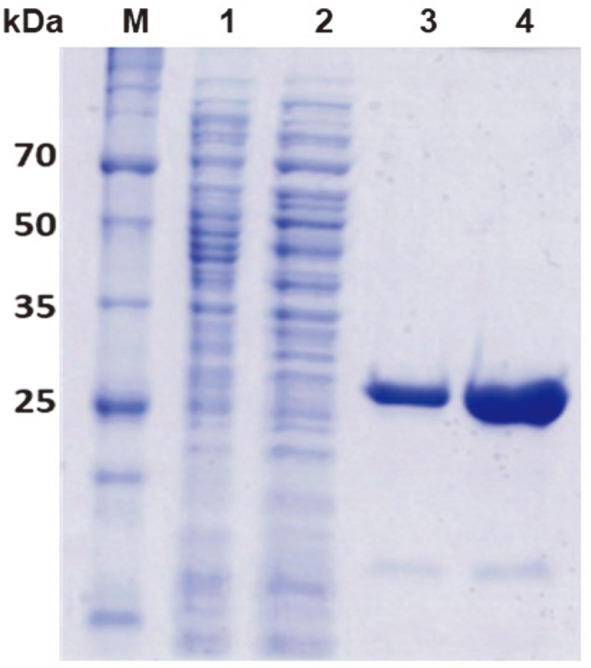
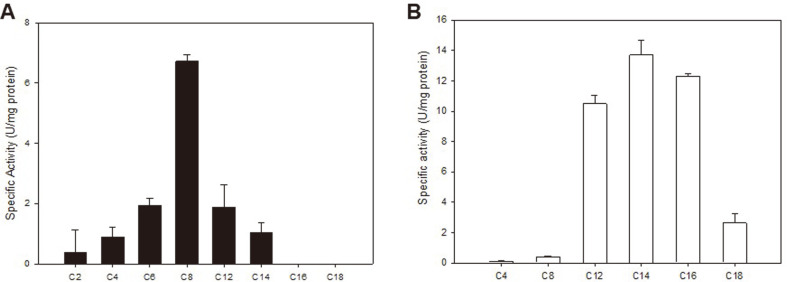
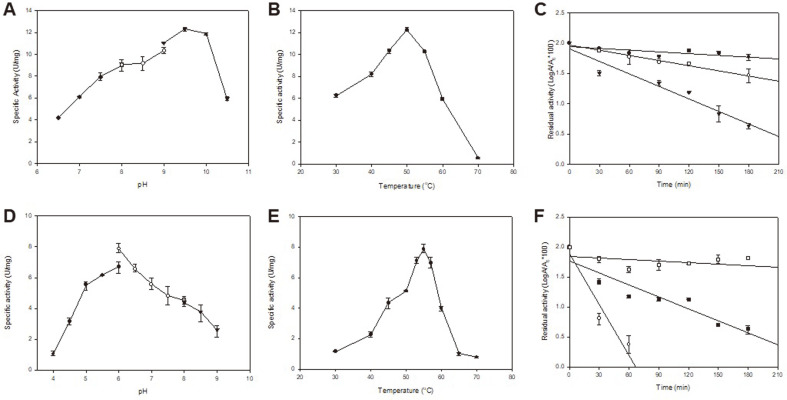
Two putative genes, and , encoding lipolytic enzymes from the thermophilic bacterium KCTC 3921 were cloned and overexpressed in . The recombinant Lip29 and Est29 were purified 67.3-fold to homogeneity with specific activity of 2.27 U/mg and recovery of 5.8% and 14.4-fold with specific activity of 0.92 U/mg and recovery of 1.3%, respectively. The molecular mass of each purified enzyme was estimated to be 29 kDa by SDSPAGE. The alignment analysis of amino acid sequences revealed that both enzymes belonged to GDSL lipase/esterase family including conserved blocks with SGNH catalytic residues which was mainly identified in plants before. While Est29 showed high specificity toward short-chain fatty acids (C4-C8), Lip29 showed strong lipolytic activity to long-chain fatty acids (C12-C16). The optimal activity of Lip29 toward -nitrophenyl palmitate as a substrate was observed at 50°C and pH 9.5, respectively, and its activity was maintained more than 24 h at optimal temperatures, indicating that Lip29 was thermostable. Lip29 exhibited high tolerance against detergents and metal ions. The homology modeling and substrate docking revealed that the long-chain substrates showed the greatest binding affinity toward enzyme. Based on the biochemical and in silico analyses, we present for the first time a GDSL-type lipase in the thermophilic bacteria group.
两个假定的基因, 和 ,编码来自嗜热细菌 KCTC 3921 的脂肪酶,在 中被克隆并过表达。重组 Lip29 和 Est29 经纯化至 67.3 倍的均一性,比活为 2.27 U/mg,回收率为 5.8%;比活为 0.92 U/mg,回收率为 14.4%。两种纯化酶的分子量均通过 SDS-PAGE 估计为 29 kDa。氨基酸序列的比对分析表明,两种酶均属于 GDSL 脂肪酶/酯酶家族,包括保守的 SGNH 催化残基,该残基以前主要在植物中鉴定。虽然 Est29 对短链脂肪酸(C4-C8)表现出高特异性,但 Lip29 对长链脂肪酸(C12-C16)具有强烈的脂肪酶活性。Lip29 对 -硝基苯棕榈酸作为底物的最适活性在 50°C 和 pH 9.5 下分别观察到,其活性在最佳温度下保持超过 24 小时,表明 Lip29 具有热稳定性。Lip29 对洗涤剂和金属离子表现出高耐受性。同源建模和底物对接表明,长链底物对酶表现出最大的结合亲和力。基于生化和计算分析,我们首次在嗜热细菌群中展示了一种 GDSL 型脂肪酶。