The Perinatal Institute and Section of Neonatology, Perinatal and Pulmonary Biology, Cincinnati Children's Hospital Medical Center, Cincinnati, Ohio, USA.
Molecular and Developmental Biology Graduate Program, Cincinnati Children's Hospital Medical Center, Cincinnati, Ohio, USA.
Stem Cells Transl Med. 2021 Jul;10(7):1021-1032. doi: 10.1002/sctm.20-0526. Epub 2021 Feb 24.
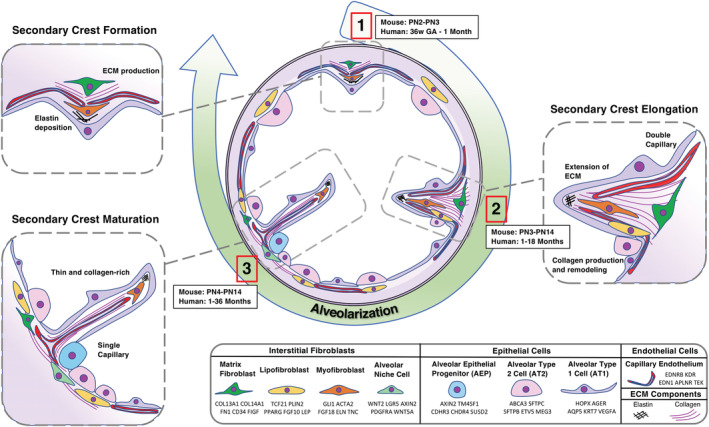
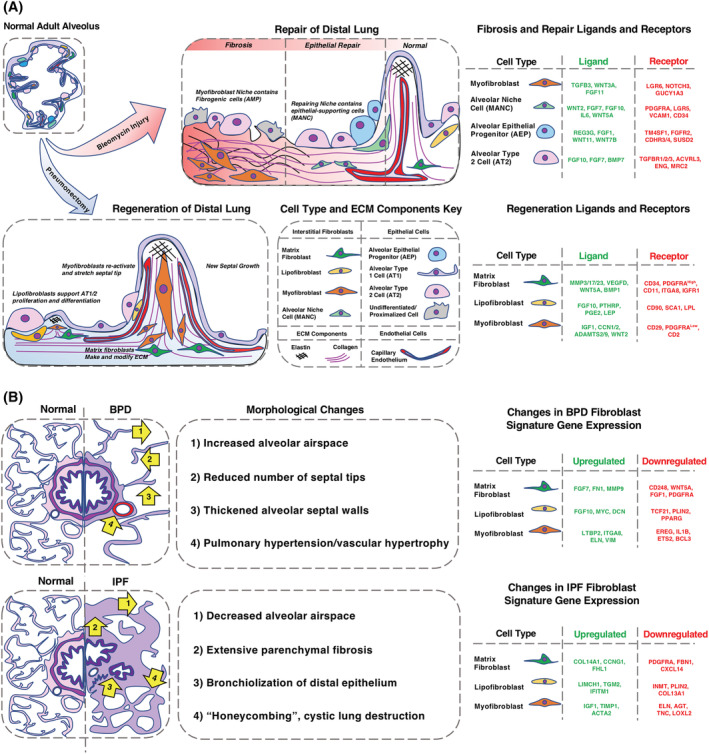
Developing, regenerating, and repairing a lung all require interstitial resident fibroblasts (iReFs) to direct the behavior of the epithelial stem cell niche. During lung development, distal lung fibroblasts, in the form of matrix-, myo-, and lipofibroblasts, form the extra cellular matrix (ECM), create tensile strength, and support distal epithelial differentiation, respectively. During de novo septation in a murine pneumonectomy lung regeneration model, developmental processes are reactivated within the iReFs, indicating progenitor function well into adulthood. In contrast to the regenerative activation of fibroblasts upon acute injury, chronic injury results in fibrotic activation. In murine lung fibrosis models, fibroblasts can pathologically differentiate into lineages beyond their normal commitment during homeostasis. In lung injury, recently defined alveolar niche cells support the expansion of alveolar epithelial progenitors to regenerate the epithelium. In human fibrotic lung diseases like bronchopulmonary dysplasia (BPD), idiopathic pulmonary fibrosis (IPF), and chronic obstructive pulmonary disease (COPD), dynamic changes in matrix-, myo-, lipofibroblasts, and alveolar niche cells suggest differential requirements for injury pathogenesis and repair. In this review, we summarize the role of alveolar fibroblasts and their activation stage in alveolar septation and regeneration and incorporate them into the context of human lung disease, discussing fibroblast activation stages and how they contribute to BPD, IPF, and COPD.
肺的发育、再生和修复都需要间质固有成纤维细胞(iReFs)来指导上皮干细胞龛的行为。在肺发育过程中,以基质、肌和成脂肪成纤维细胞形式存在的远端肺成纤维细胞形成细胞外基质(ECM),分别产生张力强度并支持远端上皮分化。在鼠肺切除术肺再生模型的新分隔过程中,iReFs 中重新激活了发育过程,表明祖细胞功能在成年期仍在发挥作用。与急性损伤时成纤维细胞的再生激活相反,慢性损伤导致纤维化激活。在鼠肺纤维化模型中,成纤维细胞可以在稳态期间病理性地分化为超出其正常分化的谱系。在肺损伤中,最近定义的肺泡龛细胞支持肺泡上皮祖细胞的扩增以再生上皮。在人类纤维性肺疾病如支气管肺发育不良(BPD)、特发性肺纤维化(IPF)和慢性阻塞性肺疾病(COPD)中,基质、肌、脂肪成纤维细胞和肺泡龛细胞的动态变化表明损伤发病机制和修复的要求存在差异。在这篇综述中,我们总结了肺泡成纤维细胞及其在肺泡分隔和再生中的激活阶段的作用,并将其纳入人类肺部疾病的背景中,讨论成纤维细胞激活阶段及其如何导致 BPD、IPF 和 COPD。