Alvarez-Gutiérrez Francisco Javier, Gómez-Bastero Fernández Ana, Medina Gallardo Juan Francisco, Campo Sien Carlos, Rytilä Paula, Delgado Romero Julio
Unidad de Asma, Hospital Universitario Virgen del Rocio, Sevilla, Spain.
Unidad de Asma, Hospital Universitario Virgen Macarena, Sevilla, Spain.
Patient Prefer Adherence. 2021 Feb 16;15:349-358. doi: 10.2147/PPA.S295710. eCollection 2021.
To study patient preference for and satisfaction with the Easyhaler device and to assess ease of training and use of the inhaler in patients previously treated with a variety of dry powder inhalers (DPIs).
We designed a non-interventional, cross-sectional, single-visit observational study of adult patients with persistent asthma referred to specialized care who had previously been treated with DPI inhalers for at least 3 months. Once clinical baseline data had been checked, patients filled in questionnaires on asthma control (GINA 2019), Feeling of Satisfaction with the Inhaler (FSI-10), and adherence (TAI and Morisky-Green questionnaires). Thereafter, all patients were trained in the use of Easyhaler. We assessed ease of use and satisfaction (FSI-10) with Easyhaler, as well as inhaler device preferences.
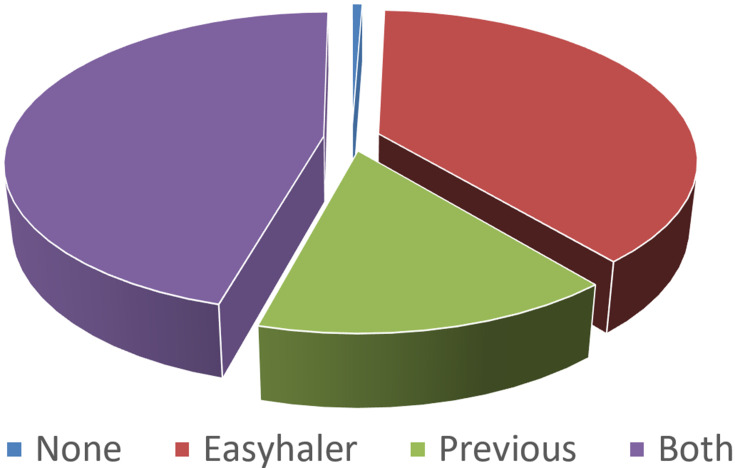
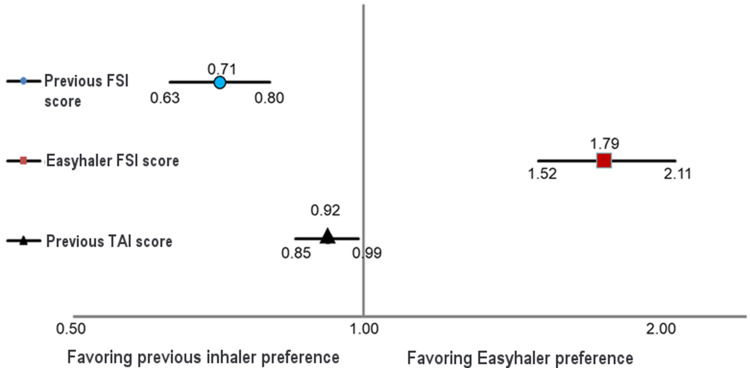
We recruited 502 patients (mean age, 50.2 ± 16.2 y; 63.1% female), of whom 485 were evaluable. In response to the main objective of the study, we compared the values of the self-completed adapted FSI-10, to measure satisfaction with the inhaler. A significantly higher score in each item of the questionnaire was recorded for Easyhaler. Overall, 38% of patients showed exclusive preference for Easyhaler (compared with 15% for the previous device) or were evenly matched in 46% of cases.
In the present study, Easyhaler achieved better patient ratings in terms of preference and satisfaction than previously used DPI devices. In order to improve asthma adherence strategies, patient preferences and device choice should be taken into account.
研究患者对易纳器装置的偏好和满意度,并评估该吸入器在先前使用过多种干粉吸入器(DPI)的患者中的培训和使用便捷性。
我们设计了一项针对转诊至专科护理的持续性哮喘成年患者的非干预性、横断面、单次就诊观察性研究,这些患者先前使用DPI吸入器治疗至少3个月。在检查临床基线数据后,患者填写关于哮喘控制(2019年全球哮喘防治创议)、对吸入器的满意度(FSI-10)和依从性(TAI和Morisky-Green问卷)的问卷。此后,所有患者均接受易纳器使用培训。我们评估了易纳器的使用便捷性和满意度(FSI-10)以及对吸入器装置的偏好。
我们招募了502名患者(平均年龄50.2±16.2岁;63.1%为女性),其中485名可进行评估。针对研究的主要目标,我们比较了自行填写的改良FSI-10的数值,以衡量对吸入器的满意度。易纳器在问卷的每个项目中记录的分数均显著更高。总体而言,38%的患者表现出对易纳器的唯一偏好(相比之前的装置为15%),或在46%的情况下两者相当。
在本研究中,易纳器在偏好和满意度方面比先前使用的DPI装置获得了更好的患者评分。为了改善哮喘依从性策略,应考虑患者的偏好和装置选择。