Al-Asmakh Maha, Sohail Muhammad Umar, Al-Jamal Ola, Shoair Banan Mosaad, Al-Baniali Asmaa Yousef, Bouabidi Salma, Nasr Shahd, Bawadi Hiba
Department of Biomedical Sciences, College of Health Sciences, QU Health, Qatar University, Doha, Qatar.
Biomedical Research Center, QU Health, Qatar University, Doha, Qatar.
Front Pharmacol. 2020 Dec 22;11:569402. doi: 10.3389/fphar.2020.569402. eCollection 2020.
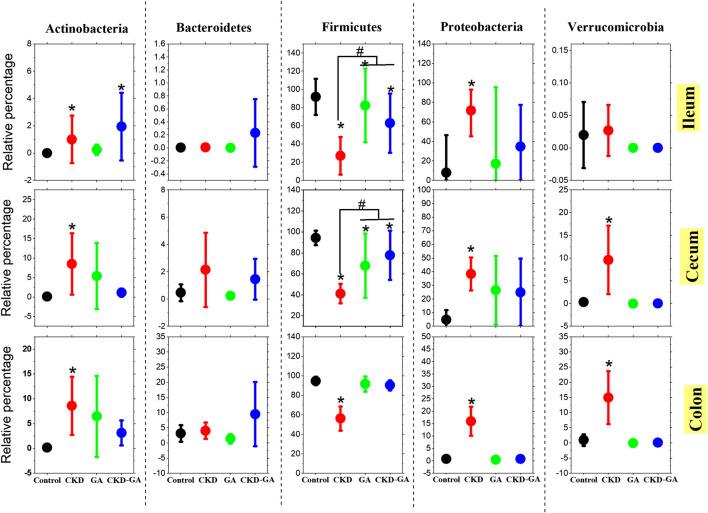
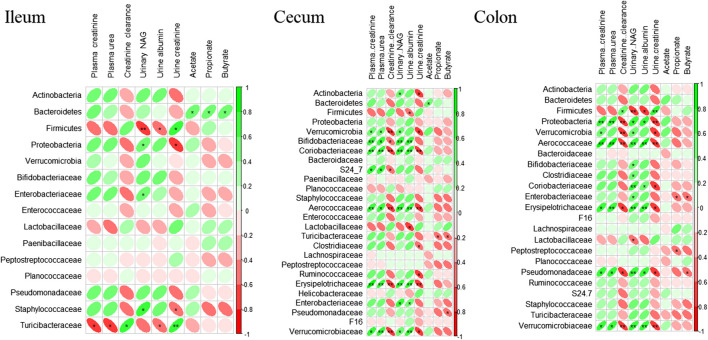
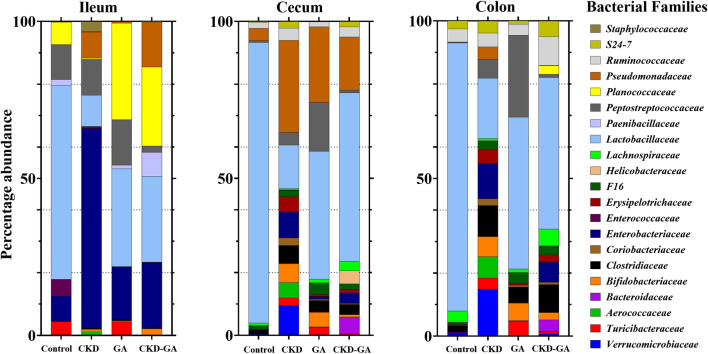
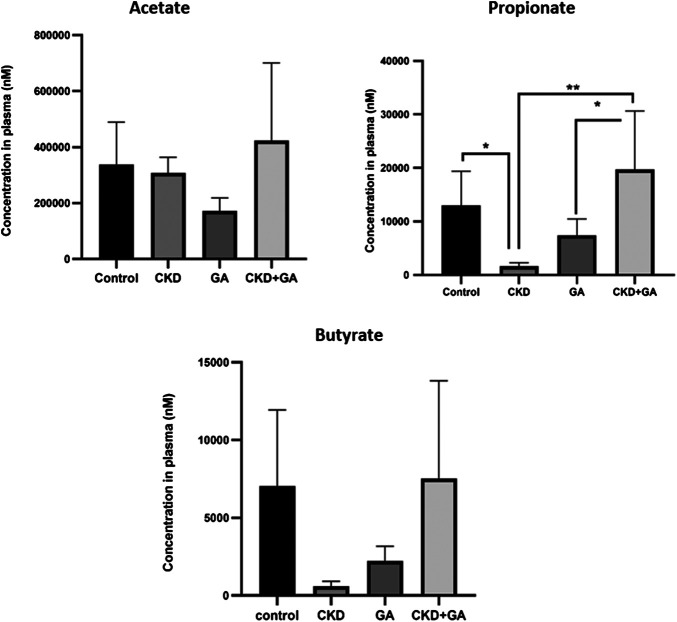
Chronic kidney disease (CKD) may be fatal for its victims and is an important long-term public health problem. The complicated medical procedures and diet restrictions to which patients with CKD are subjected alter the gut microbiome in an adverse manner, favoring over-accumulation of proteolytic bacteria that produce ammonia and other toxic substances. The present study aimed to investigate the effect of GA on 1) the composition of the gut microbiome and 2) on plasma levels of short-chain fatty acids. Male Wister rats were divided into four groups (six each) and treated for 4 weeks based on the following: control, dietary adenine (0.75%, w/w) to induce CKD, GA in the drinking water (15%, w/v), and both adenine and GA. At the end of the treatment period, plasma, urine, and fecal samples were collected for determination of several biochemical indicators of renal function and plasma levels of short-chain fatty acids (SCFAs) as well as characterization of the gut microbiome. Dietary adenine induced the typical signs of CKD, i.e., loss of body weight and impairment of renal function, while GA alleviated these effects. The intestine of the rats with CKD contained an elevated abundance of pathogenic Proteobacteria, Actinobacteria, and Verrucomicrobia but lowered proportions of belonging to the Firmicutes phylum. Plasma levels of propionate and butyrate were lowered by dietary adenine and restored by GA. A negative association (Spearman's -value ≤ 0.01, r ≤ 0.5) was observed between Firmicutes and plasma creatinine, urea, urine N-acetyl-beta-D-glucosaminidase (NAG) and albumin. Phylum Proteobacteria on the other hand was positively associated with these markers while Phylum Bacteroidetes was positively associated with plasma SCFAs. In conclusion, the adverse changes in the composition of the gut microbiome, plasma levels of SCFAs, and biochemical indicators of renal function observed in the rats with CKD induced by dietary adenine were mitigated by GA. These findings are indicative of a link between uremia and the composition of the microbiome in connection with this disease. Dietary administration of GA to patients with CKD may improve their renal function via modulating the composition of their microbiome-a finding that certainly warrants further investigation.
慢性肾脏病(CKD)可能对患者致命,是一个重要的长期公共卫生问题。CKD患者所经历的复杂医疗程序和饮食限制会以不利方式改变肠道微生物群,促使产生氨和其他有毒物质的蛋白水解细菌过度积累。本研究旨在调查GA对1)肠道微生物群组成和2)血浆短链脂肪酸水平的影响。将雄性Wistar大鼠分为四组(每组六只),并根据以下情况进行4周的治疗:对照组、给予饮食腺嘌呤(0.75%,w/w)以诱导CKD、给予饮用水中的GA(15%,w/v)以及同时给予腺嘌呤和GA。在治疗期结束时,收集血浆、尿液和粪便样本,以测定肾功能的几种生化指标、血浆短链脂肪酸(SCFAs)水平以及对肠道微生物群进行表征。饮食腺嘌呤诱导了CKD的典型症状,即体重减轻和肾功能损害,而GA减轻了这些影响。患有CKD的大鼠肠道中致病性变形菌门、放线菌门和疣微菌门的丰度升高,但厚壁菌门所属比例降低。饮食腺嘌呤降低了丙酸和丁酸的血浆水平,而GA使其恢复。观察到厚壁菌门与血浆肌酐、尿素、尿N-乙酰-β-D-氨基葡萄糖苷酶(NAG)和白蛋白之间呈负相关(斯皮尔曼相关系数≤ 0.01,r≤ 0.5)。另一方面,变形菌门与这些标志物呈正相关,而拟杆菌门与血浆SCFAs呈正相关。总之,GA减轻了饮食腺嘌呤诱导所致CKD大鼠肠道微生物群组成、血浆SCFAs水平和肾功能生化指标的不良变化。这些发现表明尿毒症与该疾病相关的微生物群组成之间存在联系。对CKD患者进行GA饮食给药可能通过调节其微生物群组成来改善肾功能——这一发现肯定值得进一步研究