Kolarz Bogdan, Ciesla Marek, Rosenthal Ann K, Dryglewska Magdalena, Majdan Maria
Faculty of Medicine, University of Rzeszow, Kopisto 2A, Rzeszow, 35-959, Poland.
Faculty of Medicine, University of Rzeszow, Rzeszow, Poland.
Ther Adv Musculoskelet Dis. 2021 Feb 11;13:1759720X21989868. doi: 10.1177/1759720X21989868. eCollection 2021.
Anti-citrullinated protein antibodies (ACPAs) and rheumatoid factor (RF) are key factors in the American College of Rheumatology/European League Against Rheumatism rheumatoid arthritis (RA) classification criteria markers. However, about 30% of patients diagnosed with RA are seronegative, rationalizing the need for new serologic markers for RA. Antibodies against carbamylated proteins (anti-CarP) and against peptidyl-arginine deiminase type 4 (anti-PAD4) have been postulated to be useful RA markers. The purpose of this study is to evaluate the value of anti-CarP and anti-PAD4 in a well-characterized population of RA patients and healthy controls (HCs).
A total of 122 RA patients and 30 HCs were enrolled in the study. Serum levels of ACPA, anti-PAD4, anti-CarP and RF were determined by enzyme-linked immunosorbent immunoassays (ELISAs). Synthetic carbamylated peptides were used in the ELISA assay to determine the protein targets of the anti-CarP antibodies.
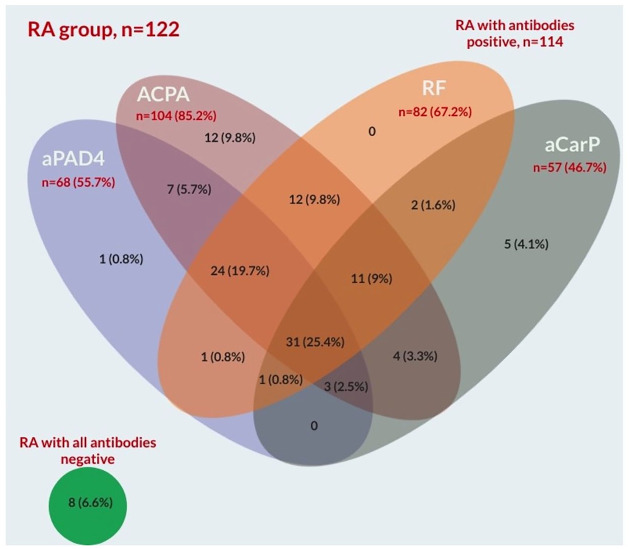
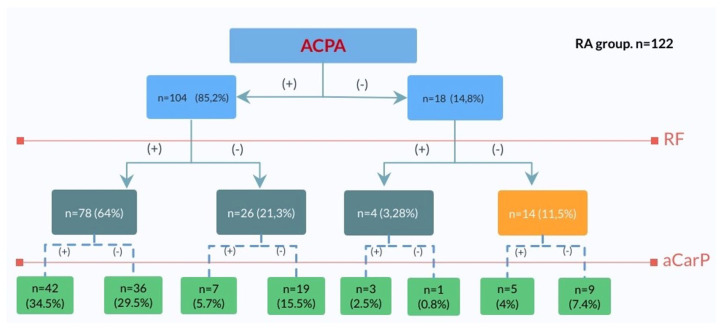
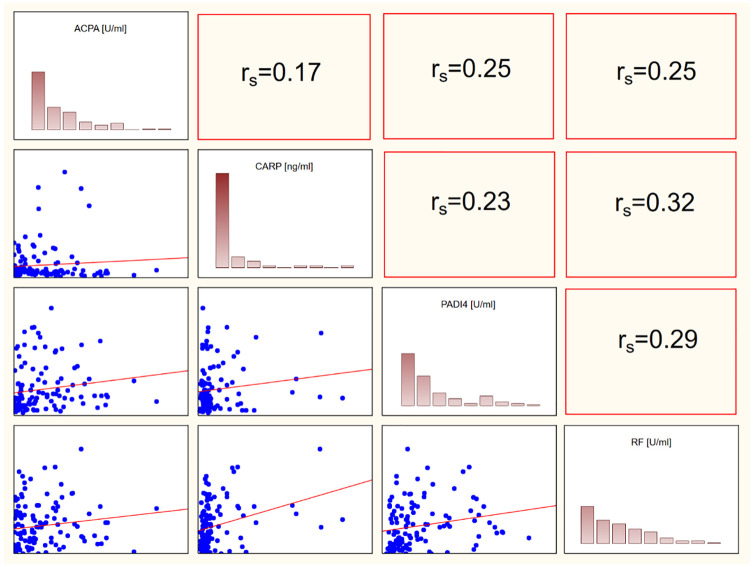
Rates of ACPA, RF, anti-PAD4 and anti-CarP positivity were 85.2%, 67.2%, 55.7% and 46.7% in RA, and 0%, 0%, 6.7% and 6.7% in HC respectively. In the RA population, 25.4% of patients had all four types of antibodies positive, while 6.6% had no antibodies. There was a significant correlation between anti-PAD4 and ACPAs ( = 0.39), RF and ACPAs, ( = 0.3) and RF and anti-CarP, ( = 0.3). There was no correlation between ACPAs and anti-CarP. Anti-CarP positivity was noted in 49 (47.1%) and 45 (54.9%) of ACPAs and RF positive patients respectively. In addition, five anti-CarP+ patients did not have ACPA nor RF.
Anti-CarP but not anti-PAD4 may be a useful biomarker in identifying ACPA/RF negative RA patients. This antibody may identify an additional RA population who may benefit from early implementation of aggressive therapy.
抗瓜氨酸化蛋白抗体(ACPAs)和类风湿因子(RF)是美国风湿病学会/欧洲抗风湿病联盟类风湿关节炎(RA)分类标准中的关键指标。然而,约30%被诊断为RA的患者血清学呈阴性,这使得寻找新的RA血清学标志物成为必要。抗氨甲酰化蛋白抗体(抗CarP)和抗肽基精氨酸脱氨酶4抗体(抗PAD4)被认为可能是有用的RA标志物。本研究旨在评估抗CarP和抗PAD4在特征明确的RA患者和健康对照人群中的价值。
本研究共纳入122例RA患者和30例健康对照。采用酶联免疫吸附测定(ELISA)法检测血清中ACPAs、抗PAD4、抗CarP和RF的水平。ELISA检测中使用合成氨甲酰化肽来确定抗CarP抗体的蛋白靶点。
RA患者中ACPAs、RF、抗PAD4和抗CarP阳性率分别为85.2%、67.2%、55.7%和46.7%,健康对照中分别为0%、0%、6.7%和6.7%。在RA患者群体中,25.4%的患者四种抗体均为阳性,而6.6%的患者无抗体。抗PAD4与ACPAs之间(r = 0.39)、RF与ACPAs之间(r = 0.3)以及RF与抗CarP之间(r = 0.3)存在显著相关性。ACPAs与抗CarP之间无相关性。在ACPAs阳性患者和RF阳性患者中,抗CarP阳性率分别为49例(47.1%)和45例(54.9%)。此外,5例抗CarP阳性患者既无ACPAs也无RF。
抗CarP而非抗PAD4可能是识别ACPAs/RF阴性RA患者的有用生物标志物。该抗体可能识别出另一组可能从早期积极治疗中获益的RA患者群体。