Department of Intensive Care Unit, The Second Affiliated Hospital of Chongqing Medical University, Chongqing, China.
Chongqing Key Laboratory of Ultrasound Molecular Imaging, The Second Affiliated Hospital of Chongqing Medical University, Chongqing, China.
JMIR Public Health Surveill. 2021 Mar 9;7(3):e24843. doi: 10.2196/24843.
Since the start of the COVID-19 pandemic, there have been over 2 million deaths globally. Acute respiratory distress syndrome (ARDS) may be the main cause of death.
This study aimed to describe the clinical features, outcomes, and ARDS characteristics of patients with COVID-19 admitted to the intensive care unit (ICU) in Chongqing, China.
The epidemiology of COVID-19 from January 21, 2020, to March 15, 2020, in Chongqing, China, was analyzed retrospectively, and 75 ICU patients from two hospitals were included in this study. On day 1, 56 patients with ARDS were selected for subgroup analysis, and a modified Poisson regression was performed to identify predictors for the early improvement of ARDS (eiARDS).
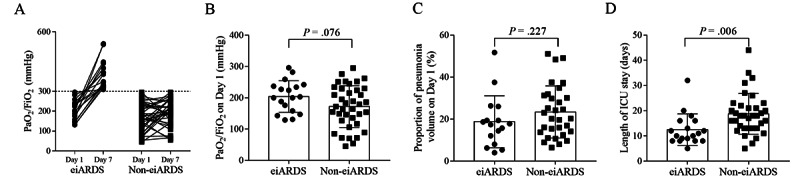
Chongqing reported a 5.3% case fatality rate for the 75 ICU patients. The median age of these patients was 57 (IQR 25-75) years, and no bias was present in the sex ratio. A total of 93% (n=70) of patients developed ARDS during ICU stay, and more than half had moderate ARDS. However, most patients (n=41, 55%) underwent high-flow nasal cannula oxygen therapy, but not mechanical ventilation. Nearly one-third of patients with ARDS improved (arterial blood oxygen partial pressure/oxygen concentration >300 mm Hg) in 1 week, which was defined as eiARDS. Patients with eiARDS had a higher survival rate and a shorter length of ICU stay than those without eiARDS. Age (<55 years) was the only variable independently associated with eiARDS, with a risk ratio of 2.67 (95% CI 1.17-6.08).
A new subphenotype of ARDS-eiARDS-in patients with COVID-19 was identified. As clinical outcomes differ, the stratified management of patients based on eiARDS or age is highly recommended.
自 COVID-19 大流行开始以来,全球已有超过 200 万人死亡。急性呼吸窘迫综合征(ARDS)可能是主要死因。
本研究旨在描述中国重庆重症监护病房(ICU)收治的 COVID-19 患者的临床特征、结局和 ARDS 特征。
回顾性分析 2020 年 1 月 21 日至 3 月 15 日中国重庆 COVID-19 的流行病学,纳入来自两家医院的 75 例 ICU 患者。第 1 天,选择 56 例 ARDS 患者进行亚组分析,并采用修正泊松回归分析确定 ARDS 早期改善(eiARDS)的预测因素。
重庆 ICU 患者的病死率为 5.3%。这些患者的中位年龄为 57(IQR 25-75)岁,性别比例无偏差。93%(n=70)的患者在 ICU 期间发生 ARDS,超过一半为中度 ARDS。然而,大多数患者(n=41,55%)接受高流量鼻导管吸氧治疗,而非机械通气。近三分之一的 ARDS 患者在 1 周内(动脉血氧分压/氧浓度>300mmHg)改善,定义为 eiARDS。与未发生 eiARDS 的患者相比,发生 eiARDS 的患者存活率更高,ICU 住院时间更短。年龄(<55 岁)是唯一与 eiARDS 独立相关的变量,风险比为 2.67(95%CI 1.17-6.08)。
在 COVID-19 患者中,确定了一种新的 ARDS 亚表型-eiARDS。由于临床结局不同,强烈推荐根据 eiARDS 或年龄对患者进行分层管理。