Department of Critical Care Medicine of Affiliated Hospital of Guangdong Medical University, Guangdong, China.
Department of Anesthesiology, Renmin Hospital of Wuhan University, Wuhan, China.
Aging (Albany NY). 2021 Jun 28;13(12):15801-15814. doi: 10.18632/aging.203224.
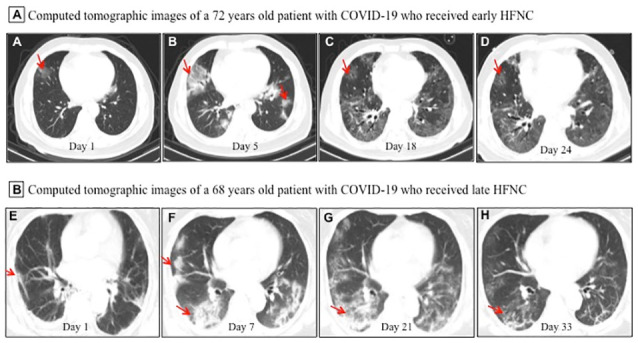
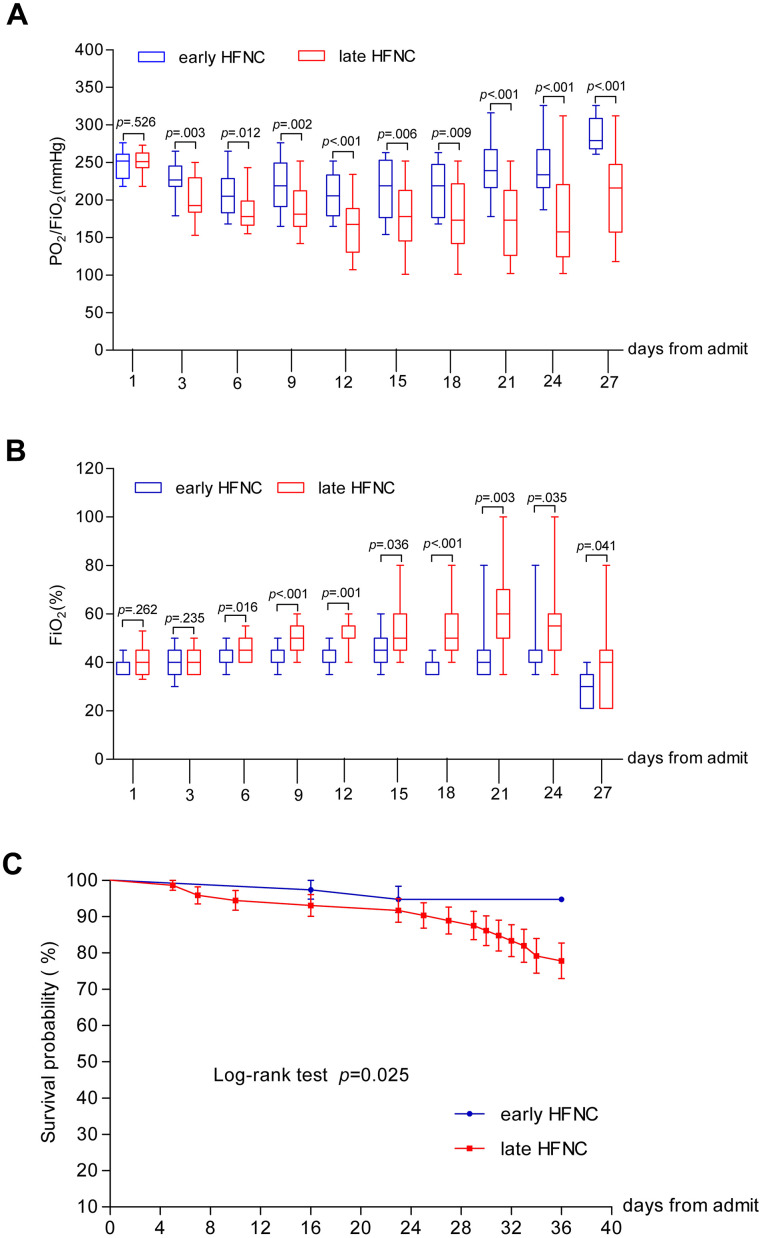
Coronavirus disease-2019 (COVID-19) has rapidly spread worldwide and causes high mortality of elderly patients. High-flow nasal cannula therapy (HFNC) is an oxygen delivery method for severely ill patients. We retrospectively analyzed the course of illness and outcomes in 110 elderly COVID-19 patients (≥65 years) treated with HFNC from 6 hospitals. 38 patients received HFNC (200 mmHg < PaO/FiO ≤ 300 mmHg, early HFNC group), and 72 patients received HFNC (100 mmHg < PaO/FiO ≤ 200 mmHg, late HFNC group). There were no significant differences of sequential organ failure assessment (SOFA) scores and APECH II scores between early and late HFNC group on admission. Compared with the late HFNC group, patients in the early HFNC group had a lower likelihood of developing severe acute respiratory distress syndrome (ARDS), longer time from illness onset to severe ARDS and shorter duration of viral shedding after illness onset, as well as shorter lengths of ICU and hospital stay. 24 patients died during hospitalization, of whom 22 deaths (30.6%) were in the late HFNC group and 2 (5.3%) in the early HFNC group. The present study suggested that the outcomes were better in severely ill elderly patients with COVID-19 receiving early compared to late HFNC.
新型冠状病毒病-2019(COVID-19)已在全球迅速蔓延,导致老年患者死亡率较高。高流量鼻导管氧疗(HFNC)是一种为重症患者提供氧气的方法。我们回顾性分析了来自 6 家医院的 110 例接受 HFNC 治疗的老年 COVID-19 患者(≥65 岁)的病程和结局。38 例患者接受 HFNC(200mmHg<PaO/FiO≤300mmHg,早期 HFNC 组),72 例患者接受 HFNC(100mmHg<PaO/FiO≤200mmHg,晚期 HFNC 组)。入院时,早期 HFNC 组和晚期 HFNC 组的序贯器官衰竭评估(SOFA)评分和急性生理学与慢性健康状况评分Ⅱ(APACHEⅡ)评分无显著差异。与晚期 HFNC 组相比,早期 HFNC 组发生严重急性呼吸窘迫综合征(ARDS)的可能性较低,从发病到严重 ARDS 的时间较长,发病后病毒脱落时间较短,ICU 住院时间和总住院时间也较短。24 例患者在住院期间死亡,其中晚期 HFNC 组 22 例(30.6%)死亡,早期 HFNC 组 2 例(5.3%)死亡。本研究表明,与晚期 HFNC 相比,接受早期 HFNC 的重症老年 COVID-19 患者的结局更好。