Department of Cardiology, Lithuanian University of Health Sciences, Kaunas, Lithuania; Institute of Cardiology, Lithuanian University of Health Sciences, Kaunas, Lithuania.
Baylor University Medical Center, Dallas, Texas; Baylor Heart and Vascular Institute, Dallas, Texas.
Am J Cardiol. 2021 May 15;147:16-22. doi: 10.1016/j.amjcard.2021.01.043. Epub 2021 Feb 23.
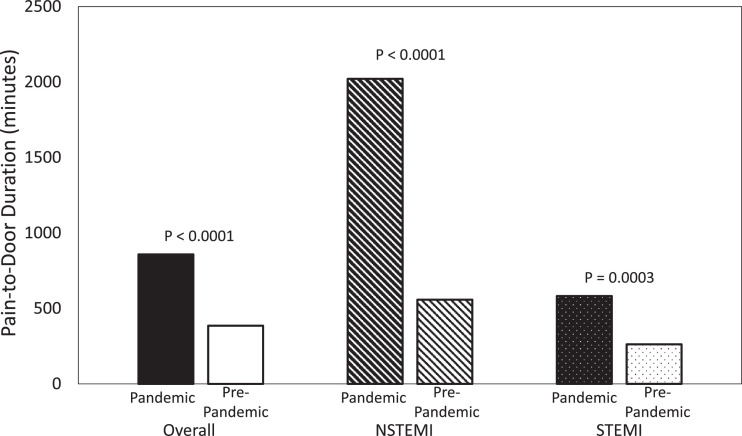
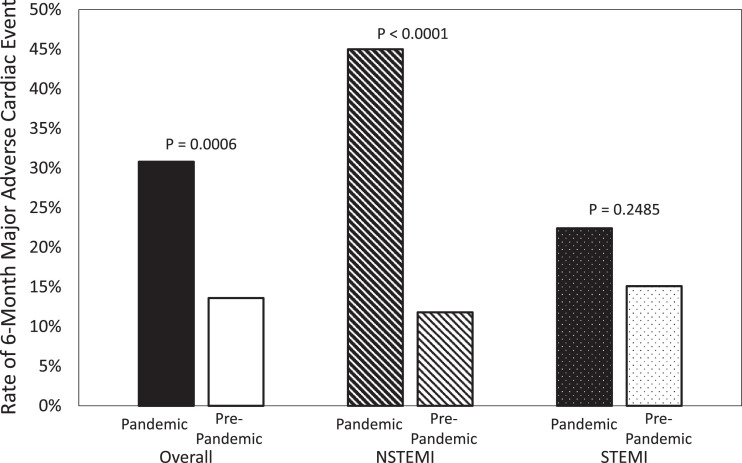
The Coronavirus disease 2019 (COVID-19) pandemic has changed the way patients seek medical attention and how medical services are provided. We sought to compare characteristics, clinical course, and outcomes of patients presenting with acute myocardial infarction (AMI) during the pandemic compared with before it. This is a multicenter, retrospective cohort study of consecutive COVID-19 negative patients with AMI in Lithuania from March 11, 2020 to April 20, 2020 compared with patients admitted with the same diagnosis during the same period in 2019. All patients underwent angiography. Six-month follow-up was obtained for all patients. A total of 269 patients were included in this study, 107 (40.8%) of whom presented during the pandemic. Median pain-to-door times were significantly longer (858 [quartile 1=360, quartile 3 = 2,600] vs 385.5 [200, 745] minutes, p <0.0001) and post-revascularization ejection fractions were significantly lower (35 [30, 45] vs 45 [40, 50], p <0.0001) for patients presenting during vs. prior to the pandemic. While the in-hospital mortality rate did not differ, we observed a higher rate of six-month major adverse cardiovascular events for patients who presented during versus prior to the pandemic (30.8% vs 13.6%, p = 0.0006). In conclusion, 34% fewer patients with AMI presented to the hospital during the COVID-19 pandemic, and those who did waited longer to present and experienced more 6-month major adverse cardiovascular events compared with patients admitted before the pandemic.
2019 年冠状病毒病(COVID-19)大流行改变了患者寻求医疗关注的方式和医疗服务的提供方式。我们旨在比较大流行期间和之前出现急性心肌梗死(AMI)的患者的特征、临床过程和结局。这是一项在立陶宛进行的多中心、回顾性队列研究,比较了 2020 年 3 月 11 日至 2020 年 4 月 20 日期间 COVID-19 阴性的 AMI 连续患者,以及同期 2019 年相同诊断的患者。所有患者均接受了血管造影术。所有患者均获得了 6 个月的随访。本研究共纳入 269 例患者,其中 107 例(40.8%)在大流行期间就诊。中位疼痛至门时间明显延长(858 [四分位距 1=360,四分位距 3=2600] vs 385.5 [200,745]分钟,p<0.0001),并且血管再通后的射血分数明显降低(35 [30,45] vs 45 [40,50],p<0.0001)。大流行期间就诊的患者与大流行前就诊的患者相比,住院死亡率无差异,但我们观察到大流行期间就诊的患者 6 个月主要不良心血管事件发生率更高(30.8% vs 13.6%,p=0.0006)。总之,在 COVID-19 大流行期间,AMI 患者到医院就诊的人数减少了 34%,与大流行前就诊的患者相比,就诊时间更长,6 个月时主要不良心血管事件更多。