Division of Cardiology, Department of Medicine, and Department of Health Metrics Sciences, Institute for Health Metrics and Evaluation, University of Washington, Seattle, Washington, USA.
Division of Cardiovascular Medicine, Brigham and Women's Hospital and Harvard Medical School, Boston, Massachusetts, USA.
J Am Coll Cardiol. 2022 Aug 9;80(6):631-640. doi: 10.1016/j.jacc.2022.06.008.
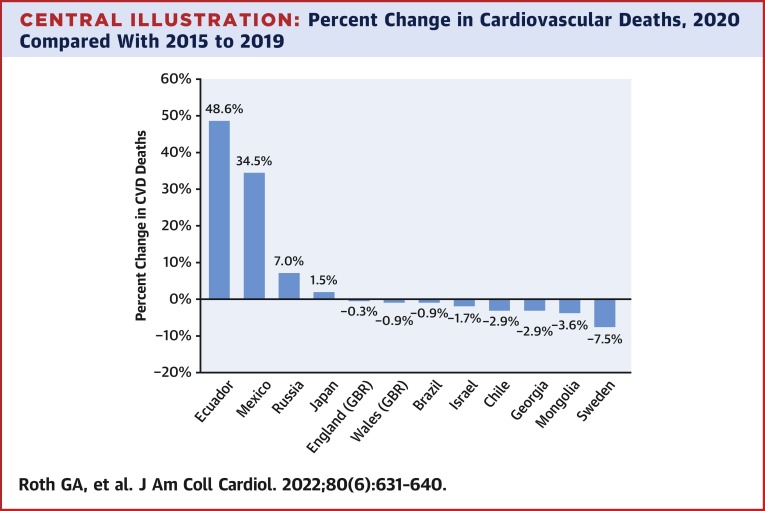
The impact of COVID-19 on the burden of cardiovascular diseases (CVD) during the early pandemic remains unclear. COVID-19 has become one of the leading causes of global mortality, with a disproportionate impact on persons with CVD. Studies of health facility admissions for CVD found significant decreases during the pandemic. Studies of hospital mortality for CVD were more variable. Studies of population-level CVD mortality differed across countries, with most showing decreases, although some revealed increases in deaths. In some countries where large increases in CVD deaths were reported in vital registration systems, misclassification of COVID-19 as CVD may have occurred. Taken together, studies suggest heterogeneous effects of the COVID-19 pandemic on CVD without large increases in CVD mortality in 2020 for a number of countries. Clinical and population science research is needed to examine the ways in which the pandemic has affected CVD burden.
新冠疫情对心血管疾病(CVD)负担的早期影响仍不清楚。新冠疫情已成为全球死亡的主要原因之一,对心血管疾病患者的影响尤为显著。对心血管疾病患者入院治疗的研究发现,疫情期间这一数字显著下降。而关于心血管疾病住院死亡率的研究结果则更为多样。各国的人群心血管疾病死亡率研究结果不同,大多数国家显示死亡率下降,尽管一些国家报告死亡率上升。在一些报告心血管疾病死亡人数大幅增加的国家,可能出现了将 COVID-19 误诊为 CVD 的情况。综上所述,研究表明新冠疫情对 CVD 的影响具有异质性,而在 2020 年,许多国家的 CVD 死亡率并未大幅上升。需要开展临床和人群科学研究,以评估疫情对 CVD 负担的影响方式。