Jiang Shun, Wang Sisi, Wang Qianqian, Deng Chao, Feng Yuhua, Ma Fang, Ma Jin'an, Liu Xianling, Hu Chunhong, Hou Tao
Department of Oncology, The Second Xiangya Hospital, Central South University, Changsha, 410011, Hunan, People's Republic of China.
Department of Oncology, The Affiliated ZhuZhou Hospital of XiangYa Medical College, Central South University, ZhuZhou, 412007, Hunan, People's Republic of China.
Cancer Manag Res. 2021 Feb 15;13:1315-1322. doi: 10.2147/CMAR.S287897. eCollection 2021.
Systemic inflammation response index (SIRI) has been reported to be an effective blood-based biomarker for predicting prognosis in various kinds of cancer patients. However, the prognostic role of SIRI in advanced lung adenocarcinoma patient remains unclear.
The aim of the present study is to evaluate the prognostic role of SIRI in EGFR-mutant advanced lung adenocarcinoma patients treated with first-generation EGFR-TKIs. A total of 245 patients who received gefitinib, erlotinib, or icotinib at the Second Xiangya Hospital were retrospectively evaluated. SIRI was defined as neutrophil count×monocyte/lymphocyte count. The optimal cut-off value was determined according to receiver operation characteristic curve analysis. Characteristics of patients were compared via chi-square test or Fisher's exact test. Survivals were estimated by the Kaplan-Meier method and compared by the Log rank test. Multivariate analysis was estimated using the Cox proportional hazards model.
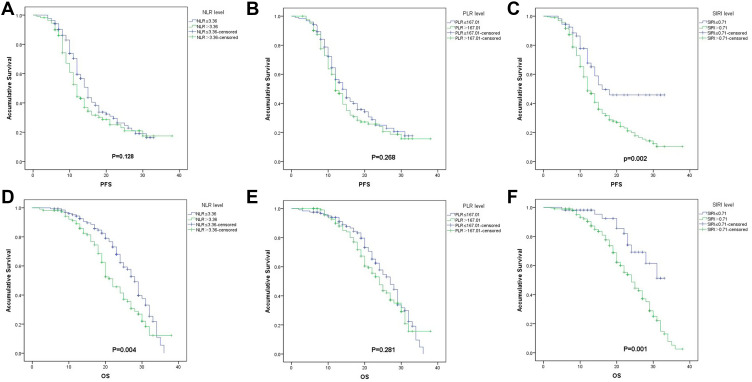
It is showed that high SIRI was associated with male patient, smoker, worse ECOG PS, 19-DEL mutation. Kaplan-Meier survival analysis showed that ECOG PS, brain metastasis, SIRI were significantly correlated with progression-free survival (PFS), and gender, ECOG PS, brain metastasis, NLR and SIRI were significantly correlated with overall survival (OS). Multivariate analysis showed that SIRI and ECOG PS independently predict PFS and OS.
Our findings indicate that SIRI is an effective and convenient marker for predicting prognosis in advanced EGFR-mutant lung adenocarcinoma patients treated with first-generation TKI.
全身炎症反应指数(SIRI)已被报道为预测各类癌症患者预后的一种有效的血液生物标志物。然而,SIRI在晚期肺腺癌患者中的预后作用仍不明确。
本研究旨在评估SIRI在接受第一代表皮生长因子受体酪氨酸激酶抑制剂(EGFR-TKIs)治疗的EGFR突变型晚期肺腺癌患者中的预后作用。对在中南大学湘雅二医院接受吉非替尼、厄洛替尼或埃克替尼治疗的245例患者进行回顾性评估。SIRI定义为中性粒细胞计数×单核细胞/淋巴细胞计数。根据受试者工作特征曲线分析确定最佳临界值。通过卡方检验或Fisher精确检验比较患者特征。采用Kaplan-Meier法估计生存率,并通过对数秩检验进行比较。使用Cox比例风险模型进行多因素分析。
结果显示,高SIRI与男性患者、吸烟者、较差的东部肿瘤协作组(ECOG)体能状态、19号外显子缺失突变相关。Kaplan-Meier生存分析显示,ECOG体能状态、脑转移、SIRI与无进展生存期(PFS)显著相关,性别、ECOG体能状态、脑转移、中性粒细胞与淋巴细胞比值(NLR)和SIRI与总生存期(OS)显著相关。多因素分析显示,SIRI和ECOG体能状态可独立预测PFS和OS。
我们的研究结果表明,SIRI是预测接受第一代TKI治疗的晚期EGFR突变型肺腺癌患者预后的一种有效且便捷的标志物。