Torao-Angosto Melody, Manasanch Arnau, Mattia Maurizio, Sanchez-Vives Maria V
Institut d'Investigacions Biomediques August Pi i Sunyer (IDIBAPS), Barcelona, Spain.
National Center for Radioprotection and Computational Physics, Istituto Superiore di Sanità, Rome, Italy.
Front Syst Neurosci. 2021 Feb 9;15:609645. doi: 10.3389/fnsys.2021.609645. eCollection 2021.
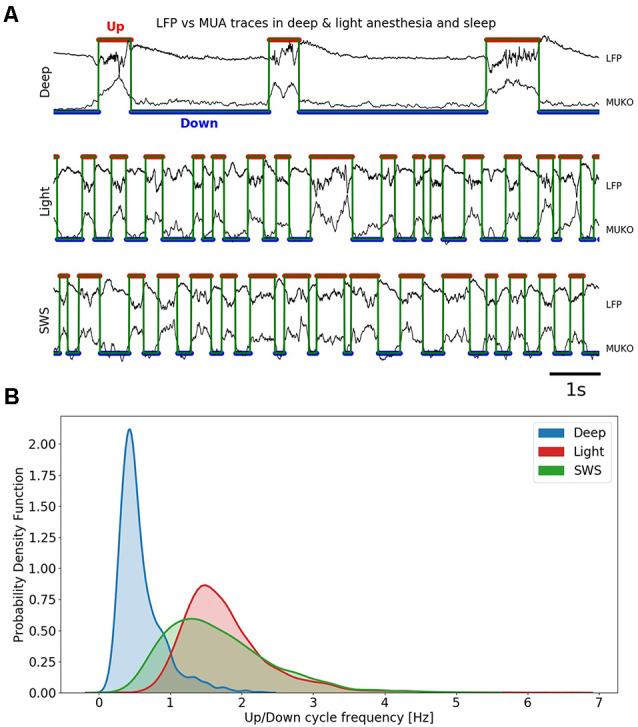
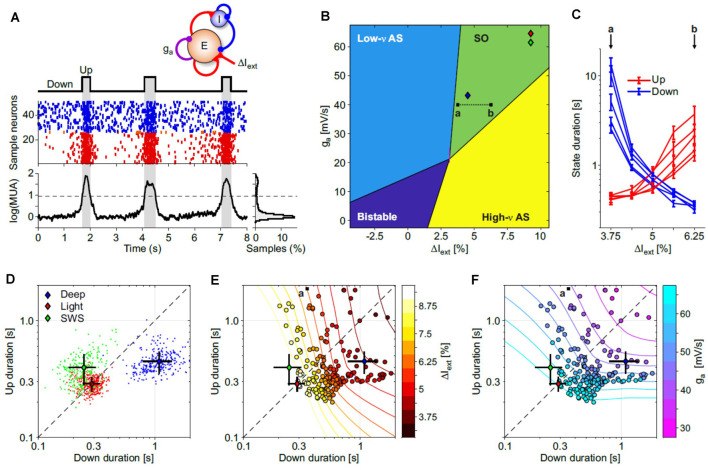
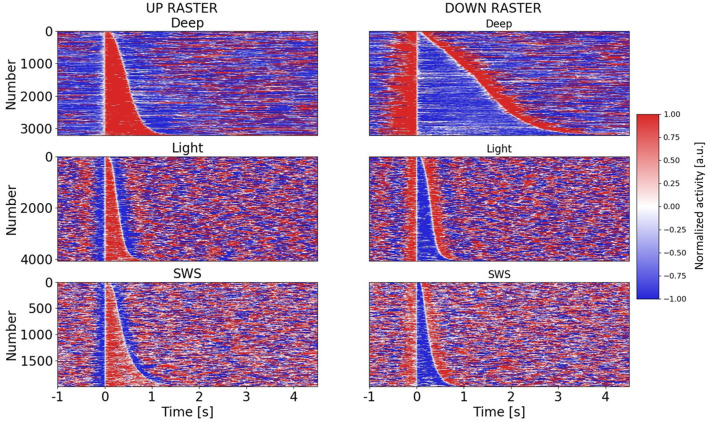
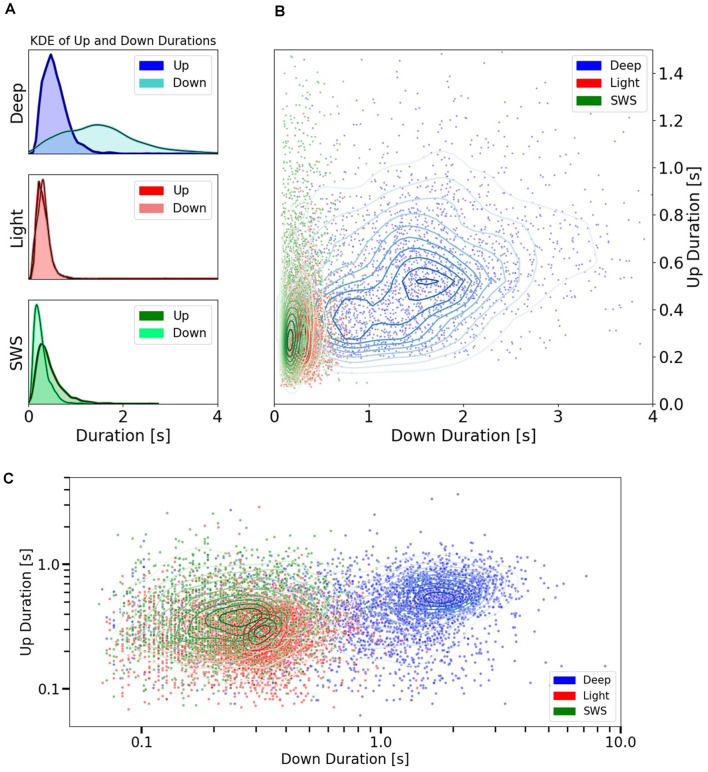
Slow oscillations are a pattern of synchronized network activity generated by the cerebral cortex. They consist of Up and Down states, which are periods of activity interspersed with periods of silence, respectively. However, even when this is a unique dynamic regime of transitions between Up and Down states, this pattern is not constant: there is a range of oscillatory frequencies (0.1-4 Hz), and the duration of Up vs. Down states during the cycles is variable. This opens many questions. Is there a constant relationship between the duration of Up and Down states? How much do they vary across conditions and oscillatory frequencies? Are there different sub regimes within the slow oscillations? To answer these questions, we aimed to explore a concrete aspect of slow oscillations, Up and Down state durations, across three conditions: deep anesthesia, light anesthesia, and slow-wave sleep (SWS), in the same chronically implanted rats. We found that light anesthesia and SWS have rather similar properties, occupying a small area of the Up and Down state duration space. Deeper levels of anesthesia occupy a larger region of this space, revealing that a large variety of Up and Down state durations can emerge within the slow oscillatory regime. In a network model, we investigated the network parameters that can explain the different points within our bifurcation diagram in which slow oscillations are expressed.
慢振荡是由大脑皮层产生的一种同步网络活动模式。它们由上行和下行状态组成,分别是活动期和静息期交替出现的阶段。然而,即使这是上行和下行状态之间转换的一种独特动态机制,这种模式也不是恒定不变的:存在一系列振荡频率(0.1 - 4赫兹),并且在周期中上行与下行状态的持续时间是可变的。这引发了许多问题。上行和下行状态的持续时间之间是否存在恒定关系?它们在不同条件和振荡频率下的变化程度如何?在慢振荡中是否存在不同的子机制?为了回答这些问题,我们旨在研究同一慢性植入大鼠在深度麻醉、浅麻醉和慢波睡眠(SWS)这三种条件下慢振荡的一个具体方面,即上行和下行状态的持续时间。我们发现浅麻醉和慢波睡眠具有相当相似的特性,占据上行和下行状态持续时间空间的一个小区域。更深程度的麻醉占据该空间的更大区域,这表明在慢振荡机制内可以出现各种各样的上行和下行状态持续时间。在一个网络模型中,我们研究了能够解释我们的分岔图中表达慢振荡的不同点的网络参数。