
新冠病毒肺炎患者获得的社会支持较少:与护士的经历比较
Less Social Support for Patients With COVID-19: Comparison With the Experience of Nurses.
作者信息
Li Zhenyu, Ge Jingwu, Feng Jianping, Jiang Riyue, Zhou Qin, Xu Xiaolin, Pan Yinbing, Liu Shijiang, Gui Bo, Wang Zhongyun, Zhu Bin, Hu Yimin, Yang Jianjun, Wang Rong, Su Dongan, Hashimoto Kenji, Yang Meiling, Yang Chun, Liu Cunming
机构信息
Department of Anesthesiology and Perioperative Medicine, The First Affiliated Hospital of Nanjing Medical University, Nanjing, China.
Department of Ultrasound Imaging, Renmin Hospital of Wuhan University, Wuhan, China.
出版信息
Front Psychiatry. 2021 Feb 1;12:554435. doi: 10.3389/fpsyt.2021.554435. eCollection 2021.
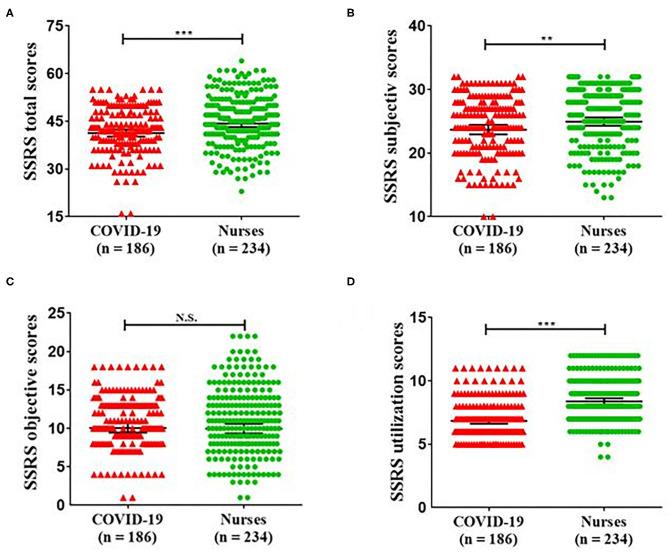
Since December 2019, more than 80,000 patients have been diagnosed with coronavirus disease 2019 (COVID-19) in China. Social support status of COVID-19 patients, especially the impact of social support on their psychological status and quality of life, needs to be addressed with increasing concern. In this study, we used social support rating scale (SSRS) to investigate the social support in COVID-19 patients and nurses. The present study included 186 COVID-19 patients at a Wuhan mobile cabin hospital and 234 nurses at a Wuhan COVID-19 control center. Responses to a mobile phone app-based questionnaire about social support, anxiety, depression, and quality of life were recorded and evaluated. COVID-19 patients scored significantly lower than nurses did on the Social Support Rating Scale (SSRS). Among these patients, 33.9% had anxiety symptoms, while 23.7% had depression symptoms. Overall SSRS, subjective social support scores and objective support scores of patients with anxiety were lower than those of patients without anxiety. This result was also found in depression. In addition, all dimensions of social support were positively correlated with quality of life. Interestingly, in all dimensions of social support, subjective support was found to be an independent predictive factor for anxiety, depression, and quality of life, whereas objective support was a predictive factor for quality of life, but not for anxiety and depression via regression analysis. Medical staffs should pay attention to the subjective feelings of patients and make COVID-19 patients feel respected, supported, and understood from the perspective of subjective support, which may greatly benefit patients, alleviate their anxiety and depression, and improve their quality of life.
自2019年12月以来,中国已有8万多名患者被诊断为新型冠状病毒肺炎(COVID-19)。COVID-19患者的社会支持状况,尤其是社会支持对其心理状态和生活质量的影响,需要得到越来越多的关注。在本研究中,我们使用社会支持评定量表(SSRS)来调查COVID-19患者和护士的社会支持情况。本研究纳入了武汉一家移动方舱医院的186例COVID-19患者和武汉COVID-19防控中心的234名护士。记录并评估了基于手机应用程序的关于社会支持、焦虑、抑郁和生活质量的问卷调查的回复。COVID-19患者在社会支持评定量表(SSRS)上的得分显著低于护士。在这些患者中,33.9%有焦虑症状,而23.7%有抑郁症状。总体SSRS、焦虑患者的主观社会支持得分和客观支持得分均低于无焦虑患者。抑郁患者也有同样的结果。此外,社会支持的各个维度与生活质量均呈正相关。有趣的是,通过回归分析发现,在社会支持的所有维度中,主观支持是焦虑、抑郁和生活质量的独立预测因素,而客观支持是生活质量的预测因素,但不是焦虑和抑郁的预测因素。医务人员应关注患者的主观感受,从主观支持的角度让COVID-19患者感到被尊重、支持和理解,这可能会使患者受益匪浅,缓解他们的焦虑和抑郁,并提高他们的生活质量。
 Zotero 插件