• 文献检索
  • 文档翻译
  • 深度研究
  • 学术资讯
  • Suppr Zotero 插件Zotero 插件
  • 邀请有礼
  • 套餐&价格
  • 历史记录
应用&插件
Suppr Zotero 插件Zotero 插件浏览器插件Mac 客户端Windows 客户端微信小程序
定价
高级版会员购买积分包购买API积分包
服务
文献检索文档翻译深度研究API 文档MCP 服务
关于我们
关于 Suppr公司介绍联系我们用户协议隐私条款
关注我们

Suppr 超能文献

核心技术专利:CN118964589B侵权必究
粤ICP备2023148730 号-1Suppr @ 2026

文献检索

告别复杂PubMed语法,用中文像聊天一样搜索,搜遍4000万医学文献。AI智能推荐,让科研检索更轻松。

立即免费搜索

文件翻译

保留排版,准确专业,支持PDF/Word/PPT等文件格式,支持 12+语言互译。

免费翻译文档

深度研究

AI帮你快速写综述,25分钟生成高质量综述,智能提取关键信息,辅助科研写作。

立即免费体验

甲状腺癌个性化医疗中的人工智能:现状与未来展望

Artificial Intelligence for Personalized Medicine in Thyroid Cancer: Current Status and Future Perspectives.

作者信息

Li Ling-Rui, Du Bo, Liu Han-Qing, Chen Chuang

机构信息

Department of Breast and Thyroid Surgery, Renmin Hospital of Wuhan University, Wuhan, China.

School of Computer Science, Wuhan University, Wuhan, China.

出版信息

Front Oncol. 2021 Feb 9;10:604051. doi: 10.3389/fonc.2020.604051. eCollection 2020.

DOI:10.3389/fonc.2020.604051
PMID:33634025
原文链接:https://pmc.ncbi.nlm.nih.gov/articles/PMC7899964/
Abstract

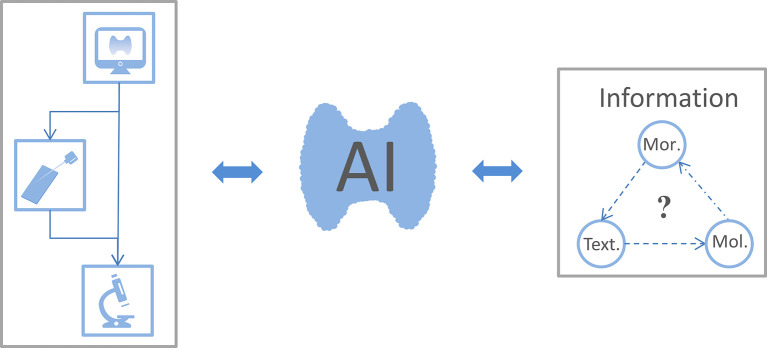
Thyroid cancers (TC) have increasingly been detected following advances in diagnostic methods. Risk stratification guided by refined information becomes a crucial step toward the goal of personalized medicine. The diagnosis of TC mainly relies on imaging analysis, but visual examination may not reveal much information and not enable comprehensive analysis. Artificial intelligence (AI) is a technology used to extract and quantify key image information by simulating complex human functions. This latent, precise information contributes to stratify TC on the distinct risk and drives tailored management to transit from the surface (population-based) to a point (individual-based). In this review, we started with several challenges regarding personalized care in TC, for example, inconsistent rating ability of ultrasound physicians, uncertainty in cytopathological diagnosis, difficulty in discriminating follicular neoplasms, and inaccurate prognostication. We then analyzed and summarized the advances of AI to extract and analyze morphological, textural, and molecular features to reveal the ground truth of TC. Consequently, their combination with AI technology will make individual medical strategies possible.

摘要

随着诊断方法的进步,甲状腺癌(TC)的检出率日益增加。基于精确信息的风险分层成为实现个性化医疗目标的关键一步。TC的诊断主要依靠影像分析,但肉眼检查可能无法揭示太多信息,也无法进行全面分析。人工智能(AI)是一种通过模拟复杂人类功能来提取和量化关键图像信息的技术。这种潜在的精确信息有助于根据不同风险对TC进行分层,并推动从表面(基于人群)到点(基于个体)的个性化管理。在本综述中,我们首先探讨了TC个性化治疗面临的几个挑战,例如超声医生评级能力不一致、细胞病理学诊断存在不确定性、鉴别滤泡性肿瘤困难以及预后预测不准确。然后,我们分析并总结了AI在提取和分析形态学、纹理和分子特征以揭示TC真实情况方面的进展。因此,将它们与AI技术相结合将使个性化医疗策略成为可能。
https://cdn.ncbi.nlm.nih.gov/pmc/blobs/1c29/7899964/c122c957a31b/fonc-10-604051-g002.jpg
https://cdn.ncbi.nlm.nih.gov/pmc/blobs/1c29/7899964/0334012d3dcf/fonc-10-604051-g001.jpg
https://cdn.ncbi.nlm.nih.gov/pmc/blobs/1c29/7899964/c122c957a31b/fonc-10-604051-g002.jpg
https://cdn.ncbi.nlm.nih.gov/pmc/blobs/1c29/7899964/0334012d3dcf/fonc-10-604051-g001.jpg
https://cdn.ncbi.nlm.nih.gov/pmc/blobs/1c29/7899964/c122c957a31b/fonc-10-604051-g002.jpg

相似文献

1
Artificial Intelligence for Personalized Medicine in Thyroid Cancer: Current Status and Future Perspectives.甲状腺癌个性化医疗中的人工智能:现状与未来展望
Front Oncol. 2021 Feb 9;10:604051. doi: 10.3389/fonc.2020.604051. eCollection 2020.
2
Artificial intelligence assisted diagnosis of early tc markers and its application.人工智能辅助早期肿瘤标志物诊断及其应用
Discov Oncol. 2024 May 18;15(1):172. doi: 10.1007/s12672-024-01017-w.
3
Update on thyroid ultrasound: a narrative review from diagnostic criteria to artificial intelligence techniques.甲状腺超声的最新进展:从诊断标准到人工智能技术的叙述性综述。
Chin Med J (Engl). 2019 Aug 20;132(16):1974-1982. doi: 10.1097/CM9.0000000000000346.
4
[The frequency of malignant disease in cytological group of suspected cancer (ultrasound-guided fine-needle aspiration biopsy of nonpalpable thyroid nodules)].[疑似癌症细胞学组(超声引导下不可触及甲状腺结节细针穿刺活检)中恶性疾病的发生率]
Medicina (Kaunas). 2008;44(3):189-94.
5
A Novel Risk Stratification System for Thyroid Nodules With Indeterminate Cytology-A Pilot Cohort Study.具有不确定细胞学的甲状腺结节的新型风险分层系统——一项试点队列研究。
Front Endocrinol (Lausanne). 2020 Feb 18;11:53. doi: 10.3389/fendo.2020.00053. eCollection 2020.
6
Diagnosis of Thyroid Nodule with New Ultrasound Imaging Modalities.利用新型超声成像模式诊断甲状腺结节
VideoEndocrinology. 2020 Mar 30;7(1). doi: 10.1089/ve.2020.0173. eCollection 2019.
7
The current issues and future perspective of artificial intelligence for developing new treatment strategy in non-small cell lung cancer: harmonization of molecular cancer biology and artificial intelligence.人工智能在非小细胞肺癌新治疗策略开发中的当前问题与未来展望:分子癌症生物学与人工智能的协调统一
Cancer Cell Int. 2021 Aug 26;21(1):454. doi: 10.1186/s12935-021-02165-7.
8
Artificial Intelligence in the Management of Glioma: Era of Personalized Medicine.人工智能在胶质瘤管理中的应用:个性化医疗时代
Front Oncol. 2019 Aug 14;9:768. doi: 10.3389/fonc.2019.00768. eCollection 2019.
9
Differences of HBME-1 Expression in Thyroid Follicular Adenoma and Follicular Thyroid Carcinoma by Ultrasound-Guided Fine-Needle Aspiration Biopsy.超声引导下细针穿刺活检检测甲状腺滤泡性腺瘤和滤泡状甲状腺癌中HBME-1表达的差异
J Coll Physicians Surg Pak. 2019 Apr;29(4):337-340. doi: 10.29271/jcpsp.2019.04.337.
10
Artificial intelligence in dentistry: current applications and future perspectives.牙科中的人工智能:当前应用与未来展望
Quintessence Int. 2020;51(3):248-257. doi: 10.3290/j.qi.a43952.

引用本文的文献

1
How New Chatbots Can Support Personalized Medicine.新型聊天机器人如何助力个性化医疗。
Healthc Inform Res. 2025 Jul;31(3):245-252. doi: 10.4258/hir.2025.31.3.245. Epub 2025 Jul 31.
2
A narrative review on innovations of thyroid nodule ultrasound diagnosis: applications of robot and artificial intelligence technology.甲状腺结节超声诊断创新的叙述性综述:机器人与人工智能技术的应用
Gland Surg. 2025 Jul 31;14(7):1379-1389. doi: 10.21037/gs-2025-75. Epub 2025 Jul 28.
3
Thyroid Cancer: Epidemiology, Classification, Risk Factors, Diagnostic and Prognostic Markers, and Current Treatment Strategies.

本文引用的文献

1
Segmentation and classification of thyroid follicular neoplasm using cascaded convolutional neural network.基于级联卷积神经网络的甲状腺滤泡性肿瘤分割与分类。
Phys Med Biol. 2020 Dec 22;65(24):245040. doi: 10.1088/1361-6560/abc6f2.
2
Thyroid nodules risk stratification through deep learning based on ultrasound images.基于超声图像的深度学习甲状腺结节风险分层
Med Phys. 2020 Dec;47(12):6355-6365. doi: 10.1002/mp.14543. Epub 2020 Nov 14.
3
Lymph node metastasis prediction of papillary thyroid carcinoma based on transfer learning radiomics.
甲状腺癌:流行病学、分类、危险因素、诊断和预后标志物以及当前的治疗策略。
Int J Mol Sci. 2025 May 28;26(11):5173. doi: 10.3390/ijms26115173.
4
Appropriateness of Thyroid Nodule Cancer Risk Assessment and Management Recommendations Provided by Large Language Models.大语言模型提供的甲状腺结节癌症风险评估及管理建议的适宜性
J Imaging Inform Med. 2025 Mar 3. doi: 10.1007/s10278-025-01454-1.
5
Exploring the role of artificial intelligence in chemotherapy development, cancer diagnosis, and treatment: present achievements and future outlook.探索人工智能在化疗研发、癌症诊断和治疗中的作用:当前成就与未来展望。
Front Oncol. 2025 Feb 4;15:1475893. doi: 10.3389/fonc.2025.1475893. eCollection 2025.
6
Artificial intelligence is going to transform the field of endocrinology: an overview.人工智能将变革内分泌学领域:综述
Front Endocrinol (Lausanne). 2025 Jan 14;16:1513929. doi: 10.3389/fendo.2025.1513929. eCollection 2025.
7
Holomics and Artificial Intelligence-Driven Precision Oncology for Medullary Thyroid Carcinoma: Addressing Challenges of a Rare and Aggressive Disease.全基因组学与人工智能驱动的甲状腺髓样癌精准肿瘤学:应对一种罕见侵袭性疾病的挑战
Cancers (Basel). 2024 Oct 13;16(20):3469. doi: 10.3390/cancers16203469.
8
AI empowering traditional Chinese medicine?人工智能赋能中医?
Chem Sci. 2024 Sep 23;15(41):16844-86. doi: 10.1039/d4sc04107k.
9
Artificial intelligence assisted diagnosis of early tc markers and its application.人工智能辅助早期肿瘤标志物诊断及其应用
Discov Oncol. 2024 May 18;15(1):172. doi: 10.1007/s12672-024-01017-w.
10
Enhancing the fairness of AI prediction models by Quasi-Pareto improvement among heterogeneous thyroid nodule population.通过异质甲状腺结节人群中的拟 Pareto 改进提高 AI 预测模型的公平性。
Nat Commun. 2024 Mar 4;15(1):1958. doi: 10.1038/s41467-024-44906-y.
基于迁移学习放射组学的甲状腺乳头状癌淋巴结转移预测。
Nat Commun. 2020 Sep 23;11(1):4807. doi: 10.1038/s41467-020-18497-3.
4
The ultrasound risk stratification systems for thyroid nodule have been evaluated against papillary carcinoma. A meta-analysis.超声甲状腺结节危险分层系统在甲状腺乳头状癌中的评估。一项荟萃分析。
Rev Endocr Metab Disord. 2021 Jun;22(2):453-460. doi: 10.1007/s11154-020-09592-3. Epub 2020 Sep 21.
5
Visual Interpretability in Computer-Assisted Diagnosis of Thyroid Nodules Using Ultrasound Images.基于超声图像的甲状腺结节计算机辅助诊断中的可视解释性
Med Sci Monit. 2020 Aug 15;26:e927007. doi: 10.12659/MSM.927007.
6
A Comparative Analysis of Two Machine Learning-Based Diagnostic Patterns with Thyroid Imaging Reporting and Data System for Thyroid Nodules: Diagnostic Performance and Unnecessary Biopsy Rate.两种基于机器学习的甲状腺结节影像报告和数据系统诊断模式的对比分析:诊断性能和不必要的活检率。
Thyroid. 2021 Mar;31(3):470-481. doi: 10.1089/thy.2020.0305. Epub 2020 Sep 9.
7
Primary cell cultures for the personalized therapy in aggressive thyroid cancer of follicular origin.用于滤泡性起源侵袭性甲状腺癌个体化治疗的原代细胞培养。
Semin Cancer Biol. 2022 Feb;79:203-216. doi: 10.1016/j.semcancer.2020.06.013. Epub 2020 Jun 20.
8
Evaluation of a deep learning-based computer-aided diagnosis system for distinguishing benign from malignant thyroid nodules in ultrasound images.基于深度学习的超声图像甲状腺良恶性结节鉴别计算机辅助诊断系统的评估
Med Phys. 2020 Sep;47(9):3952-3960. doi: 10.1002/mp.14301. Epub 2020 Jun 25.
9
Artificial intelligence versus clinicians: systematic review of design, reporting standards, and claims of deep learning studies.人工智能与临床医生:深度学习研究的设计、报告标准和主张的系统评价。
BMJ. 2020 Mar 25;368:m689. doi: 10.1136/bmj.m689.
10
Incidence and Mortality Risk Spectrum Across Aggressive Variants of Papillary Thyroid Carcinoma.侵袭性甲状腺乳头状癌各亚型的发病率和死亡率风险谱。
JAMA Oncol. 2020 May 1;6(5):706-713. doi: 10.1001/jamaoncol.2019.6851.