Moser-Katz Tyler, Joseph Nisha S, Dhodapkar Madhav V, Lee Kelvin P, Boise Lawrence H
Department of Hematology and Medical Oncology, Winship Cancer Institute, Emory University, Atlanta, GA, United States.
Department of Immunology, Roswell Park Cancer Institute, Buffalo, NY, United States.
Front Oncol. 2021 Feb 9;10:625199. doi: 10.3389/fonc.2020.625199. eCollection 2020.
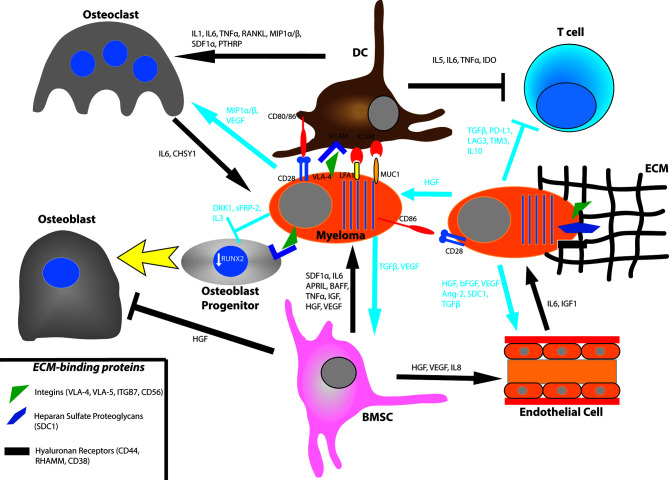
Multiple myeloma is a clonal disease of long-lived plasma cells and is the second most common hematological cancer behind Non-Hodgkin's Lymphoma. Malignant transformation of plasma cells imparts the ability to proliferate, causing harmful lesions in patients. In advanced stages myeloma cells become independent of their bone marrow microenvironment and form extramedullary disease. Plasma cells depend on a rich array of signals from neighboring cells within the bone marrow for survival which myeloma cells exploit for growth and proliferation. Recent evidence suggests, however, that both the myeloma cells and the microenvironment have undergone alterations as early as during precursor stages of the disease. There are no current therapies routinely used for treating myeloma in early stages, and while recent therapeutic efforts have improved patients' median survival, most will eventually relapse. This is due to mutations in myeloma cells that not only allow them to utilize its bone marrow niche but also facilitate autocrine pro-survival signaling loops for further progression. This review will discuss the stages of myeloma cell progression and how myeloma cells progress within and outside of the bone marrow microenvironment.
多发性骨髓瘤是一种长寿浆细胞的克隆性疾病,是仅次于非霍奇金淋巴瘤的第二常见血液系统癌症。浆细胞的恶性转化赋予其增殖能力,在患者体内造成有害病变。在晚期,骨髓瘤细胞变得独立于其骨髓微环境并形成髓外疾病。浆细胞依赖于来自骨髓内邻近细胞的丰富信号来维持生存,骨髓瘤细胞利用这些信号进行生长和增殖。然而,最近的证据表明,早在疾病的前驱阶段,骨髓瘤细胞和微环境就已经发生了改变。目前尚无常规用于早期治疗骨髓瘤的疗法,虽然最近的治疗努力提高了患者的中位生存期,但大多数患者最终仍会复发。这是由于骨髓瘤细胞中的突变不仅使其能够利用其骨髓龛,还促进了自分泌促生存信号通路以进一步进展。本综述将讨论骨髓瘤细胞进展的阶段以及骨髓瘤细胞如何在骨髓微环境内外进展。