School of Pharmacy, University College London, 29-39 Brunswick Square, London, WC1N 1AX, UK.
Drug Delivery, Disposition and Dynamics, Monash Institute of Pharmaceutics Science, Monash University, Parkville Campus, 381 Royal Parade, Parkville, VIC, 3052, Australia.
J Nanobiotechnology. 2021 Feb 26;19(1):60. doi: 10.1186/s12951-021-00798-4.
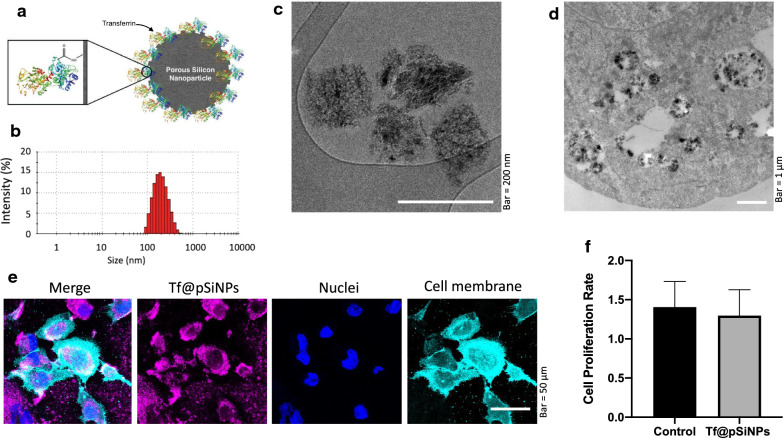
Approximately 80% of brain tumours are gliomas. Despite treatment, patient mortality remains high due to local metastasis and relapse. It has been shown that transferrin-functionalised porous silicon nanoparticles (Tf@pSiNPs) can inhibit the migration of U87 glioma cells. However, the underlying mechanisms and the effect of glioma cell heterogeneity, which is a hallmark of the disease, on the efficacy of Tf@pSiNPs remains to be addressed.
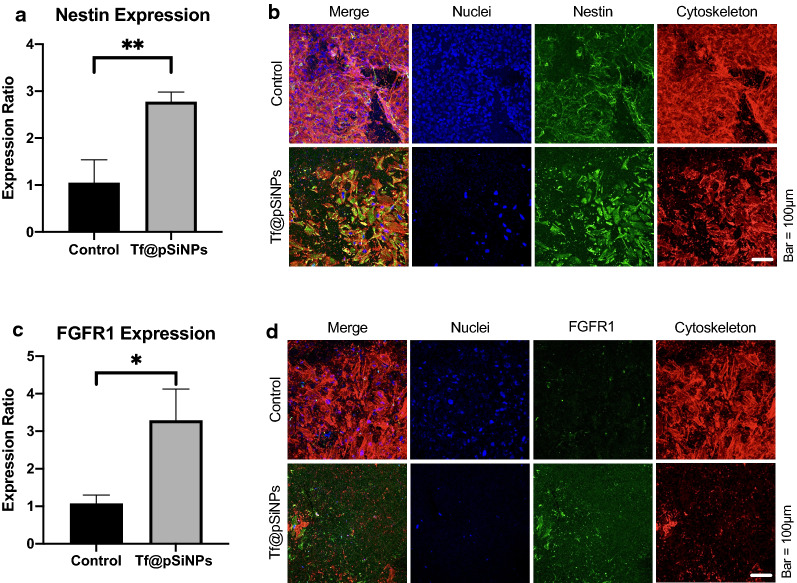
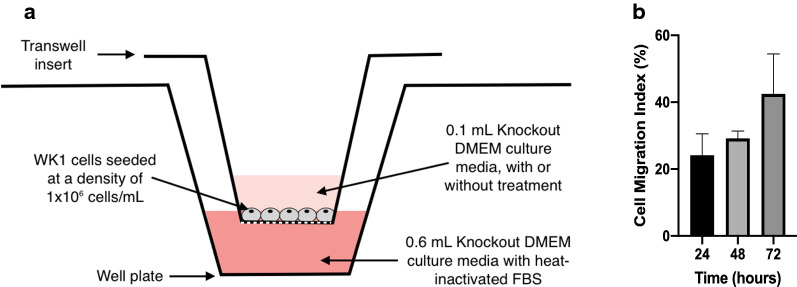
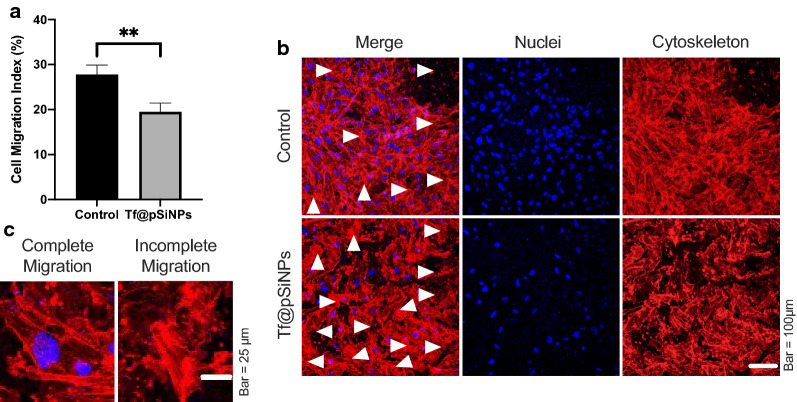
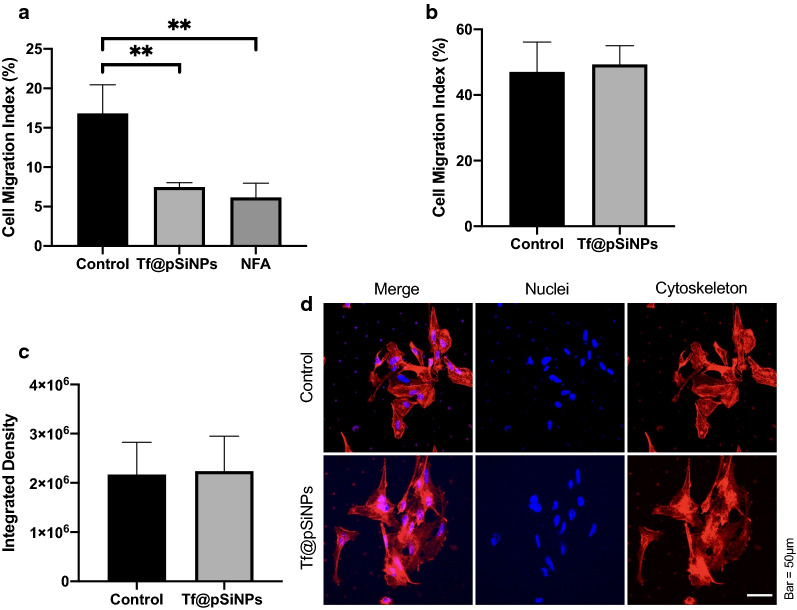
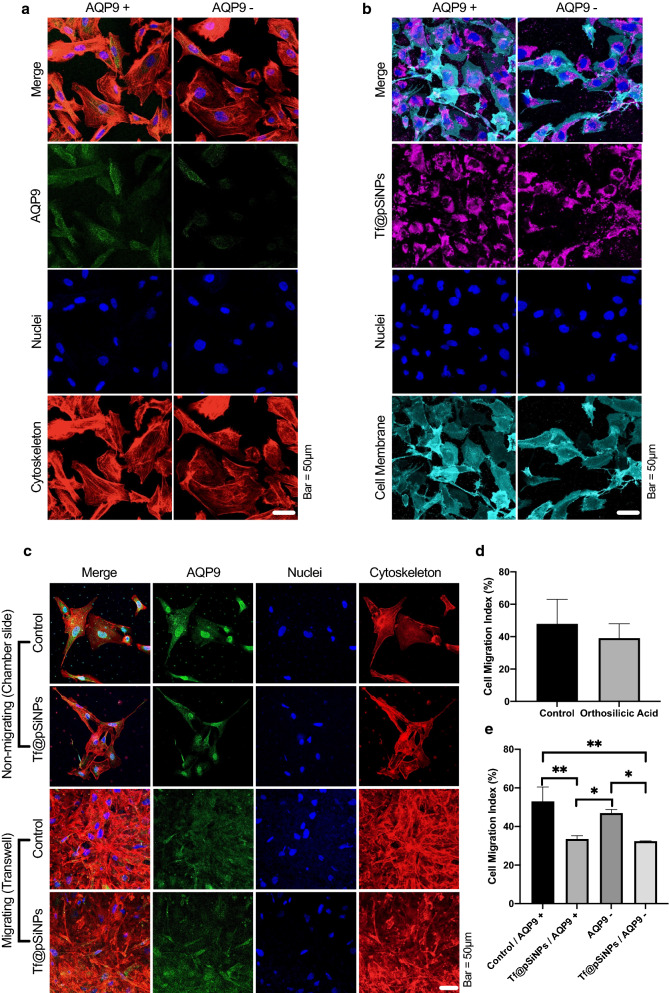
Here, we observed that Tf@pSiNPs inhibited heterogeneous patient-derived glioma cells' (WK1) migration across small perforations (3 μm) by approximately 30%. A phenotypical characterisation of the migrated subpopulations revealed that the majority of them were nestin and fibroblast growth factor receptor 1 positive, an indication of their cancer stem cell origin. The treatment did not inhibit cell migration across large perforations (8 μm), nor cytoskeleton formation. This is in agreement with our previous observations that cellular-volume regulation is a mediator of Tf@pSiNPs' cell migration inhibition. Since aquaporin 9 (AQP9) is closely linked to cellular-volume regulation, and is highly expressed in glioma, the effect of AQP9 expression on WK1 migration was investigated. We showed that WK1 migration is correlated to the differential expression patterns of AQP9. However, AQP9-silencing did not affect WK1 cell migration across perforations, nor the efficacy of cell migration inhibition mediated by Tf@pSiNPs, suggesting that AQP9 is not a mediator of the inhibition.
This in vitro investigation highlights the unique therapeutic potentials of Tf@pSiNPs against glioma cell migration and indicates further optimisations that are required to maximise its therapeutic efficacies.
大约 80%的脑肿瘤是神经胶质瘤。尽管进行了治疗,由于局部转移和复发,患者死亡率仍然很高。已经表明,转铁蛋白功能化多孔硅纳米粒子(Tf@pSiNPs)可以抑制 U87 神经胶质瘤细胞的迁移。然而,神经胶质瘤细胞异质性的潜在机制及其对 Tf@pSiNPs 疗效的影响,这是该疾病的一个标志,仍有待解决。
在这里,我们观察到 Tf@pSiNPs 抑制了异质患者来源的神经胶质瘤细胞(WK1)穿过小穿孔(3μm)的迁移约 30%。对迁移亚群的表型特征进行分析表明,它们中的大多数为巢蛋白和成纤维细胞生长因子受体 1 阳性,表明它们具有癌症干细胞的起源。该治疗方法并未抑制穿过大穿孔(8μm)的细胞迁移,也未抑制细胞骨架的形成。这与我们之前的观察结果一致,即细胞体积调节是 Tf@pSiNPs 抑制细胞迁移的介导物。由于水通道蛋白 9(AQP9)与细胞体积调节密切相关,并且在神经胶质瘤中高度表达,因此研究了 AQP9 表达对 WK1 迁移的影响。我们表明,WK1 迁移与 AQP9 的差异表达模式相关。然而,AQP9 沉默并不影响 WK1 细胞穿过穿孔的迁移,也不影响 Tf@pSiNPs 介导的细胞迁移抑制的疗效,表明 AQP9 不是抑制作用的介导物。
这项体外研究强调了 Tf@pSiNPs 针对神经胶质瘤细胞迁移的独特治疗潜力,并表明需要进一步优化以最大程度地提高其治疗效果。