
唾液细胞因子作为口腔癌生物标志物的系统评价和荟萃分析。
Salivary cytokines as biomarkers of oral cancer: a systematic review and meta-analysis.
机构信息
Universidade do Oeste de Santa Catarina (UNOESC), Joacaba, SC, Brazil.
Programa de Pos-Graduacao em Biociencias e Saude/Universidade do Oeste de Santa Catarina, Joacaba, SC, Brazil.
出版信息
BMC Cancer. 2021 Feb 27;21(1):205. doi: 10.1186/s12885-021-07932-3.
BACKGROUND
Oral cancer (OC) is usually diagnosed at advanced clinical stages due to its asymptomatic nature and absence of pathognomonic signs in its early development phase. Delayed diagnosis is one of the major causes of OC treatment failure and poor prognosis. Development of alternative diagnostic approaches are imperative for improving early detection and therapeutic success rates. Salivary cytokines (SC) have been studied as potential diagnostic biomarkers for OC and may represent a potential tool for improvement of its early detection.
METHODS
In this systematic review and meta-analysis we identified SC studied as OC biomarkers by systematically reviewing the PubMed and Cochrane Library databases using the terms: "oral cancer", "cytokine", and "saliva", and also combined with "interleukin" or "interferon". Only case-control studies that measured SC by ELISA from treatment naïve patients were included in the qualitative review. For the meta-analysis were included all comparable studies that provided enough data (sample size, mean and standard deviation or standard error of the mean) for SC levels in OC patients, non-cancer controls and patients with oral potentially malignant disorders (OPMD), including leukoplakia. Comparisons with patients with oral lichen planus (OLP) and gingivitis were included in the qualitative analysis.
RESULTS
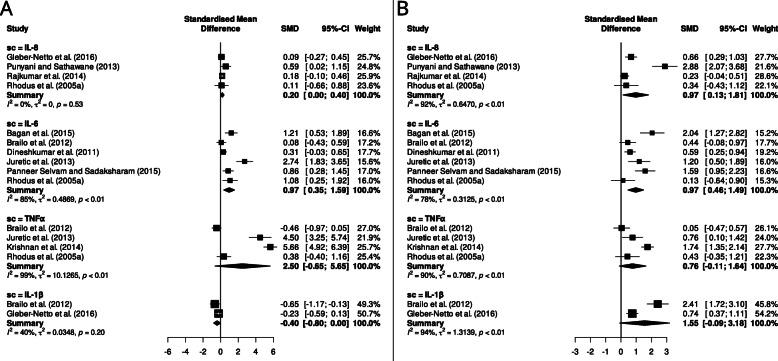
A total of 28 articles (from 2004 to 2018) were included in the systematic review, describing 10 different SC, being IL-8 and IL-6 the most studied ones. SC levels were consistently higher among OC patients when compared to healthy controls and to patients with OPMD, OLP and gingivitis. Meta-analysis including 23 eligible studies showed that IL-8, IL-6, TNF-α, IL-1β and IL-10 salivary levels were significantly higher in OC patients compared to controls; and that IL-8, IL-6, TNF-α and IL-1β salivary levels were also higher in OC patients compared to individuals with OPMD. When compared to healthy controls, OPMD patients showed significantly higher IL-6 and TNF-α salivary levels.
CONCLUSIONS
Our analyses showed that the salivary levels of some cytokines are consistently different among OC, OPMD and healthy patients, indicating that these SC may represent potential diagnostic biomarkers for OC and OPMD. Despite of that, SC levels were highly variable among studies, suggesting that further technical improvement and standardization for SC measurement by ELISA is needed in order to successfully translate these biomarkers to the clinical practice.
背景
口腔癌(OC)通常在临床晚期诊断,因为其在早期发展阶段无症状且缺乏特征性体征。诊断延迟是 OC 治疗失败和预后不良的主要原因之一。开发替代诊断方法对于提高早期检测和治疗成功率至关重要。唾液细胞因子(SC)已被研究为 OC 的潜在诊断生物标志物,可能代表提高其早期检测的潜在工具。
方法
在这项系统评价和荟萃分析中,我们通过系统地审查 PubMed 和 Cochrane 图书馆数据库中的术语“口腔癌”、“细胞因子”和“唾液”,并结合“白细胞介素”或“干扰素”,来确定作为 OC 生物标志物的 SC。仅纳入了通过 ELISA 从未经治疗的患者中测量 SC 的病例对照研究,纳入了定性综述。对于荟萃分析,纳入了所有提供足够数据(样本量、OC 患者、非癌症对照和口腔潜在恶性疾病(OPMD)患者的 SC 水平的均值和标准差或均值的标准误差)的可比研究,包括白斑。将与口腔扁平苔藓(OLP)和牙龈炎患者的比较纳入定性分析。
结果
共纳入 28 篇文章(2004 年至 2018 年)进行系统评价,描述了 10 种不同的 SC,其中 IL-8 和 IL-6 研究最多。与健康对照和 OPMD 患者相比,OC 患者的 SC 水平始终较高,与 OLP 和牙龈炎患者相比也是如此。纳入 23 项合格研究的荟萃分析表明,与对照组相比,OC 患者的 IL-8、IL-6、TNF-α、IL-1β 和 IL-10 唾液水平显著升高;与 OPMD 患者相比,OC 患者的 IL-8、IL-6、TNF-α 和 IL-1β 唾液水平也更高。与健康对照相比,OPMD 患者的 IL-6 和 TNF-α 唾液水平显著升高。
结论
我们的分析表明,OC、OPMD 和健康患者之间的一些细胞因子的唾液水平存在差异,表明这些 SC 可能代表 OC 和 OPMD 的潜在诊断生物标志物。尽管如此,研究之间的 SC 水平差异很大,这表明需要进一步改进和标准化 ELISA 测量 SC 的技术,以便成功将这些生物标志物转化为临床实践。


 Zotero 插件