Department of Family and Community Medicine, University of California, Davis, Davis, USA.
Center for Healthcare Policy and Research, University of California, Davis, Davis, USA.
Trials. 2021 Feb 27;22(1):167. doi: 10.1186/s13063-021-05106-x.
Patients with acute low back pain frequently request diagnostic imaging, and clinicians feel pressure to acquiesce to such requests to sustain patient trust and satisfaction. Spinal imaging in patients with acute low back pain poses risks from diagnostic evaluation of false-positive findings, patient labeling and anxiety, and unnecessary treatment (including spinal surgery). Watchful waiting advice has been an effective strategy to reduce some low-value treatments, and some evidence suggests a watchful waiting approach would be acceptable to many patients requesting diagnostic tests.
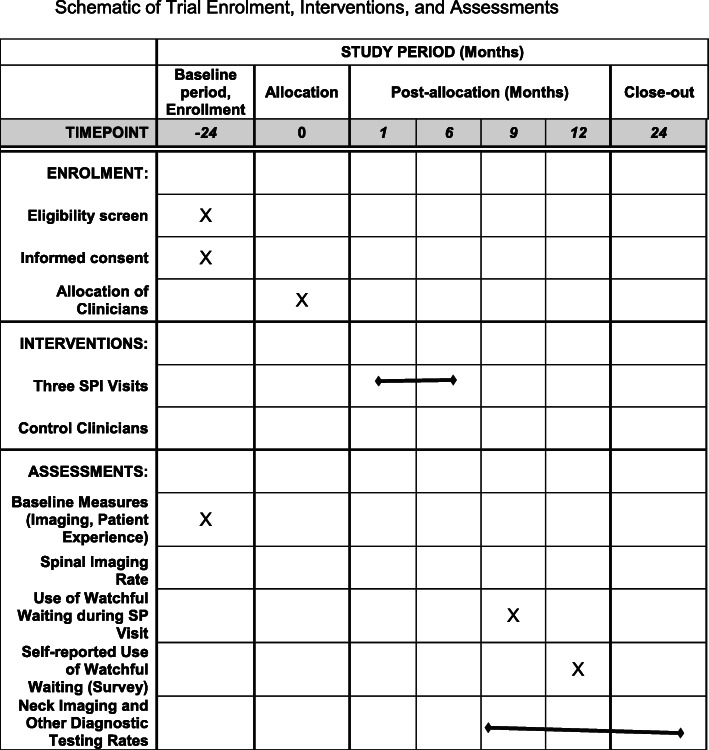
We will use key informant interviews of clinicians and focus groups with primary care patients to refine a theory-informed standardized patient-based intervention designed to teach clinicians how to advise watchful waiting when patients request low-value spinal imaging for low back pain. We will test the effectiveness of the intervention in a randomized clinical trial. We will recruit 8-10 primary care and urgent care clinics (~ 55 clinicians) in Sacramento, CA; clinicians will be randomized 1:1 to intervention and control groups. Over a 3- to 6-month period, clinicians in the intervention group will receive 3 visits with standardized patient instructors (SPIs) portraying patients with acute back pain; SPIs will instruct clinicians in a three-step model emphasizing establishing trust, empathic communication, and negotiation of a watchful waiting approach. Control physicians will receive no intervention. The primary outcome is the post-intervention rate of spinal imaging among actual patients with acute back pain seen by the clinicians adjusted for rate of imaging during a baseline period. Secondary outcomes are use of targeted communication techniques during a follow-up visit with an SP, clinician self-reported use of watchful waiting with actual low back pain patients, post-intervention rates of diagnostic imaging for other musculoskeletal pain syndromes (to test for generalization of intervention effects beyond back pain), and patient trust and satisfaction with physicians.
This trial will determine whether standardized patient instructors can help clinicians develop skill in negotiating a watchful waiting approach with patients with acute low back pain, thereby reducing rates of low-value spinal imaging. The trial will also examine the possibility that intervention effects generalize to other diagnostic tests.
ClinicalTrials.gov NCT04255199 . Registered on January 20, 2020.
急性腰痛患者经常要求进行诊断性影像学检查,临床医生感到压力,不得不满足患者的要求,以维持患者的信任和满意度。对急性腰痛患者进行脊柱影像学检查会带来诊断评估假阳性结果、患者标签和焦虑以及不必要治疗(包括脊柱手术)的风险。观察等待建议一直是减少一些低价值治疗的有效策略,一些证据表明,观察等待方法对许多要求进行诊断测试的患者是可以接受的。
我们将对临床医生进行关键知情人访谈,并对初级保健患者进行焦点小组讨论,以完善一项基于理论的标准化患者为基础的干预措施,该干预措施旨在教导临床医生如何在患者要求对腰痛进行低价值脊柱成像时建议观察等待。我们将在一项随机临床试验中测试该干预措施的有效性。我们将在加利福尼亚州萨克拉门托的 8-10 个初级保健和紧急护理诊所(~55 名临床医生)招募参与者;临床医生将被随机分为干预组和对照组,比例为 1:1。在 3 至 6 个月的时间里,干预组的临床医生将与标准化患者指导员(SPI)进行 3 次会面,这些指导员将扮演急性背痛患者;SPI 将教导临床医生使用三步模型,重点是建立信任、同理心沟通和协商观察等待方法。对照组医生将不接受干预。主要结果是干预后实际急性背痛患者的脊柱成像率,根据基线期成像率进行调整。次要结果是在与 SPI 的随访访问中使用有针对性的沟通技巧、临床医生对实际腰痛患者使用观察等待的自我报告、干预后其他肌肉骨骼疼痛综合征的诊断成像率(以测试干预效果是否超出腰痛)以及患者对医生的信任和满意度。
这项试验将确定标准化患者指导员是否可以帮助临床医生发展与急性腰痛患者协商观察等待方法的技能,从而降低低价值脊柱成像的比率。该试验还将研究干预效果是否可以推广到其他诊断测试。
ClinicalTrials.gov NCT04255199。于 2020 年 1 月 20 日注册。