
美国成年人口两个代表性样本中按年龄、性别和种族/族裔划分的过去一年物质使用估计值比较。
Comparison of Past Year Substance Use Estimates by Age, Sex, and Race/Ethnicity Between Two Representative Samples of the U.S. Adult Population.
作者信息
Grigsby Timothy J, Howard Krista, Howard Jeffrey T
机构信息
Department of Environmental and Occupational Health, University of Nevada, Las Vegas, 4505 S. Maryland Pkwy, Las Vegas, NV 89154 USA.
Department of Psychology, Texas State University, 601 University Dr., San Marcos, TX 78666 USA.
出版信息
Popul Res Policy Rev. 2022;41(1):401-416. doi: 10.1007/s11113-021-09645-8. Epub 2021 Feb 19.
UNLABELLED
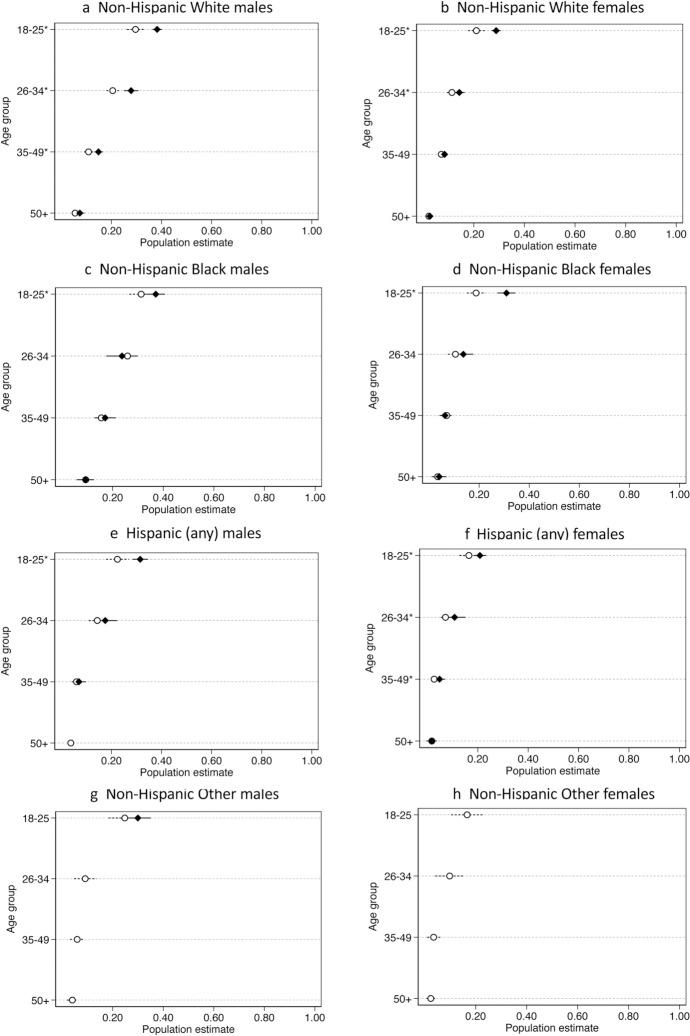
Comparative evaluations of national survey data can improve future survey design and sampling strategies thereby enhancing our ability to detect important population level trends. This paper presents differences in past year estimates of alcohol, cigarette, marijuana, and non-medical painkiller use prevalence by age, sex, and race/ethnicity between the 2012 National Survey on Drug Use and Health (NSDUH) and the National Epidemiologic Survey on Alcohol and Related Conditions (NESARC-III) administered in 2012-2013. In general, estimates were higher for the NSDUH survey, but patterns of substance use prevalence were similar across race/ethnicity, age, and sex. Results show most significant differences in estimates, across substances, age groups, and sex were greatest among Hispanics, followed by non-Hispanic Whites, and non-Hispanic Blacks. Members of other racial/ethnic groups (e.g., Asian-American, Native American/Alaskan Native) were underrepresented in the NSDUH survey. In many cases, estimates for these subpopulations could not be calculated using the NSDUH data limiting our ability to draw comparisons with the NESARC estimates. Methodological differences in data collection for the NSDUH and NESARC surveys may have contributed to these findings. To promote effective population health surveillance methods, more work is needed to derive reliable and valid estimates from demographic subpopulations to better improve policymaking and intervention programming for at-risk populations.
SUPPLEMENTARY INFORMATION
The online version contains supplementary material available at 10.1007/s11113-021-09645-8.
未标注
对全国调查数据进行比较评估可以改进未来的调查设计和抽样策略,从而增强我们发现重要人群层面趋势的能力。本文呈现了2012年全国药物使用和健康调查(NSDUH)与2012 - 2013年进行的全国酒精及相关状况流行病学调查(NESARC - III)在过去一年中按年龄、性别和种族/族裔划分的酒精、香烟、大麻和非医疗用止痛药使用流行率估计值的差异。总体而言,NSDUH调查的估计值更高,但物质使用流行率模式在种族/族裔、年龄和性别方面相似。结果显示,在不同物质、年龄组和性别中,估计值的最大差异在西班牙裔中最为显著,其次是非西班牙裔白人,然后是非西班牙裔黑人。其他种族/族裔群体(如亚裔美国人、美洲原住民/阿拉斯加原住民)在NSDUH调查中的代表性不足。在许多情况下,无法使用NSDUH数据计算这些亚人群的估计值,这限制了我们与NESARC估计值进行比较的能力。NSDUH和NESARC调查在数据收集方面的方法差异可能导致了这些结果。为了推广有效的人群健康监测方法,需要做更多工作以从人口统计学亚人群中得出可靠有效的估计值,从而更好地改进针对高危人群的政策制定和干预规划。
补充信息
在线版本包含可在10.1007/s11113 - 021 - 09645 - 8获取的补充材料。


 Zotero 插件