Scheinman Sarah B, Zaldua Steve, Dada Adedoyin, Krochmaliuk Kateryna, Dye Katherine, Marottoli Felecia M, Thatcher Gregory R J, Tai Leon M
Department of Anatomy and Cell Biology, University of Illinois at Chicago, Chicago, IL, United States.
UICentre, University of Illinois at Chicago, Chicago, IL, United States.
Front Neurosci. 2021 Feb 10;15:628403. doi: 10.3389/fnins.2021.628403. eCollection 2021.
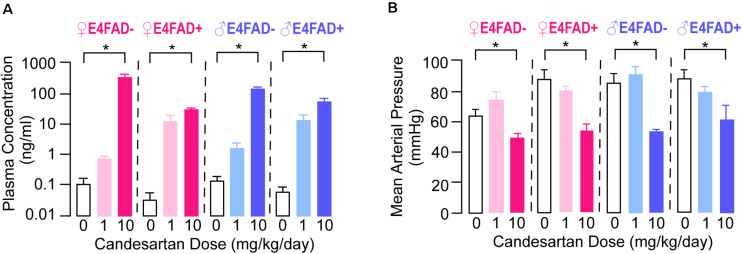
Evidence suggests that angiotensin receptor blockers (ARBs) could be beneficial for Alzheimer's disease (AD) patients independent of any effects on hypertension. However, studies in rodent models directly testing the activity of ARB treatment on behavior and AD-relevent pathology including neuroinflammation, Aβ levels, and cerebrovascular function, have produced mixed results. is a major genetic risk factor for AD and has been linked to many of the same functions as those purported to be modulated by ARB treatment. Therefore, evaluating the effects of ARB treatment on behavior and AD-relevant pathology in mice that express human could provide important information on whether to further develop ARBs for AD therapy. In this study, we treated female and male mice that express the human gene in the absence (E4FAD-) or presence (E4FAD+) of high Aβ levels with the ARB prodrug candesartan cilexetil for a duration of 4 months. Compared to vehicle, candesartan treatment resulted in greater memory-relevant behavior and higher hippocampal presynaptic protein levels in female, but not male, E4FAD- and E4FAD+ mice. The beneficial effects of candesartan in female E4FAD- and E4FAD+ mice occurred in tandem with lower GFAP and Iba1 levels in the hippocampus, whereas there were no effects on markers of cerebrovascular function and Aβ levels. Collectively, these data imply that the effects of ARBs on AD-relevant pathology may be modulated in part by the interaction between genotype and biological sex. Thus, the further development of ARBs could provide therapeutic options for targeting neuroinflammation in female carriers.
有证据表明,血管紧张素受体阻滞剂(ARBs)可能对阿尔茨海默病(AD)患者有益,且独立于其对高血压的任何影响。然而,在啮齿动物模型中直接测试ARB治疗对行为和AD相关病理(包括神经炎症、Aβ水平和脑血管功能)的活性的研究结果不一。是AD的主要遗传风险因素,并且与许多据称受ARB治疗调节的功能相关。因此,评估ARB治疗对表达人类的小鼠行为和AD相关病理的影响,可以为是否进一步开发用于AD治疗的ARBs提供重要信息。在本研究中,我们用ARB前药坎地沙坦酯治疗了在无(E4FAD-)或有(E4FAD+)高Aβ水平情况下表达人类基因的雌性和雄性小鼠,持续4个月。与载体相比,坎地沙坦治疗在雌性而非雄性E4FAD-和E4FAD+小鼠中导致了与记忆相关的行为增强和海马突触前蛋白水平升高。坎地沙坦对雌性E4FAD-和E4FAD+小鼠的有益作用与海马中较低的GFAP和Iba1水平同时出现,而对脑血管功能标志物和Aβ水平没有影响。总体而言,这些数据表明,ARBs对AD相关病理的影响可能部分受基因型和生物性别的相互作用调节。因此,ARBs的进一步开发可为靶向雌性携带者的神经炎症提供治疗选择。