Barp Clarissa Germano, Bonaventura Daniella, Assreuy Jamil
Department of Pharmacology, Centre of Biological Sciences, Universidade Federal de Santa Catarina, Florianópolis, Brazil.
Department of Pharmacology, Institute of Biological Sciences, Universidade Federal de Minas Gerais, Belo Horizonte, Brazil.
Front Physiol. 2021 Feb 10;12:640021. doi: 10.3389/fphys.2021.640021. eCollection 2021.
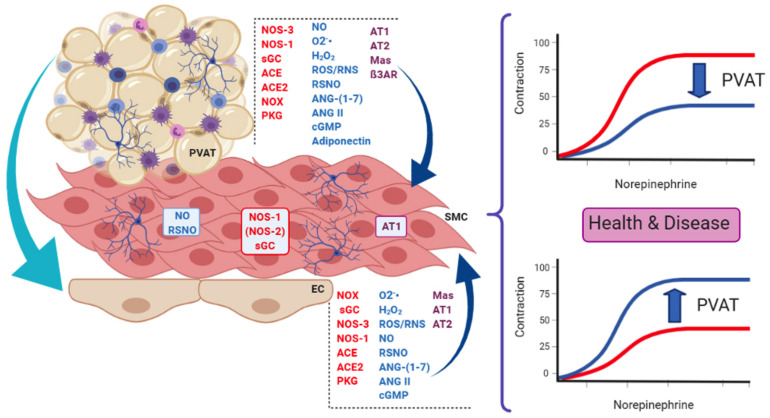
Perivascular adipose tissue (PVAT) has recently entered in the realm of cardiovascular diseases as a putative target for intervention. Notwithstanding its relevance, there is still a long way before the role of PVAT in physiology and pathology is fully understood. The general idea that PVAT anti-contractile effect is beneficial and its pro-contractile effect is harmful is being questioned by several reports. The role of some PVAT important products or systems such as nitric oxide (NO), reactive oxygen species (ROS), and RAS may vary depending on the context, disease, place of production, etc., which adds doubts on how mediators of PVAT anti- and pro-contractile effects are called to action and their final result. This short review will address some points regarding NO, ROS, and RAS in the beneficial and harmful roles of PVAT.
血管周围脂肪组织(PVAT)最近作为一个潜在的干预靶点进入了心血管疾病领域。尽管其具有相关性,但要完全理解PVAT在生理和病理中的作用仍有很长的路要走。一些报告对PVAT抗收缩作用有益而其促收缩作用有害这一普遍观点提出了质疑。一些PVAT重要产物或系统,如一氧化氮(NO)、活性氧(ROS)和肾素-血管紧张素系统(RAS)的作用可能因背景、疾病、产生部位等因素而有所不同,这增加了人们对PVAT抗收缩和促收缩作用的介质如何发挥作用及其最终结果的疑问。本简短综述将阐述有关NO、ROS和RAS在PVAT有益和有害作用方面的一些要点。