Clinical Orthopedic Research Center - midden Nederland (CORC-mN), Department of Orthopedics, Diakonessenhuis Utrecht/Zeist, The Netherlands.
Department of Orthopedics, University Medical Center Utrecht, Utrecht University, The Netherlands.
J Back Musculoskelet Rehabil. 2021;34(4):605-611. doi: 10.3233/BMR-200206.
Low back pain is a common health problem for which there are several treatment options. For optimizing clinical decision making, evaluation of treatments and research purposes it is important that health care professionals are able to evaluate the functional status of patients. Patient reported outcome measures (PROMs) are widely accepted and recommended. The Roland Morris Disability Questionnaire (RMDQ) and the Oswestry Disability Index (ODI) are the two mainly used condition-specific patient reported outcomes. Concerns regarding the content and structural validity and also the different scoring systems of these outcome measures makes comparison of treatment results difficult.
Aim of this study was to determine if the RMDQ and ODI could be used exchangeable by assessing the correlation and comparing different measurement properties between the questionnaires.
Clinical data from patients who participated in a multicenter RCT with 2 year follow-up after lumbar spinal fusion were used. Outcome measures were the RMDQ, ODI, Short Form 36 - Health Survey (SF-36), leg pain and back pain measured on a 0-100 mm visual analogue scale (VAS). Cronbach's alpha coefficients, Spearman correlation coefficients, multiple regression analysis and Bland-Altman plots were calculated.
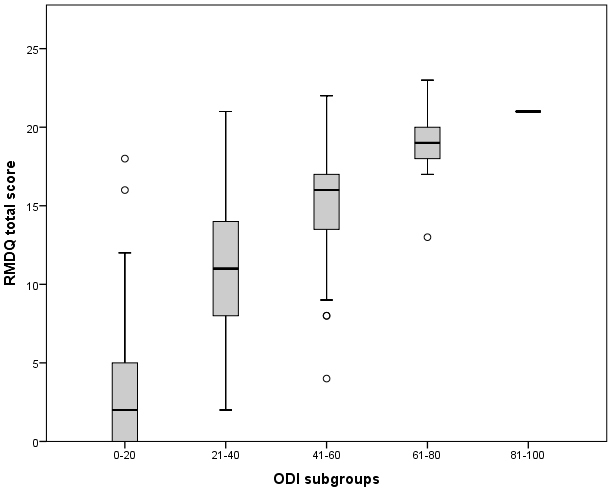
three hundred and seventy-six completed questionnaires filled out by 87 patients were used. The ODI and RMDQ had both a good level of internal consistency. There was a very strong correlation between the RMDQ and the ODI (r= 0.87; p< 0.001), and between the VAS and both the ODI and RMDQ. However, the Bland-Altman plot indicated bad agreement between the ODI and RMDQ.
The RMDQ and ODI cannot be used interchangeably, nor is there a possibility of converting the score from one questionnaire to the other. However, leg pain and back pain seemed to be predictors for both the ODI and the RMDQ.
腰痛是一种常见的健康问题,有几种治疗选择。为了优化临床决策、评估治疗效果和开展研究,医护人员需要能够评估患者的功能状态。患者报告的结局测量(PROMs)被广泛接受和推荐。Roland Morris 残疾问卷(RMDQ)和 Oswestry 残疾指数(ODI)是两种主要的特定于疾病的患者报告结局。这些结局测量存在内容和结构有效性方面的问题,评分系统也不同,这使得治疗结果的比较变得困难。
本研究旨在通过评估相关性和比较问卷之间的不同测量特性,确定 RMDQ 和 ODI 是否可以互换使用。
使用参与腰椎融合术后 2 年随访的多中心 RCT 的患者临床数据。结局测量包括 RMDQ、ODI、36 项简短健康调查问卷(SF-36)、0-100mm 视觉模拟量表(VAS)上的腿部疼痛和背部疼痛。计算了 Cronbach's alpha 系数、Spearman 相关系数、多元回归分析和 Bland-Altman 图。
使用了 87 名患者的 376 份完整问卷。ODI 和 RMDQ 都具有较好的内部一致性。RMDQ 和 ODI 之间存在很强的相关性(r=0.87;p<0.001),与 VAS 以及 ODI 和 RMDQ 之间均存在很强的相关性。然而,Bland-Altman 图表明 ODI 和 RMDQ 之间的一致性较差。
RMDQ 和 ODI 不能互换使用,也不可能将一个问卷的分数转换为另一个问卷的分数。然而,腿部疼痛和背部疼痛似乎是 ODI 和 RMDQ 的预测因素。