Cognitive Neurology Unit, Neurological Institute, Tel Aviv Sourasky Medical Center, Tel Aviv, Israel.
Sackler School of Medicine, Tel Aviv University, Tel Aviv, Israel.
J Alzheimers Dis. 2021;80(3):1221-1229. doi: 10.3233/JAD-201295.
Glucocerebrosidase (GBA) gene mutations and APOE polymorphisms are common in dementia with Lewy bodies (DLB), however their clinical impact is only partially elucidated.
To explore the clinical impact of mutations in the GBA gene and APOE polymorphisms separately and in combination, in a cohort of Ashkenazi Jewish (AJ) patients with DLB.
One hundred consecutively recruited AJ patients with clinically diagnosed DLB underwent genotyping for GBA mutations and APOE polymorphisms, and performed cognitive and motor clinical assessments.
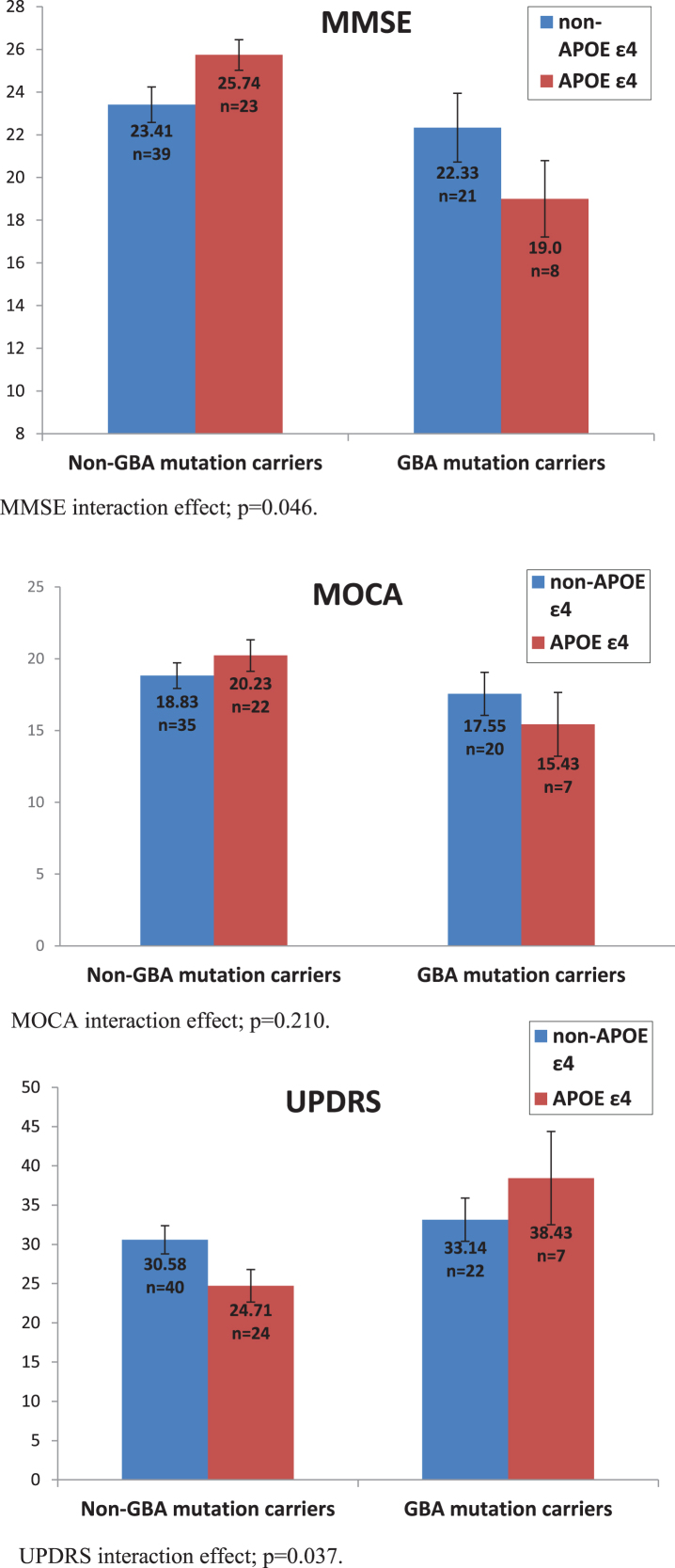
Thirty-two (32%) patients with DLB were carriers of GBA mutations and 33 (33%) carried an APOE ɛ4 allele. GBA mutation carriers had a younger age of onset (mean [SD] age, 67.2 years [8.9] versus 71.97 [5.91]; p = 0.03), poorer cognition as assessed by the Mini-Mental State Examination (21.41 [6.9] versus 23.97 [5.18]; p < 0.005), and more severe parkinsonism as assessed with the Unified Parkinson's Disease Rating Scale motor part III (34.41 [13.49] versus 28.38 [11.21]; p = 0.01) compared to non-carriers. There were statistically significant interactions between the two genetic factors, so that patients who carried both a mild GBA mutation and the APOE ɛ4 allele (n = 9) had more severe cognitive (p = 0.048) and motor dysfunction (p = 0.037).
We found a high frequency of both GBA mutations and the APOE ɛ4 allele among AJ patients with DLB, both of which have distinct effects on the clinical disease phenotype, separately and in combination.
葡萄糖脑苷脂酶(GBA)基因突变和 APOE 多态性在路易体痴呆(DLB)中很常见,但它们的临床影响仅部分阐明。
探讨 GBA 基因突变和 APOE 多态性单独及联合在一组阿什肯纳兹犹太人(AJ)DLB 患者中的临床影响。
连续招募了 100 名经临床诊断为 DLB 的 AJ 患者,对其进行 GBA 基因突变和 APOE 多态性基因分型,并进行认知和运动临床评估。
32 例(32%)DLB 患者为 GBA 基因突变携带者,33 例(33%)携带 APOE ɛ4 等位基因。GBA 基因突变携带者的发病年龄更小(平均[标准差]年龄,67.2 岁[8.9]比 71.97[5.91];p=0.03),认知功能更差(以简易精神状态检查[MMSE]评估,21.41[6.9]比 23.97[5.18];p<0.005),运动功能更严重(以统一帕金森病评定量表运动部分[UPDRS-III]评估,34.41[13.49]比 28.38[11.21];p=0.01)与非携带者相比。这两种遗传因素之间存在统计学显著的相互作用,因此,同时携带轻度 GBA 基因突变和 APOE ɛ4 等位基因的 9 例患者的认知(p=0.048)和运动功能障碍(p=0.037)更严重。
我们发现 AJ 患者中 DLB 患者的 GBA 基因突变和 APOE ɛ4 等位基因频率均较高,这两种因素单独及联合对临床疾病表型均有明显影响。