Faculty of Medicine, University of Geneva, CMU, Geneva, Switzerland.
Division of Neurology, Geneva University Hospitals, Geneva, Switzerland.
J Parkinsons Dis. 2021;11(2):619-631. doi: 10.3233/JPD-202459.
Oral microbiota has largely escaped attention in Parkinson's disease (PD), despite its pivotal role in maintaining oral and systemic health.
The aim of our study was to examine the composition of the oral microbiota and the degree of oral inflammation in PD.
Twenty PD patients were compared to 20 healthy controls. Neurological, periodontal and dental examinations were performed as well as dental scaling and gingival crevicular fluid sampling for cytokines measurement (interleukine (IL)-1β, IL-6, IL-1 receptor antagonist (RA), interferon-γ and tumor necrosis factor (TNF)-α). Two months later, oral microbiota was sampled from saliva and subgingival dental plaque. A 16S rRNA gene amplicon sequencing was used to assess bacterial communities.
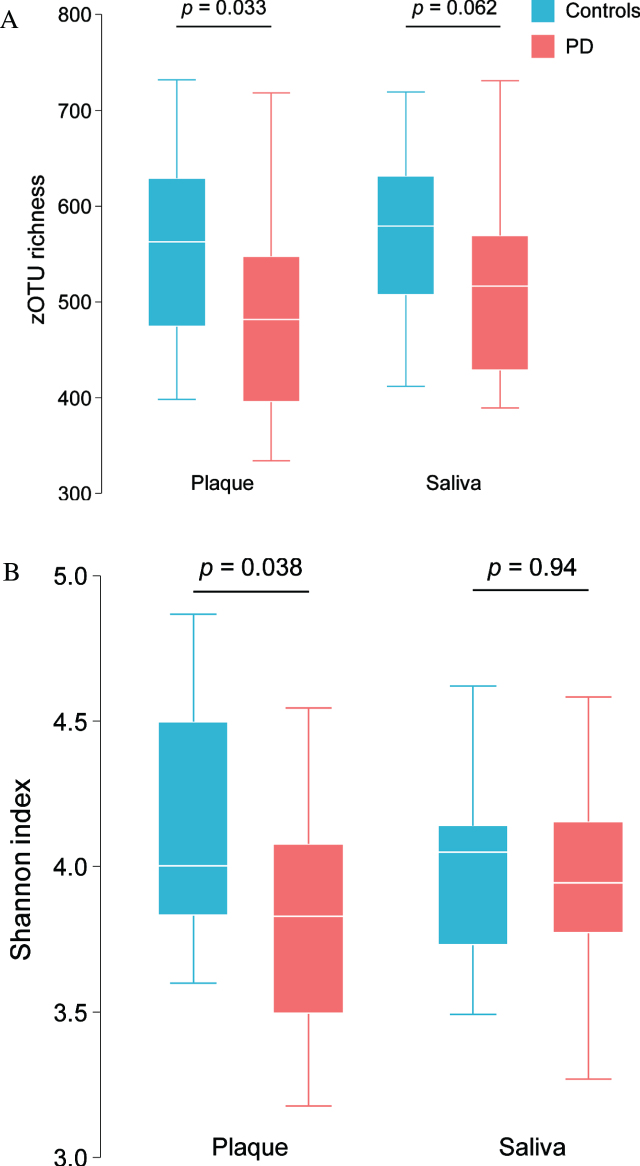
PD patients were in the early and mid-stage phases of their disease (Hoehn & Yahr 2-2.5). Dental and periodontal parameters did not differ between groups. The levels of IL-1β and IL-1RA were significantly increased in patients compared to controls with a trend for an increased level of TNF-α in patients. Both saliva and subgingival dental plaque microbiota differed between patients and controls. Streptococcus mutans, Kingella oralis, Actinomyces AFQC_s, Veillonella AFUJ_s, Scardovia, Lactobacillaceae, Negativicutes and Firmicutes were more abundant in patients, whereas Treponema KE332528_s, Lachnospiraceae AM420052_s, and phylum SR1 were less abundant.
Our findings show that the oral microbiome is altered in early and mid-stage PD. Although PD patients had good dental and periodontal status, local inflammation was already present in the oral cavity. The relationship between oral dysbiosis, inflammation and the pathogenesis of PD requires further study.
尽管口腔微生物群在维持口腔和全身健康方面起着关键作用,但在帕金森病 (PD) 中,它在很大程度上被忽视了。
我们的研究旨在检查 PD 患者口腔微生物群的组成和口腔炎症程度。
将 20 名 PD 患者与 20 名健康对照进行比较。进行了神经学、牙周和牙科检查,以及牙齿清洁和牙龈沟液取样以测量细胞因子(白细胞介素 (IL)-1β、IL-6、IL-1 受体拮抗剂 (RA)、干扰素-γ 和肿瘤坏死因子 (TNF)-α)。两个月后,从唾液和龈下牙菌斑中采集口腔微生物群样本。使用 16S rRNA 基因扩增子测序来评估细菌群落。
PD 患者处于疾病的早期和中期阶段(Hoehn & Yahr 2-2.5)。两组之间的牙齿和牙周参数没有差异。与对照组相比,患者的 IL-1β 和 IL-1RA 水平显着升高,患者的 TNF-α 水平呈升高趋势。患者和对照组的唾液和龈下牙菌斑微生物群存在差异。变形链球菌、口腔 Kingella 菌、AFQC_s 放线菌、AFUJ_s 韦荣球菌、Scardovia、乳杆菌科、阴性杆菌和Firmicutes 在患者中更为丰富,而 Treponema KE332528_s、Lachnospiraceae AM420052_s 和 SR1 门在患者中较少。
我们的研究结果表明,口腔微生物组在早期和中期 PD 中发生改变。尽管 PD 患者的牙齿和牙周状况良好,但口腔内已经存在局部炎症。口腔微生物失调、炎症与 PD 发病机制之间的关系需要进一步研究。