Vicerrectorado de Investigación, Universidad San Ignacio de Loyola, Lima, Peru.
Programa de Atencion Domiciliaria (PADOMI) - EsSalud, Lima, Peru.
J Thromb Thrombolysis. 2021 Oct;52(3):738-745. doi: 10.1007/s11239-021-02411-9. Epub 2021 Mar 1.
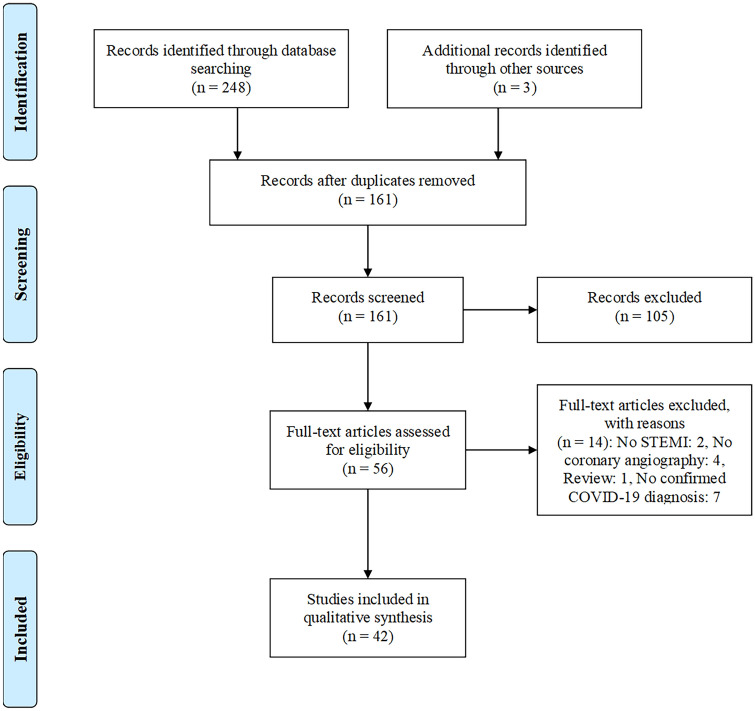
Coronavirus disease 2019 (COVID-19) can cause a wide range of cardiovascular diseases, including ST-segment elevation myocardial infarction (STEMI) and STEMI-mimickers (such as myocarditis, Takotsubo cardiomyopathy, among others). We performed a systematic review to summarize the clinical features, management, and outcomes of patients with COVID-19 who had ST-segment elevation. We searched electronic databases from inception to September 30, 2020 for studies that reported clinical data about COVID-19 patients with ST-segment elevation. Differences between patients with and without obstructive coronary artery disease (CAD) on coronary angiography were evaluated. Forty-two studies (35 case reports and seven case series) involving 161 patients were included. The mean age was 62.7 ± 13.6 years and 75% were men. The most frequent symptom was chest pain (78%). Eighty-three percent of patients had obstructive CAD. Patients with non-obstructive CAD had more diffuse ST-segment elevation (13% versus 1%, p = 0.03) and diffuse left ventricular wall-motion abnormality (23% versus 3%, p = 0.02) compared to obstructive CAD. In patients with previous coronary stent (n = 17), the 76% presented with stent thrombosis. In the majority of cases, the main reperfusion strategy was primary percutaneous coronary intervention instead of fibrinolysis. The in-hospital mortality was 30% without difference between patients with (30%) or without (31%) obstructive CAD. Our data suggest that a relatively high proportion of COVID-19 patients with ST-segment elevation had non-obstructive CAD. The prognosis was poor across groups. However, our findings are based on case reports and case series that should be confirmed in future studies.
2019 年冠状病毒病(COVID-19)可引起多种心血管疾病,包括 ST 段抬高型心肌梗死(STEMI)和 STEMI 类似疾病(如心肌炎、心尖球形综合征等)。我们进行了系统评价,以总结 ST 段抬高的 COVID-19 患者的临床特征、治疗和结局。我们从研究开始到 2020 年 9 月 30 日,在电子数据库中检索了报告 COVID-19 患者 ST 段抬高的临床数据的研究。评估了冠状动脉造影中有无阻塞性冠状动脉疾病(CAD)的患者之间的差异。纳入了 42 项研究(35 例病例报告和 7 例病例系列),涉及 161 例患者。患者的平均年龄为 62.7±13.6 岁,75%为男性。最常见的症状是胸痛(78%)。83%的患者存在阻塞性 CAD。与阻塞性 CAD 相比,非阻塞性 CAD 患者的 ST 段抬高更弥漫(13%比 1%,p=0.03),弥漫性左心室壁运动异常更常见(23%比 3%,p=0.02)。在有先前冠状动脉支架的患者(n=17)中,76%出现支架血栓形成。在大多数情况下,主要的再灌注策略是直接经皮冠状动脉介入治疗而不是溶栓。住院死亡率为 30%,无阻塞性 CAD(30%)或无阻塞性 CAD(31%)患者之间的差异。我们的数据表明,ST 段抬高的 COVID-19 患者中,相对较高比例的患者存在非阻塞性 CAD。各组的预后均较差。然而,我们的发现基于病例报告和病例系列,需要在未来的研究中得到证实。