University Department of Health Studies, University of Split, Split, Croatia.
University Postgraduate Doctoral Study Program Evidence-Based Medicine, University of Split School of Medicine, Split, Croatia.
PLoS One. 2021 Mar 1;16(3):e0247269. doi: 10.1371/journal.pone.0247269. eCollection 2021.
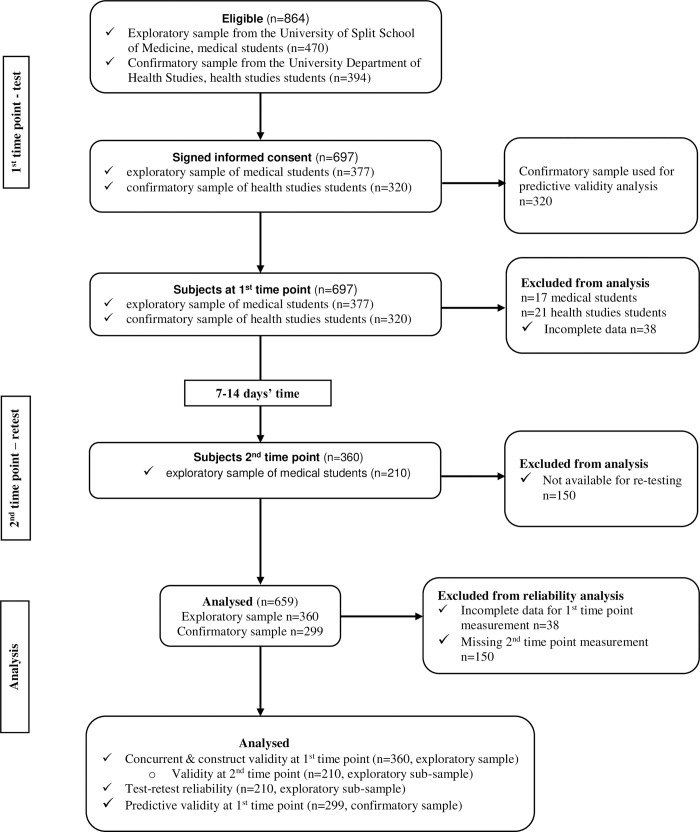
Mediterranean diet (MD) is among the most commonly investigated diets and recognized as one of the healthiest dietary patterns. Due to its complexity, geographical and cultural variations, it also represents a challenge for quantification. The aim of this cross-sectional study was to assess reliability and validity of the Croatian version of the 14-item Mediterranean Diet Serving Score (MDSS), using the Mediterranean Diet Adherence Screener (MEDAS) as the referent test. We included the exploratory sample of 360 medical students, and a confirmatory sample of 299 health studies students from the University of Split, Croatia. Test-retest reliability and validity of the MDSS were tested using intra-class correlation coefficients (ICC), while Cohen's kappa statistic was used to test correct classification of subjects into MD adherent/non-adherent category. A very good reliability was shown for the overall MDSS score (ICC = 0.881 [95% CI 0.843-0.909]), and a moderate reliability for the binary adherence (κ = 0.584). Concurrent validity of the MDSS was also better when expressed as a total score (ICC = 0.544 [0.439-0.629]) as opposed to the adherence (κ = 0.223), with similar result in the confirmatory sample (ICC = 0.510 [0.384-0.610]; κ = 0.216). Disappointingly, only 13.6% of medical students were adherent to the MD according to MDSS, and 19.7% according to the MEDAS questionnaire. Nevertheless, MDSS score was positively correlated with age (ρ = 0.179: P = 0.003), self-assessed health perception (ρ = 0.123; P = 0.047), and mental well-being (ρ = 0.139: P = 0.022). MDSS questionnaire is a short, reliable and reasonably valid instrument, and thus useful for assessing the MD adherence, with better results when used as a numeric score, even in the population with low MD adherence.
地中海饮食(MD)是最常被研究的饮食之一,被认为是最健康的饮食模式之一。由于其复杂性、地理位置和文化差异,它也代表了量化的挑战。本横断面研究的目的是使用地中海饮食依从性筛查器(MEDAS)作为参考测试,评估 14 项地中海饮食服务评分(MDSS)克罗地亚版本的可靠性和有效性。我们纳入了来自克罗地亚斯普利特大学的 360 名医学生的探索性样本和 299 名健康研究学生的验证性样本。使用组内相关系数(ICC)测试 MDSS 的重测信度和有效性,而 Cohen's kappa 统计用于测试受试者正确分类为 MD 依从/非依从类别。MDSS 总体得分显示出非常好的可靠性(ICC = 0.881 [95%CI 0.843-0.909]),而二进制依从性的可靠性中等(κ=0.584)。当 MDSS 以总分表示时,其同时效度也更好(ICC = 0.544 [0.439-0.629]),而依从性的效度(κ=0.223)较差,在验证性样本中也得到了类似的结果(ICC = 0.510 [0.384-0.610];κ=0.216)。令人失望的是,根据 MDSS,只有 13.6%的医学生遵循 MD,而根据 MEDAS 问卷,只有 19.7%的医学生遵循 MD。尽管如此,MDSS 评分与年龄呈正相关(ρ=0.179:P=0.003),与自我评估的健康感知呈正相关(ρ=0.123;P=0.047),与心理健康呈正相关(ρ=0.139:P=0.022)。MDSS 问卷是一种简短、可靠且合理有效的工具,因此可用于评估 MD 的依从性,当用作数字评分时,结果更好,即使在 MD 依从性较低的人群中也是如此。