Department of Psychiatry and Human Behavior, Department of Behavioral and Social Sciences, Center for Alcohol and Addiction Studies, Brown University, Box G-S121-4, Providence, RI, 02912, United States.
Drug Alcohol Depend. 2021 Apr 1;221:108642. doi: 10.1016/j.drugalcdep.2021.108642. Epub 2021 Feb 21.
We sought to elucidate whether stress, peers, and in vivo (i.e., direct) alcohol cues elicit alcohol craving in daily life among adolescents and to test whether individual variation in working memory function and biological sex alters these associations.
We leveraged ecological momentary assessment (EMA) to examine momentary associations between stress, peers, and direct alcohol cues with craving, assessed as "urge to drink alcohol," among 86 male (51.2 %) and female (48.8 %) frequent drinkers (i.e., two or more drinking days per week). Participants were ages 14-24 years (M = 20.7 years, SD = 2.1). Participants completed EMA throughout the day for about one week prior to randomization to a treatment condition for an AUD clinical trial. Pre-registered, secondary analyses focused on craving for assessments when adolescents were not drinking, and assessments occurring after drinking on drinking days were removed. Working memory performance was assessed in the laboratory via the Memory for Words subtest of the Woodcock-Johnson III Tests of Cognitive Abilities.
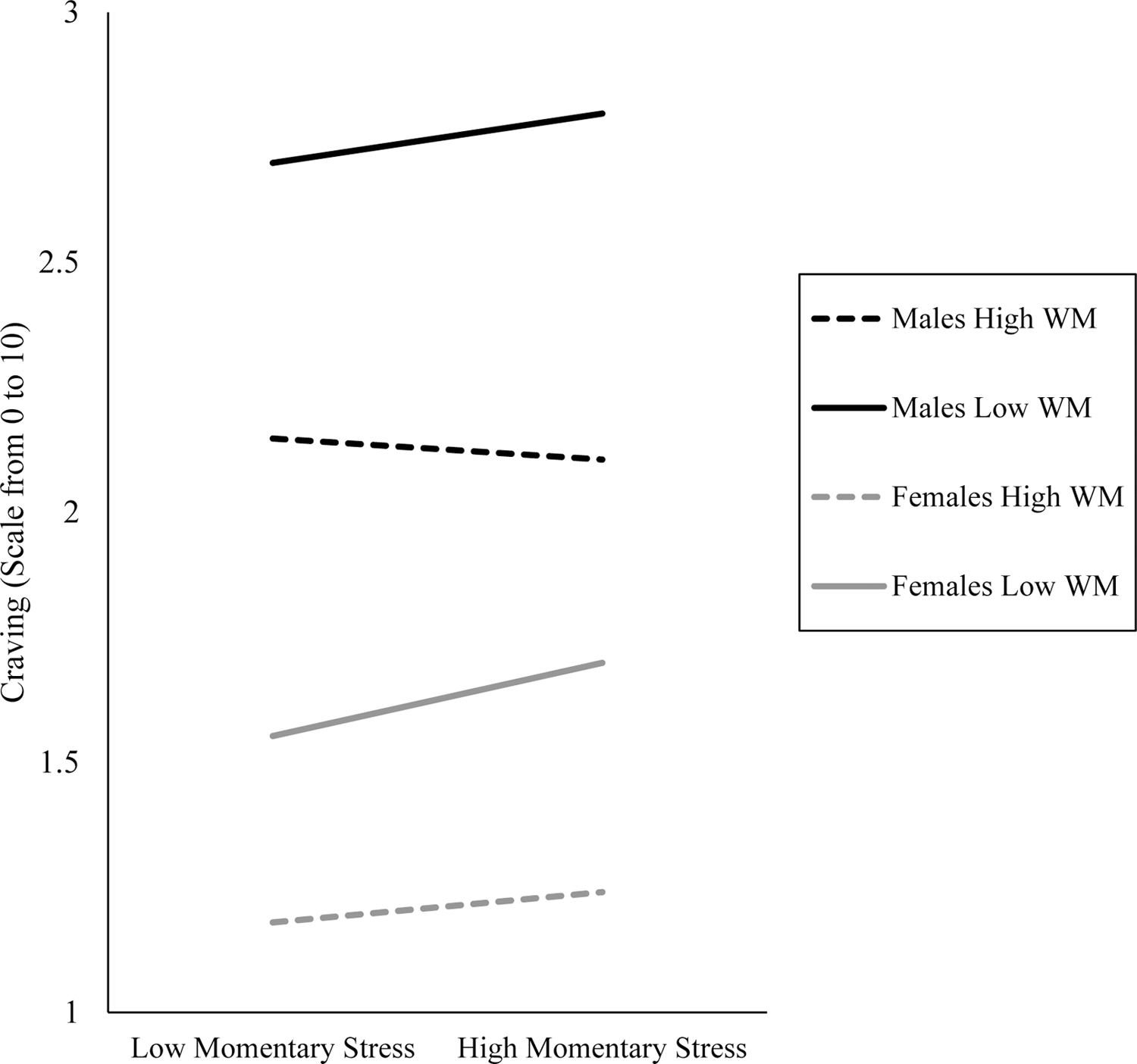
Craving was heightened at more stressful moments and when adolescents were with their peers and in the presence of direct alcohol cues. Working memory function was not related to craving but altered the relation of momentary stress, peers, and cues with craving once biological sex-related differences were considered. Females generally had lower craving than males, but working memory function served to buffer against stress-induced craving for males.
Higher working memory function buffered the in-the-moment relation of stress with alcohol craving for males but not females.
我们旨在阐明压力、同伴和体内(即直接)酒精线索是否会在青少年的日常生活中引发对酒精的渴望,并检验工作记忆功能和生物性别个体差异是否会改变这些关联。
我们利用生态瞬时评估(EMA)来考察压力、同伴和直接酒精线索与渴望之间的瞬时关联,其中渴望被评估为“想喝酒的冲动”,参与者包括 86 名男性(51.2%)和女性(48.8%)经常饮酒者(即每周饮酒两天或以上)。参与者年龄在 14 至 24 岁之间(M=20.7 岁,SD=2.1)。在随机分配到 AUD 临床试验的治疗条件之前,参与者大约在一周内每天都要完成 EMA。预先注册的次要分析重点关注青少年不饮酒时的渴望评估,以及在饮酒日饮酒后进行的评估。工作记忆能力通过 Woodcock-Johnson III 认知能力测验的单词记忆子测验在实验室中进行评估。
在压力较大的时刻、与同伴在一起以及存在直接酒精线索时,渴望会加剧。工作记忆功能与渴望无关,但在考虑到与生物性别相关的差异后,改变了瞬间压力、同伴和线索与渴望之间的关系。女性的渴望通常低于男性,但工作记忆功能可以缓冲男性因压力引起的渴望。
较高的工作记忆功能缓冲了男性压力与酒精渴望之间的即时关系,但对女性没有影响。