Department of Community, Environmental, and Occupational Medicine, Ain Shams University Faculty of Medicine, Cairo, Egypt
Ain Shams University Faculty of Medicine, Cairo, Egypt.
BMJ Open. 2021 Mar 1;11(3):e046453. doi: 10.1136/bmjopen-2020-046453.
Antibiotic resistance is a global public health concern, especially in developing countries, where antibiotic misuse is widespread. However, studies investigating relevant factors, particularly in youth, are limited. This study examined the levels of health literacy (HL) and their association with antibiotic use, knowledge of antibiotics and awareness of antibiotic resistance among university students in Egypt.
A cross-sectional study was conducted using self-administered questionnaires during 2018. The Health Literacy Survey (HLS-EU-Q16) and the WHO Antibiotic resistance: Multi-Country Public Awareness Survey were used. Bivariate and multivariable analyses were used to compare responses on use and knowledge of antibiotics, and awareness of antibiotic resistance between the three levels of students' HL.
University, Cairo, Egypt.
508 non-medical university students.
Students' HL scores were categorised into sufficient, problematic and inadequate. Students' knowledge of antibiotics was categorised into good and poor. Students' awareness of antibiotic resistance was categorised into high, average and poor.
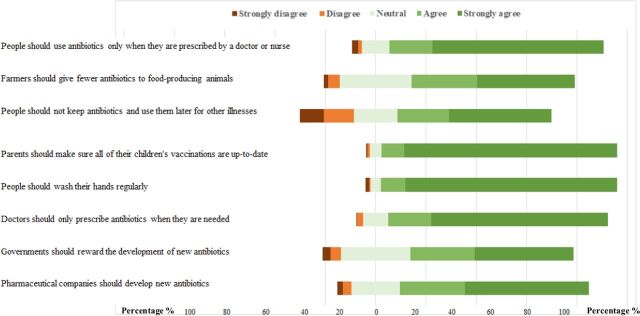
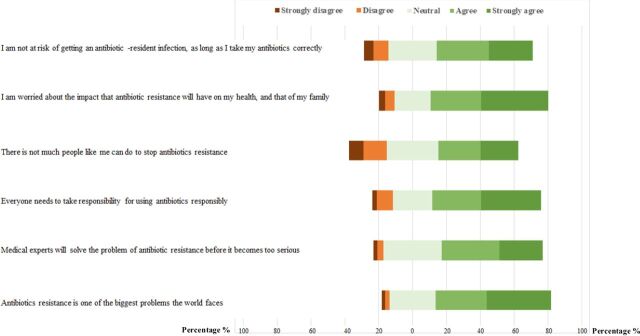
35.1% of students had sufficient HL. 79.7% of students had poor knowledge of antibiotics. 39.9% of students reported having used antibiotics in the past month without a prescription. 92.2% had limited awareness of antibiotic resistance and 30.6% of students heard about the term 'antimicrobial resistance'. Background characteristics did not significantly differ by HL levels or knowledge scores, except for students' year of study. Sufficient HL was independently associated with students' high awareness of antibiotic resistance (adjusted OR=2.8; 95% CI: 1.3 to 5.9).
HL was insufficient in this sample of non-medical Egyptian university students. Across all levels of HL, knowledge of antibiotics and awareness of antibiotic resistance were limited, reflecting deficiency in relevant education programmes. Findings suggest that sufficient HL supports high awareness of antibiotic resistance. Incorporating HL and rational antibiotic use awareness raising programmes in university curricula is an urgent necessity to curb antibiotic resistance.
抗生素耐药性是一个全球性的公共卫生问题,特别是在抗生素滥用普遍存在的发展中国家。然而,研究抗生素耐药性相关因素的工作,尤其是在青年人群中的研究还很有限。本研究旨在调查埃及大学生的健康素养(HL)水平及其与抗生素使用、抗生素知识和对抗生素耐药性认识的关系。
这是一项 2018 年进行的横断面研究,使用自我管理问卷。采用健康素养调查(HLS-EU-Q16)和世界卫生组织抗生素耐药性:多国公众意识调查。采用单变量和多变量分析比较了三个 HL 水平学生的抗生素使用和知识、对抗生素耐药性的认识的差异。
埃及开罗的一所大学。
508 名非医学专业的大学生。
学生的 HL 评分分为充足、有问题和不足。学生对抗生素的了解程度分为良好和差。学生对抗生素耐药性的认识分为高、中、低。
35.1%的学生具有充足的 HL。79.7%的学生对抗生素知识了解程度差。39.9%的学生报告在过去一个月内未经处方使用过抗生素。92.2%的学生对抗生素耐药性的认识有限,30.6%的学生听说过“抗菌药物耐药性”这个术语。除了学生的学习年限外,背景特征在 HL 水平或知识评分上没有显著差异。充足的 HL 与学生对抗生素耐药性的高认识独立相关(调整后的 OR=2.8;95%CI:1.3 至 5.9)。
在本研究中,非医学专业的埃及大学生的 HL 水平不足。在所有 HL 水平中,学生对抗生素的了解和对抗生素耐药性的认识都很有限,这反映了相关教育项目的不足。研究结果表明,充足的 HL 有助于提高对抗生素耐药性的认识。将 HL 和合理使用抗生素的意识提高项目纳入大学课程是遏制抗生素耐药性的当务之急。