Theoretical Biology Group, Instituto de Investigaciones Biomédicas, Universidad Nacional Autónoma de México, 04510, Ciudad Universitaria, Mexico.
Sci Rep. 2021 Mar 1;11(1):4835. doi: 10.1038/s41598-021-83668-1.
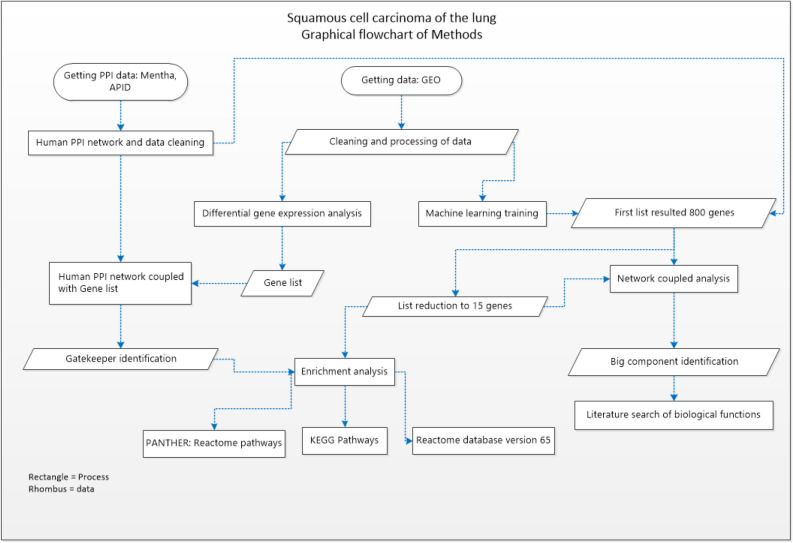
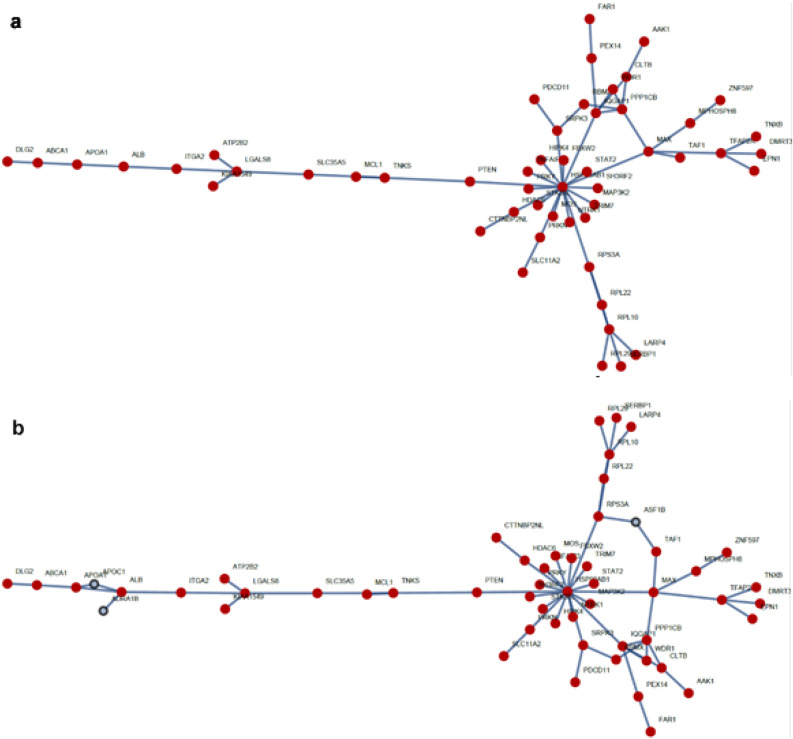
The squamous cell carcinoma of the lung (SCLC) is one of the most common types of lung cancer. As GLOBOCAN reported in 2018, lung cancer was the first cause of death and new cases by cancer worldwide. Typically, diagnosis is made in the later stages of the disease with few treatment options available. The goal of this work was to find some key components underlying each stage of the disease, to help in the classification of tumor samples, and to increase the available options for experimental assays and molecular targets that could be used in treatment development. We employed two approaches. The first was based in the classic method of differential gene expression analysis, network analysis, and a novel concept known as network gatekeepers. The second approach was using machine learning algorithms. From our combined approach, we identified two sets of genes that could function as a signature to identify each stage of the cancer pathology. We also arrived at a network of 55 nodes, which according to their biological functions, they can be regarded as drivers in this cancer. Although biological experiments are necessary for their validation, we proposed that all these genes could be used for cancer development treatments.
肺鳞状细胞癌(SCLC)是最常见的肺癌类型之一。正如 2018 年 GLOBOCAN 报告的那样,肺癌是全球癌症死亡和新发病例的首要原因。通常,在疾病的晚期才做出诊断,而且可供选择的治疗方法很少。这项工作的目的是找到疾病每个阶段的一些关键成分,以帮助肿瘤样本的分类,并增加实验检测和可用于治疗开发的分子靶标的可用选择。我们采用了两种方法。第一种方法基于经典的差异基因表达分析、网络分析和一个称为网络守门员的新概念。第二种方法是使用机器学习算法。通过我们的综合方法,我们确定了两组基因,可以作为识别癌症病理每个阶段的特征。我们还构建了一个由 55 个节点组成的网络,根据它们的生物学功能,可以将它们视为该癌症的驱动因素。虽然需要进行生物学实验来验证,但我们提出所有这些基因都可用于癌症发展治疗。