Grave Malú, Coutinho Alvaro L G A
Department of Civil Engineering, COPPE/Federal University of Rio de Janeiro, P.O. Box 68506, Rio de Janeiro, RJ 21945-970 Brazil.
Comput Mech. 2021;67(4):1177-1199. doi: 10.1007/s00466-021-01986-7. Epub 2021 Feb 25.
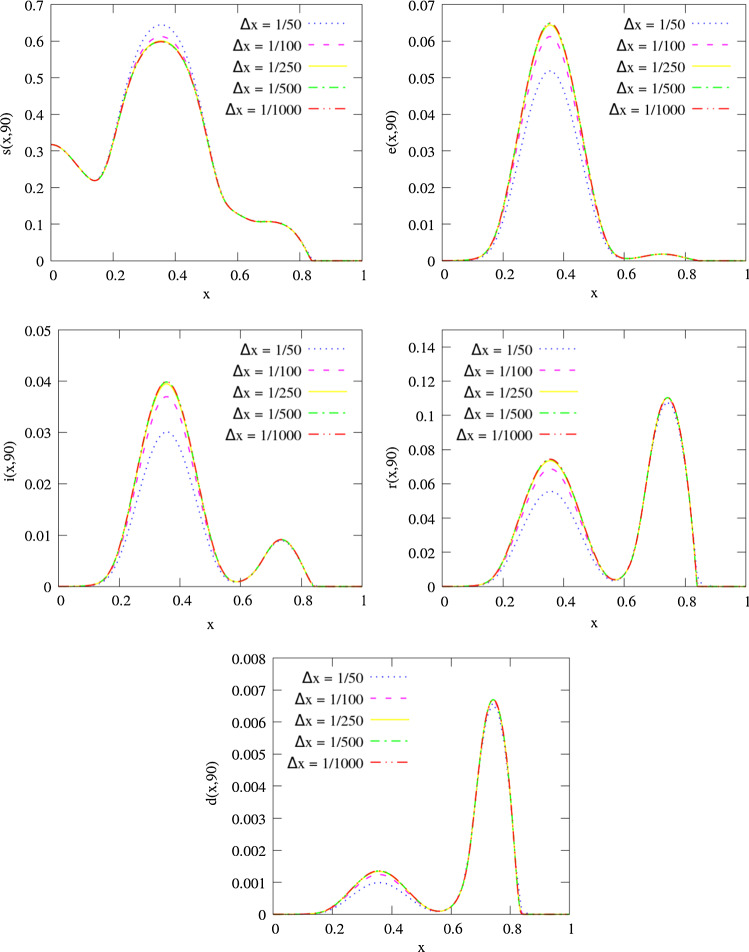
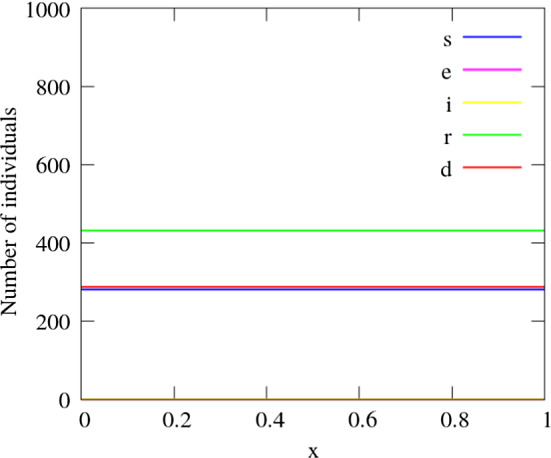
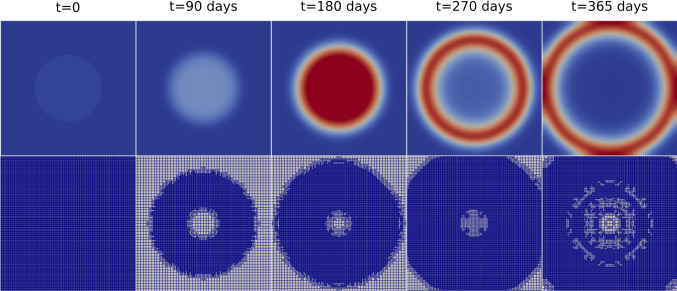
The outbreak of COVID-19 in 2020 has led to a surge in the interest in the mathematical modeling of infectious diseases. Disease transmission may be modeled as compartmental models, in which the population under study is divided into compartments and has assumptions about the nature and time rate of transfer from one compartment to another. Usually, they are composed of a system of ordinary differential equations in time. A class of such models considers the Susceptible, Exposed, Infected, Recovered, and Deceased populations, the SEIRD model. However, these models do not always account for the movement of individuals from one region to another. In this work, we extend the formulation of SEIRD compartmental models to diffusion-reaction systems of partial differential equations to capture the continuous spatio-temporal dynamics of COVID-19. Since the virus spread is not only through diffusion, we introduce a source term to the equation system, representing exposed people who return from travel. We also add the possibility of anisotropic non-homogeneous diffusion. We implement the whole model in libMesh, an open finite element library that provides a framework for multiphysics, considering adaptive mesh refinement and coarsening. Therefore, the model can represent several spatial scales, adapting the resolution to the disease dynamics. We verify our model with standard SEIRD models and show several examples highlighting the present model's new capabilities.
2020年新冠疫情的爆发引发了人们对传染病数学建模的兴趣激增。疾病传播可以用 compartmental 模型来建模,在这种模型中,所研究的人群被划分为不同的 compartment,并对从一个 compartment 转移到另一个 compartment 的性质和时间速率做出假设。通常,它们由关于时间的常微分方程系统组成。一类这样的模型考虑易感、暴露、感染、康复和死亡人群,即SEIRD模型。然而,这些模型并不总是考虑个体从一个地区到另一个地区的流动。在这项工作中,我们将SEIRD compartmental模型的公式扩展到偏微分方程的扩散 - 反应系统,以捕捉新冠疫情的连续时空动态。由于病毒传播不仅通过扩散,我们在方程组中引入一个源项,代表旅行归来的暴露人群。我们还增加了各向异性非均匀扩散的可能性。我们在libMesh中实现了整个模型,libMesh是一个开放的有限元库,它为多物理场提供了一个框架,考虑了自适应网格细化和粗化。因此,该模型可以代表几个空间尺度,根据疾病动态调整分辨率。我们用标准的SEIRD模型验证了我们的模型,并展示了几个例子,突出了本模型的新能力。